

A missed WhatsApp enquiry is a patient message that gets no useful reply before the patient loses interest and books elsewhere. For clinics and medical centers in Dubai and across the UAE, these losses often go unseen because nobody counts them. This guide shows owners and managers how to find missed enquiries in their own chats, measure them with five numbers, and decide what to fix first. It does not assume you use any particular software.
Short answer: To find missed WhatsApp enquiries, take one month of patient chats and record, for each, when it arrived, how long the first reply took and whether it became an appointment. Count the enquiries with no reply or a slow one, then separate those that arrived outside reception hours. Divide that count by all enquiries to get your missed-enquiry rate.
What counts as a missed WhatsApp enquiry
A missed enquiry is any patient message that did not receive a useful answer in time. Every enquiry is a lead, meaning a person who has shown interest in a service and given you a way to contact them. Four kinds of missed enquiry matter, and you should count them separately.
- Unanswered: the patient never received a reply, even days later.
- Late: a reply arrived, but after the cut-off your clinic sets for a reasonable wait. A cut-off of 30 minutes in opening hours is one example. Choose a figure your team can meet.
- Incomplete: a reply arrived but skipped what the patient asked, such as the location or whether a doctor is available, so they had to ask again.
- Dropped: the conversation started well and then stalled, with nobody following up.
The four kinds have different causes, so a single “missed” total hides what to fix. Keep them in separate columns from the start.
Six places where WhatsApp enquiries go missing
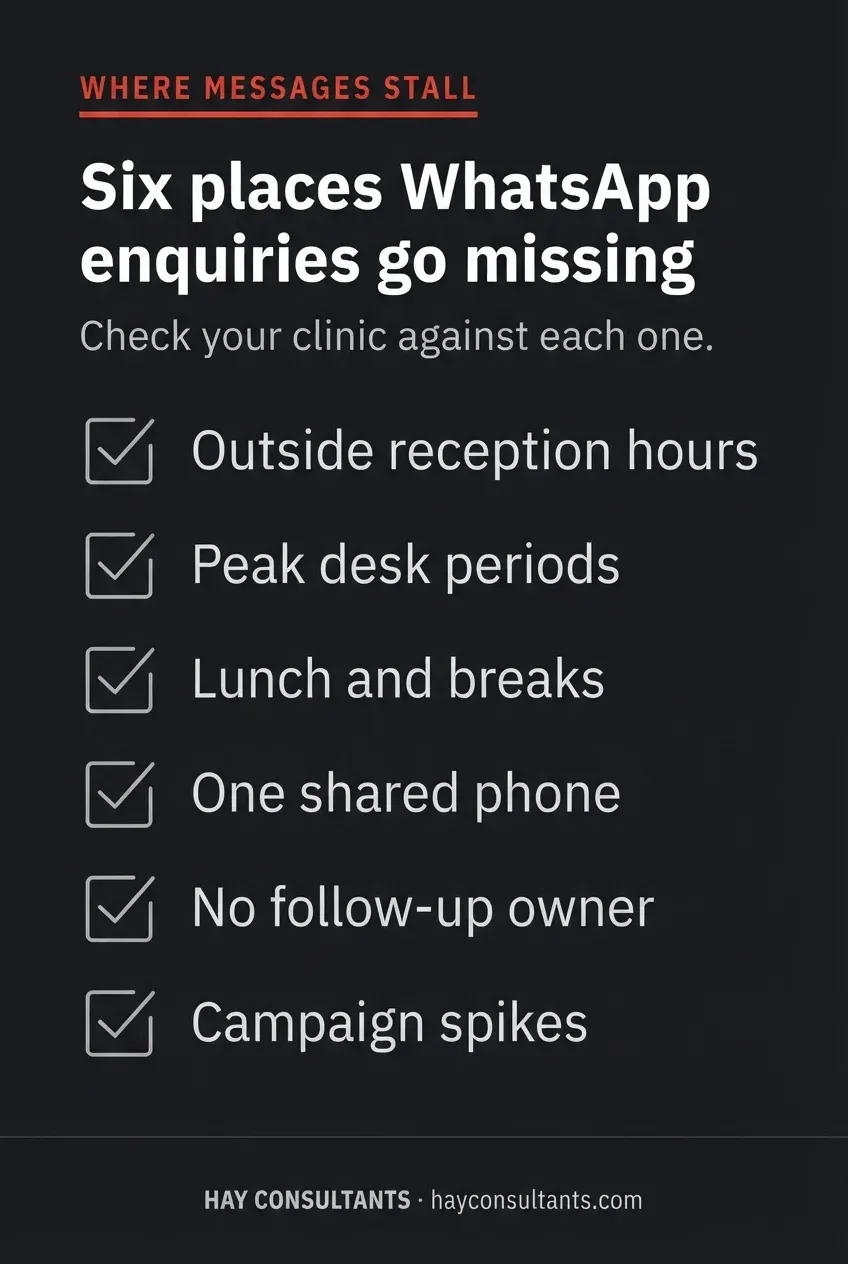
Enquiries tend to go missing at a small set of predictable points. Check your clinic against each one before you start counting.
- Outside reception hours. Evenings, weekends and public holidays, when nobody watches the phone.
- Peak desk periods. Reception is checking patients in and the messages wait.
- Lunch and breaks. Cover ends when the one person watching WhatsApp steps away.
- One shared phone. Only the person holding it sees new messages, so an absence leaves them unread.
- No follow-up owner. A patient says they will think about it and nobody writes back.
- Campaign spikes. After an advertising push, more messages arrive than the desk planned for.
These are coverage problems, not effort problems. A capable receptionist still cannot answer a message that arrives at 11 pm, or two that arrive at the same moment.
How to audit one month of WhatsApp enquiries
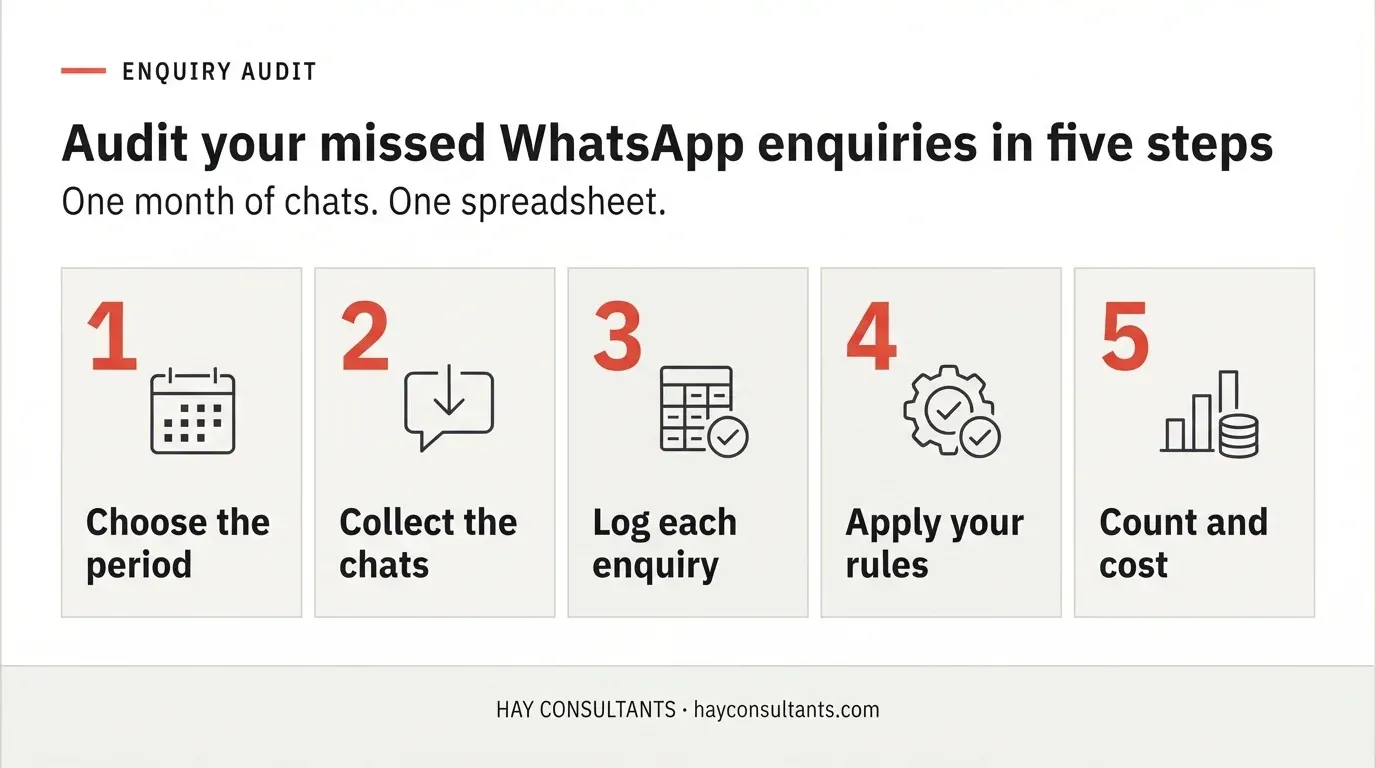
You can audit missed enquiries with a spreadsheet and one month of chats. The audit takes five steps, in this order.
- Choose the period. Take the last full calendar month, or four recent weeks that include weekends. Avoid a month distorted by a closure or a one-off campaign.
- Collect the chats. Gather every new patient enquiry from each WhatsApp number your clinic uses, including enquiries handled on staff members’ own phones.
- Log each enquiry. Add one row per enquiry, using the fields in the table below.
- Apply your rules. Decide in advance what counts as late and which hours count as outside reception hours. Then mark every row the same way.
- Count and cost. Total each category, then compare with the appointments booked to estimate the value at stake.
| Field | What to record | What it shows |
|---|---|---|
| Date and time received | The exact time of the first message | Whether misses cluster after hours or at peak times |
| Service asked about | For example, a dental check-up | Which services lose the most enquiries |
| Time to first reply | Minutes or hours, or “none” | Unanswered and late enquiries |
| Reply completeness | Complete or incomplete | Gaps in the answers your desk gives |
| Outcome | Booked, not booked or unknown | Which enquiries became patients |
| Source of enquiry | Website button, Google listing, advertising, referral or unknown | Which channels bring enquiries that go unanswered |
| WhatsApp number or branch | Which number received the message | Differences between branches |
Patient messages are personal data. Log a reference number instead of a name, limit the sheet to staff who already see the chats, and keep clinical details out of it.
Mistakes that distort a missed-enquiry audit
Four mistakes can make an audit look better or worse than the truth. Avoid them before you trust the numbers.
- Counting only the chats you can see. Messages sent to a number nobody monitors, or in chats that were deleted, never reach your log. Ask staff whether any number or phone was left out.
- Counting one patient twice. A person who sends three messages is one enquiry. Log the first message and treat the rest as part of the same conversation.
- Mixing in other contacts. Suppliers, job applicants and existing patients asking about a booked visit are not new enquiries. Exclude them or log them on a separate sheet.
- Judging replies from memory. Staff tend to remember the fast replies and forget the slow ones. Use the message timestamps.
Five numbers that measure missed enquiries
Five numbers turn the log into a clear picture, and each one comes straight from the spreadsheet.
- Unanswered rate: enquiries with no reply, divided by all enquiries.
- Median time to first reply: sort every reply time from shortest to longest and take the middle value. Half of enquiries were answered faster and half slower. The median is more reliable than the average, because a few very slow replies can distort an average.
- After-hours share: enquiries that arrived outside reception hours, divided by all enquiries.
- Dropped rate: conversations that stalled with no follow-up, divided by those that received a first reply.
- Enquiry-to-appointment rate: appointments booked, divided by all enquiries. This is a conversion rate, the share of people who take the action you want.
Record all five before you change anything. Without a baseline you cannot tell whether a change helped.
Reading the audit by hour, service and source
Cutting the log in four ways shows where to act. Start with the hour of the day, then the service, the source and the branch.
- By hour. Group enquiries into bands such as opening hours, lunch, evening and weekend. If the misses sit in one band, the fix is cover for that band, not a general push to reply faster.
- By service. If one service loses far more enquiries than the others, check whether its common questions have approved answers, and whether the staff who handle it are free when people ask.
- By source. An enquiry from an advertisement or a Google listing cost you money to attract. Unanswered enquiries from paid sources are the most expensive misses, so look at them first.
- By branch. A clinic with several numbers should read each one separately, because one weak branch can hide behind a healthy overall figure.
Ignore any group with too few enquiries to show a pattern. Ten enquiries are a hint, not a finding.
Illustrative example: reading an audit
Illustrative example. The figures are round numbers chosen for the sums, not market data.
Assume a Dubai clinic logs 200 WhatsApp enquiries in one month.
- 70 arrive outside reception hours, so the after-hours share is 70 ÷ 200 = 35%.
- 30 of those 70 get no reply at all. Assuming no daytime enquiry went unanswered, the unanswered rate is 30 ÷ 200 = 15%.
- The other 40 after-hours enquiries get a reply the next morning.
The gap sits after hours. Of the 70 after-hours enquiries, 30 (about 43%) were never answered.
Now add a value. Assume 1 in 5 of the 30 unanswered patients would have booked, and each new patient is worth AED 2,000 in their first year. That gives 30 × 20% = 6 patients, and 6 × AED 2,000 = AED 12,000 a month.
This is the value at stake, not a forecast. Next-morning replies are not counted as lost here, although some of those patients will also have moved on. Replace every assumption with your own audit figures.
If you want a second opinion on your own numbers, talk to HAY Consultants about how enquiries reach your clinic.
The 24-hour rule for replying on WhatsApp
On the WhatsApp Business Platform, a clinic can reply to a patient without a template only within 24 hours of the patient’s last message. After that, only approved message templates are allowed. As of 8 October 2026, this is set out in Meta’s WhatsApp Business Messaging Policy.
Three other points in the same policy affect missed enquiries.
- A business may contact people only if they have given their number and opted in to receive messages from it.
- Automation is allowed inside the 24-hour window, but the patient must have a prompt, clear route to a person, such as a transfer to staff, a phone number or an email address.
- Meta restricts using WhatsApp to send or request health information where regulations prohibit sending it to systems that do not meet heightened requirements.
In practice, an enquiry that arrives at 9 pm can still receive a free-text reply until 9 pm the next day. A patient left unanswered for two days can be reached only with an approved template.
These terms sit in the policy’s section for the WhatsApp Business Platform. The ordinary WhatsApp Business app works differently, so check which one your clinic uses. Keep WhatsApp enquiries to booking and service questions, and move anything clinical to a phone call or a visit. Health-data rules in the UAE differ by emirate, so confirm what applies to you with DHA, DoH or MOHAP, or with a UAE-qualified adviser.
Fixes to try first, matched to your audit
The first fixes are rules and ownership, and they need no new software. Match each one to what your audit found, and change one thing at a time so you can see what worked.
| Audit finding | Fix to try first |
|---|---|
| High unanswered rate after hours | Rota someone to watch WhatsApp for set evening hours, and use an automatic away message if your setup supports one, so patients know when to expect a reply |
| Slow median reply time in opening hours | Name one owner per shift, including lunch, and set a reply target you measure each week |
| Many incomplete replies | Write approved answers to the questions your desk handles most, such as opening hours, locations and service descriptions |
| High dropped rate | Add a follow-up rule: any conversation without a booking gets one follow-up within 24 hours, which keeps it inside the reply window described above |
| Fast replies but few appointments | Review the booking step with your team, because the problem sits after the reply |
How to set a reply target your team can meet
Set the reply target from your own baseline, not from a figure you read elsewhere. A target your team cannot meet is soon ignored.
Take the median time to first reply from the audit and aim to improve it in steps. Set separate targets for opening hours and for after hours, because the cover available is different. For after hours, the target may be an acknowledgement at once if cover is in place, or a first reply by a set time next morning if it is not.
Review the target after each quarterly audit. Tighten it only when the team has met it consistently.
Where an AI WhatsApp agent fits
The fixes above cannot create cover at 11 pm unless someone is paid to watch the phone. An AI WhatsApp agent fills the coverage gaps staff cannot: after hours, peak periods and breaks. It does not make decisions that need a person. A basic menu-based chatbot offers fixed options, whereas an AI agent reads what the patient wrote, replies from approved information and collects the details your team needs.
HAY Consultants helps healthcare businesses design this through its AI WhatsApp agent service for clinics. The agent responds to the enquiry, asks qualification questions, answers common questions from approved information, follows up and hands the conversation to your team when human involvement is needed. It handles sales and enquiries only and gives no clinical advice. Our guide to the 24/7 AI sales agent for clinics walks through how it works.
An agent does not replace the audit. Run the audit first, so you know how many enquiries it would cover and which gaps it would leave.
How often to repeat the audit and who should own it
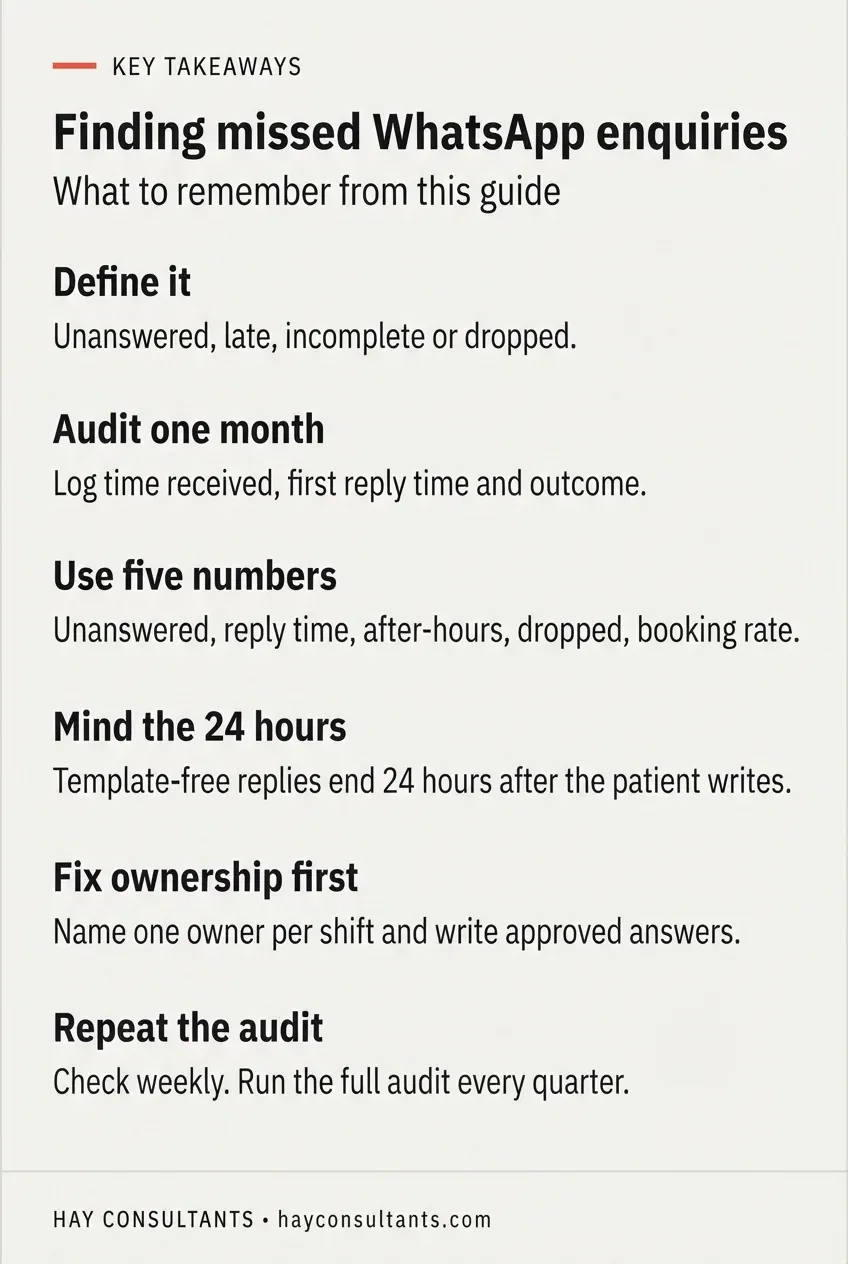
Repeat a short check every week and the full audit every quarter. Give one person ownership of the numbers.
The weekly check can stay brief. Count the unanswered enquiries, read the median reply time and note any conversations that stalled, then compare each figure with your baseline. The quarterly audit repeats the full five steps, so you can see whether your changes held.
Make the owner someone other than the person answering the messages, such as the practice or operations manager. People who handle the messages are poorly placed to count their own misses. Write down each change and its date, so a shift in the numbers can be traced to its cause.
Next step for your clinic
If you want help finding missed WhatsApp enquiries in your own chats and deciding what to fix, message HAY Consultants on WhatsApp. We will talk through how enquiries reach your clinic today and where they go unanswered.