

A clinic WhatsApp appointment booking flow is the path an enquiry follows from the patient’s first message to a confirmed slot. In an enquiry flow, an AI agent captures what the patient wants and your team confirms the booking. This guide is for owners and managers of clinics and medical centers in Dubai and across the UAE who want to design that path before they automate it. It covers what to ask, what to approve, when to hand over, and what to leave out.
For the full picture, see our guide to how AI WhatsApp agents work for clinics.
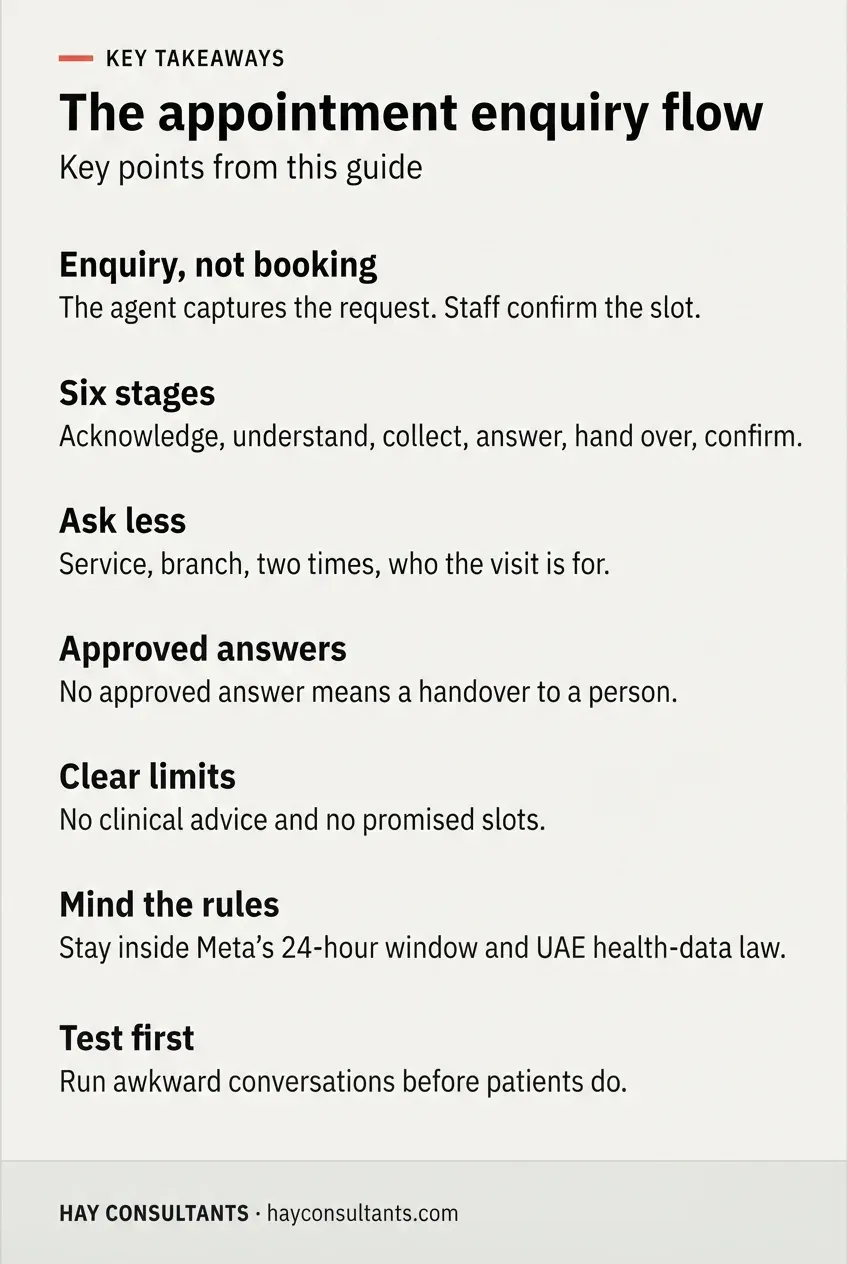
Short answer: A sound flow has six stages. The agent acknowledges the message, finds out what the patient wants, collects a preferred day and time, answers common questions from approved text and passes the request to your team. A person then confirms the slot and follows up. The agent captures the request, and staff make the booking.
What an appointment enquiry flow is, and what it is not
An appointment enquiry flow collects a patient’s request and passes it to staff, who confirm the slot. A direct booking flow reserves a slot without a person involved. Many tool vendors describe the second kind. This guide covers the first, because it suits clinics where doctors’ diaries change during the day, where branches differ, or where staff want to check each request before it becomes a booking.
A basic chatbot offers fixed menu options. An AI WhatsApp agent reads what the patient wrote, replies from approved information and collects the details your team needs.
| Enquiry flow | Direct booking flow | |
|---|---|---|
| Who confirms the slot | A staff member | The system |
| What the patient is told | Your request has been received and a team member will confirm | Your slot is booked |
| Main risk | The patient waits for staff to reply | A booked slot that the diary should not have offered |
| What it depends on | Approved answers and a clear handover | A live link to every doctor’s diary |
The six stages of a WhatsApp appointment booking flow
The flow runs in six stages, and each stage has one job.
- Acknowledge. The agent replies at once, so the patient knows the message arrived and that someone is dealing with it.
- Understand. The agent works out what the patient is asking for, such as a service, a doctor or a branch, and whether it is a first visit.
- Collect. The agent asks for the details your team needs to offer a slot, covered in the next section.
- Answer. The agent replies to common questions using text your clinic has approved.
- Hand over. The agent passes a short summary of the request to your team and tells the patient what happens next.
- Confirm and follow up. A staff member offers a slot and confirms it. If the patient goes quiet, the flow follows up.
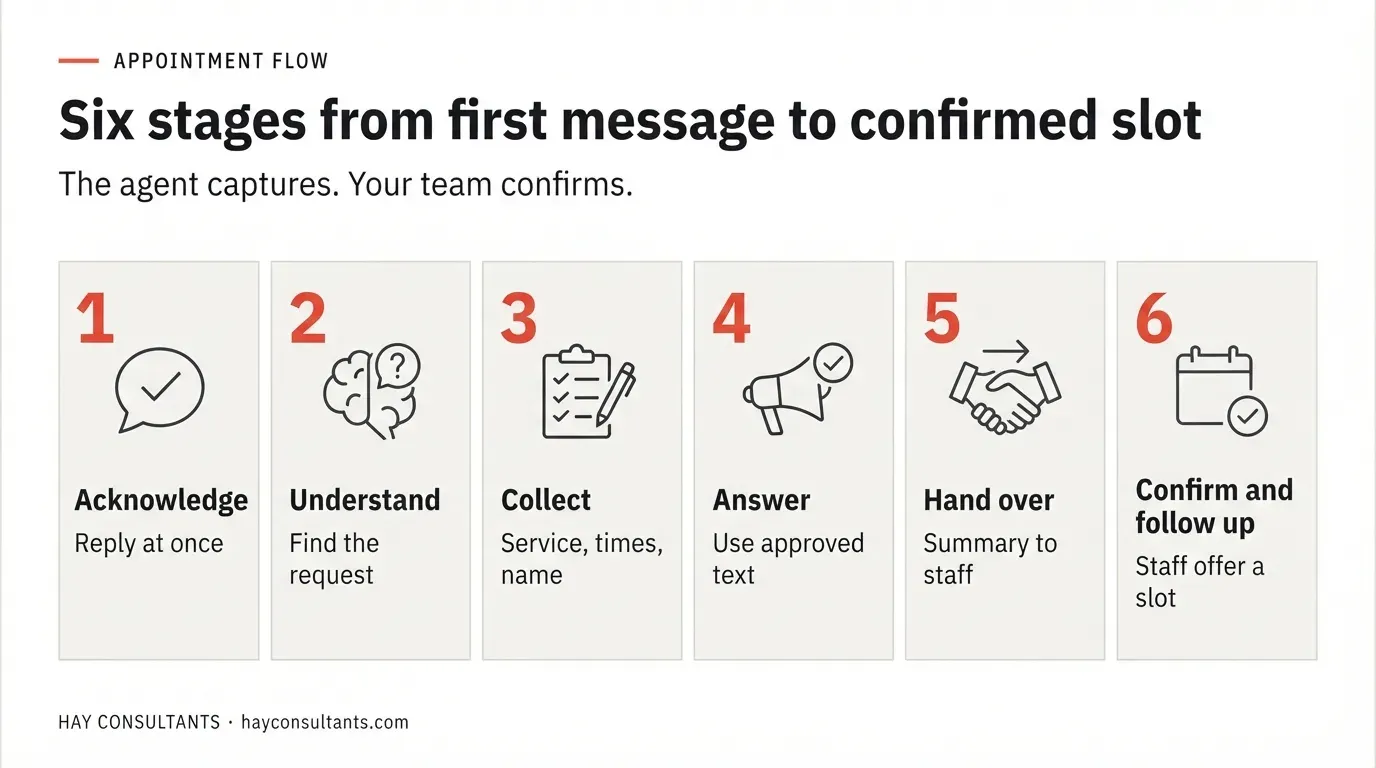
Patients rarely answer in order. The flow should accept an answer to a later question and carry on, instead of asking the same thing again.
What to ask the patient and what to leave out
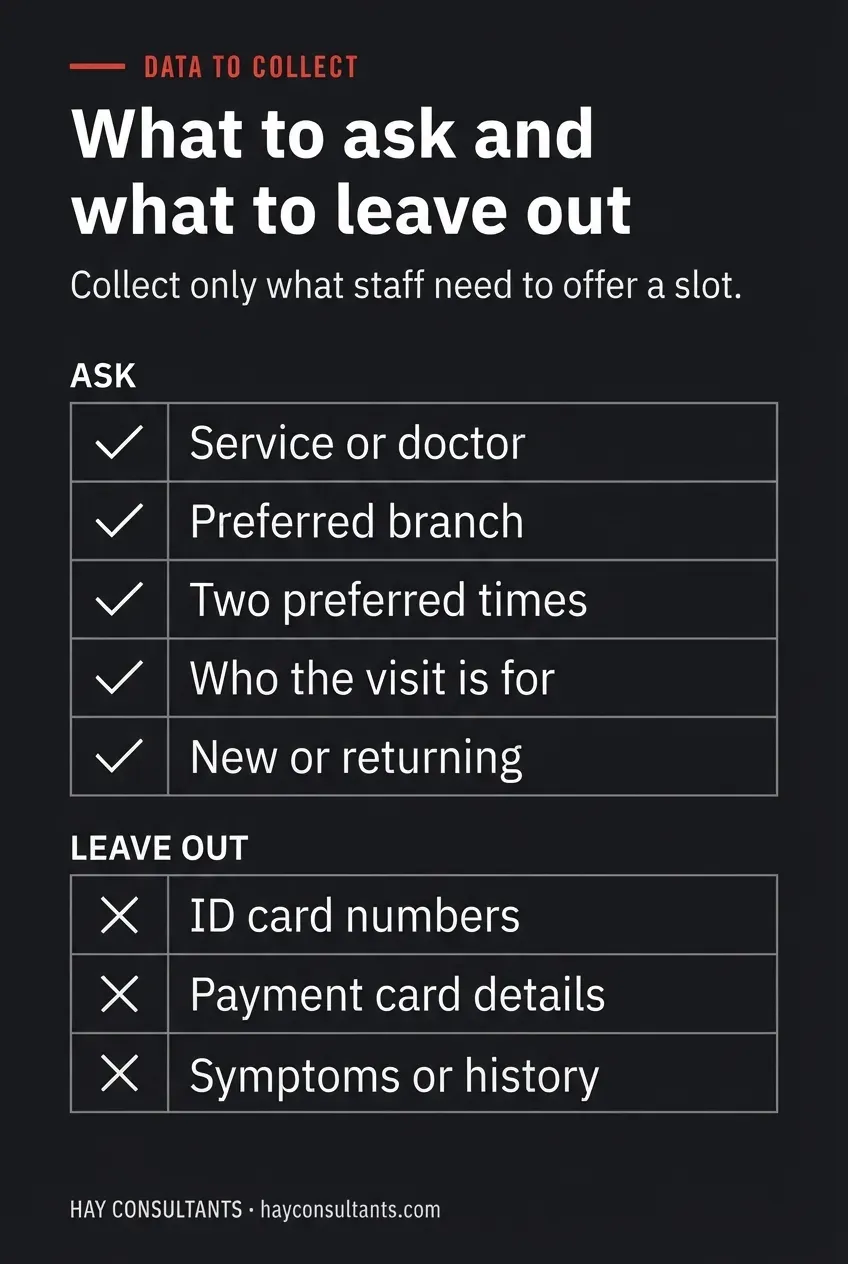
Ask only for what your team needs to offer a slot. Every extra question adds friction, and every extra piece of personal data adds risk. This is data minimization: collecting only the personal data a purpose requires.
| Ask | Why |
|---|---|
| Service or doctor wanted | Lets staff match the request to a diary |
| Preferred branch | Matters for clinics with more than one location |
| Two preferred days and times | Gives staff a fallback if the first choice is taken |
| Who the visit is for | The person writing may be booking for a child or relative |
| New or returning patient | Tells staff which record to open |
Leave out three things.
- ID card numbers. As of 8 October 2026, Meta’s WhatsApp Business Messaging Policy says businesses must not ask people to share personal ID card numbers or other sensitive identifiers. Staff can collect these at reception.
- Payment card details. The same policy rules these out.
- Symptoms, history and reports. These belong in a phone call or a visit. Collecting them also brings health-data duties, covered below.
A useful test is to keep the questions to what a receptionist would ask in the first minute of a phone call.
If you want a second opinion on the questions your own flow should ask, talk to HAY Consultants about your appointment enquiries.
Writing approved answers for common questions
Approved answers are short replies that your clinic has signed off, and the agent uses only these for common questions. Write the answers to the questions your desk handles most often, starting with these:
- Opening hours and branch locations
- How to reach the clinic by phone
- The services each branch offers
- Which doctors see which kinds of patients, as already described on your website
- Which documents to bring, if your clinic requires any
- How a request becomes a confirmed appointment, and how long staff aim to take
Give one person the job of signing off every answer. Keep each answer to a few sentences, add a date, and review the set whenever hours, doctors or services change.
Decide for each service whether the agent may quote a fee. If it may not, the approved answer is that a team member will share it. A question with no approved answer goes to a person. The agent should never improvise.
When the flow hands over to your team
The flow hands over whenever the next step needs judgement, and always when the patient asks for a person. Set these triggers in advance:
- The patient asks to speak to a person
- The question has no approved answer
- The message mentions symptoms, pain, urgency or any clinical question
- The patient is upset or makes a complaint
- The question concerns insurance cover or payment
Each handover should arrive as a short summary, so staff do not start from zero. Include the patient’s name, the service or doctor, the branch, the two preferred times, any questions asked with the answers given, and the time of the first message.
Agree an internal service-level agreement for handovers: a stated standard for how quickly a staff member responds in opening hours. Choose a time your team can meet, and measure it.
What the flow must never say
The flow must never give clinical advice or promise a slot. It handles sales and enquiries only. Four rules cover it:
- No diagnosis, urgency judgement or advice on symptoms or treatment
- No promise that a time is available, because staff confirm every slot
- No fees, discounts or doctor guarantees unless your clinic has approved them
- No information about other patients
If a patient describes symptoms or an urgent problem, the flow should stop collecting details and tell them a team member will contact them. It should also advise them to phone the clinic, or use emergency services if they believe they need urgent care.
Illustrative example: one enquiry from first message to handover
Illustrative example. This conversation is invented to show the flow. It is not a real patient or a real clinic.
Patient: Hello, I would like to see a dermatologist next week.
Agent: Hello, thank you for contacting the clinic. I can take your request and pass it to our team. Which branch suits you best?
Patient: The main branch.
Agent: Thank you. Which two days and times next week would suit you?
Patient: Tuesday morning or Thursday afternoon.
Agent: Noted. Who is the appointment for, and is this a first visit?
Patient: It is for me, and it is my first visit.
Agent: Thank you. May I have your full name?
Patient: (gives name)
Agent: Thank you. I have passed your request to our team. A team member will confirm a time with you during opening hours.
Patient: Do you take walk-ins?
Agent: I do not have that information, so I have asked a team member to answer you with your request.
Notice what the agent did not do. It did not promise Tuesday, it did not ask for an ID number, and it did not guess at the walk-in answer. The team now holds a complete request and one open question.
WhatsApp rules that shape an appointment flow
Meta’s rules decide how long staff can reply freely and what an automated flow may ask for. As of 8 October 2026, the WhatsApp Business Messaging Policy sets out four points that matter here:
- On the WhatsApp Business Platform, a business can reply without a template only within 24 hours of the patient’s last message. After that, only approved templates are allowed.
- Automation is allowed inside that window, provided the patient has a prompt, clear route to a person.
- A business may contact people only if they have given their number and opted in.
- Businesses must not ask people to share personal ID card numbers or payment card numbers.
The first point sets your confirmation deadline. A request taken at 9 pm on Monday can be confirmed in free text until 9 pm on Tuesday. Build your staff confirmation target inside that window.
Health data and your appointment flow
An appointment enquiry can reveal health information, and UAE law treats health information with extra care. Federal Law No. 2 of 2019 on the use of information and communication technology in health fields was issued on 6 February 2019. You can read it on the UAE Ministry of Justice legislation portal.
In plain words, the law requires health data to be kept confidential (Article 4). It bars the use of patient information for non-health purposes without the patient’s written approval, with listed exceptions (Article 16). It also generally bars storing or moving health data tied to services in the UAE outside the country, except in cases set by a Health Authority decision (Article 13). The UAE government portal describes the law as covering health care in the UAE, including free zones.
Whether an ordinary booking message counts as health information depends on what it says. Ask any provider where chats are stored, who can read them, and how long they are kept. Then confirm your own position with the relevant authority or a UAE-qualified adviser. Other emirates have their own rules as well. Abu Dhabi’s Department of Health, for example, publishes its own digital health policy.
This guide is general information, not legal, tax or financial advice. Confirm regulatory points with the relevant authority or a UAE-qualified lawyer.
How to test the flow before patients use it
Test the flow with realistic conversations, including the awkward ones, before it goes live. Ask a receptionist to run them, not only the person who built the flow. Cover at least these eight cases:
- A new patient who gives every detail in one message
- A patient who answers the questions out of order
- A message sent at night, outside reception hours
- A request to speak to a person
- A message that mentions symptoms
- A question with no approved answer
- A patient who goes quiet halfway through
- A message in a language or style your staff do not expect
Record what happened in each case, fix the wording, and run it again. Write down every place the flow could not cope, and decide whether the answer is a new approved reply or a handover.
How to measure an appointment flow
Five measures show whether the flow works, and each comes from the conversation log.
- Request completion rate: requests passed to staff with all details, divided by conversations started.
- Drop-off by stage: the stage at which patients stop answering.
- Median time to confirm: the middle value when you sort the time from first message to staff confirmation.
- Request-to-confirmed rate: requests that became confirmed slots, divided by all requests.
- Handover reasons: the count of each reason for a handover. The same unanswered question appearing repeatedly means an approved answer is missing.
Record a baseline before you change anything. Review the numbers every week at first, and then monthly once they settle.
Where an AI WhatsApp agent fits
An AI WhatsApp agent runs the first stages whenever a message arrives, including outside reception hours, and your team handles the confirmation. It responds, asks qualification questions, answers common questions from approved information, follows up and hands the conversation to your team when human involvement is needed. HAY Consultants helps healthcare businesses design this through its AI WhatsApp agent service for clinics.
Our guide to the 24/7 AI sales agent for clinics explains how the agent works step by step. Design the flow first on paper, so the agent is built around rules your team already trusts.
Next step for your clinic
If you want help designing a clinic WhatsApp appointment booking flow, message HAY Consultants on WhatsApp. We will talk through your enquiries, your approved answers and your handover rules.