

Valuing a healthcare business in Dubai requires more than a standard financial model. Practice owners must account for regulatory licensing, physician dependency, and insurance payer mix alongside the numbers on a P&L. This guide from HAY Consultants walks through the frameworks used to assess the enterprise value of a medical facility in the UAE.
1. Introduction to Healthcare Business Valuation in Dubai
Dubai’s healthcare sector continues to expand across hubs such as Dubai Healthcare City (DHCC), Business Bay, and Jumeirah, driving steady demand for clinic mergers, acquisitions, and investor buy-ins.
General valuation approaches cannot be applied to a medical practice without adjustment. Medical facilities depend on regulatory approvals, qualified clinical staff, and payer billing arrangements that don’t appear in a typical SME valuation. A credible valuation combines operational data with standard accounting metrics.
Healthcare business owners typically need an accurate practice appraisal for specific events:
- Selling an established practice to a strategic buyer
- Negotiating equity stakes for incoming clinical partners
- Securing expansion financing from UAE commercial banks
- Resolving shareholder restructuring or exit plans

2. What Are the Three Primary Valuation Methods for Medical Clinics in Dubai?
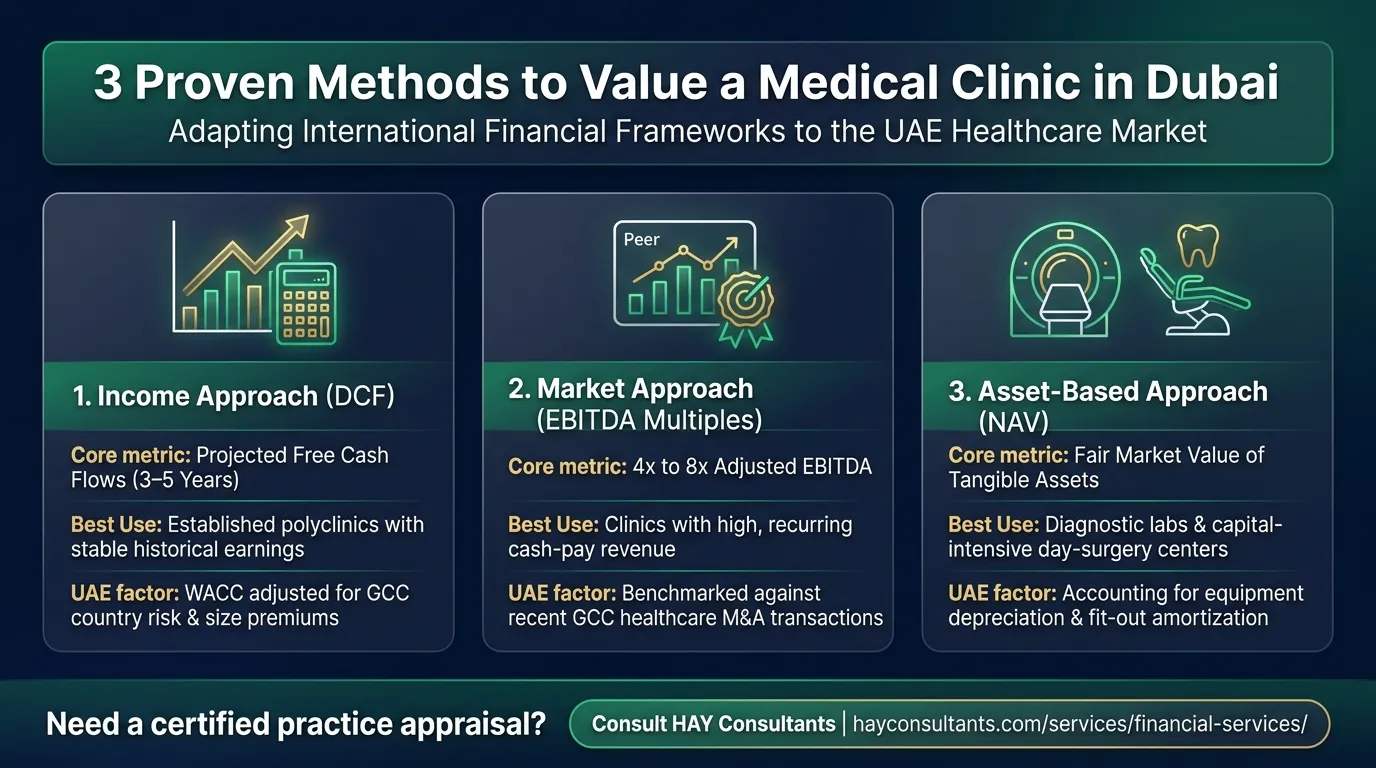
Valuation professionals rely on three core approaches to value a medical facility: the Income Approach, the Market Approach, and the Asset-Based Approach.
| Valuation Approach | Primary Financial Metric | Best Suited For | Key Local Consideration |
|---|---|---|---|
| Income Approach (DCF) | Projected free cash flows | Established polyclinics with predictable cash flow | Discount rate adjusted for UAE market risk |
| Market Approach | Adjusted EBITDA multiples | Clinics with strong, recurring cash revenue | Benchmarked against GCC healthcare M&A data |
| Asset-Based Approach | Net Asset Value (NAV) | Capital-intensive diagnostic or surgery centers | Depreciation of advanced medical equipment |
Method 1: The Income Approach (Discounted Cash Flow and Capitalization of Earnings)
The Income Approach measures the future financial benefit a clinic will generate for its owners. The Discounted Cash Flow (DCF) model is the standard variation for high-growth healthcare centers.
DCF projects free cash flows three to five years into the future, then discounts those cash flows back to present value using a Weighted Average Cost of Capital (WACC). For Dubai clinics, the discount rate should account for UAE market risk, inflation, and small-business execution risk.
The Capitalization of Earnings method suits mature clinics with stable, established earnings. It divides normalized historical earnings by a capitalization rate to arrive at enterprise value.
Method 2: The Market Approach (EBITDA Multiples)
The Market Approach values a facility by comparing it to similar clinics recently sold in the GCC market, applying a market multiple to the clinic’s adjusted EBITDA.
In Dubai, medical practices generally trade between 4x and 8x adjusted EBITDA. The applied multiple depends on factors like location, specialty, scale, and management independence. High-margin practices with low doctor dependency tend to command multiples toward the top of this range, while single-doctor practices typically trade lower due to key-person risk.
Method 3: The Asset-Based Approach (Net Asset Value)
The Asset-Based Approach calculates the net market value of a clinic’s tangible assets, subtracting total liabilities from the fair market value of those assets. Tangible assets typically include:
- Specialized medical devices (lasers, imaging suites, dental chairs)
- Interior fit-outs and surgical suite builds
- Pharmaceuticals, consumables, and clinical inventory
- IT infrastructure and administrative hardware
This method establishes a floor valuation for the business. It is most often applied in liquidation scenarios or for capital-intensive facilities such as diagnostic labs.
3. What Is Adjusted EBITDA and How Do You Normalize Earnings for a UAE Clinic?
Adjusted EBITDA represents the true, ongoing operational profitability of a medical practice. Reported net profit on a standard P&L statement rarely reflects this, since clinic owners often route discretionary expenses or non-market salaries through operational accounts. Earnings normalization removes these distortions.
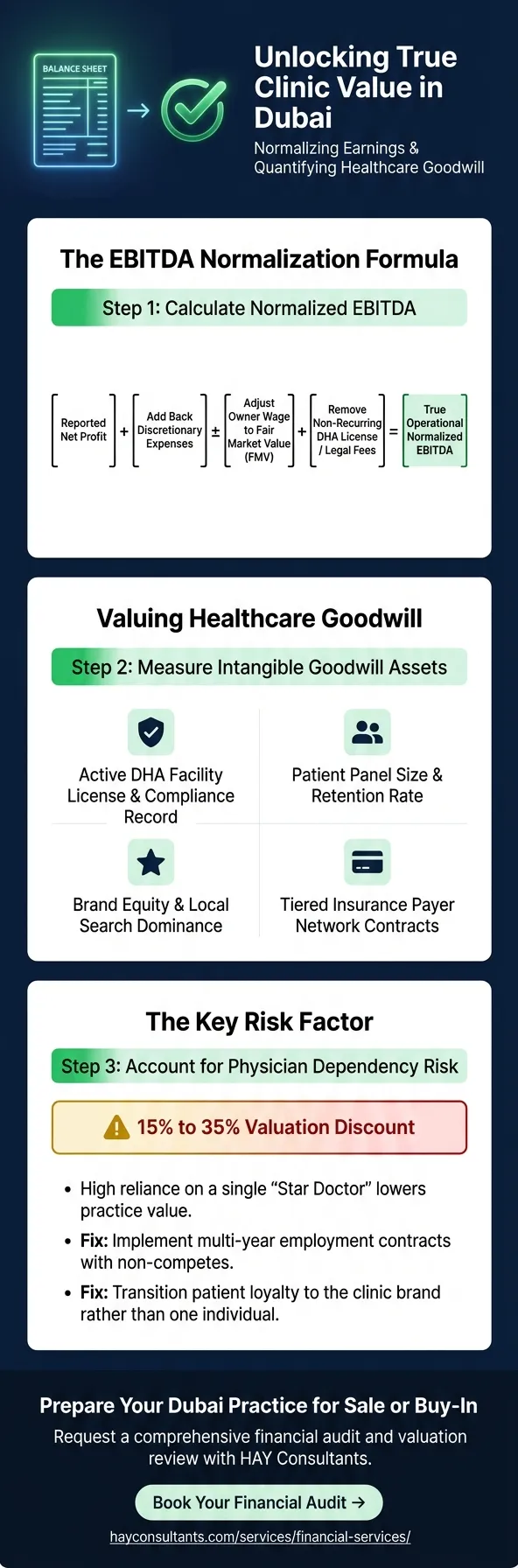
Reported Net Profit → Add Back Non-Operational / Discretionary Expenses → Adjust Owner Wage to Fair Market Value → Normalized EBITDA
Key steps to normalize clinic financials:
- Adjust owner-doctor compensation. Replace discretionary owner draws with a fair market value (FMV) clinical salary. If an owner-doctor takes no formal salary, subtract an equivalent market wage for a replacement doctor.
- Normalize real estate and rent. Adjust lease payments to reflect market rates if the clinic operates from an owner-held property.
- Remove one-off expenses. Add back non-recurring items such as initial DHA facility setup fees, one-time legal costs, or renovation spend.
- Exclude discretionary purchases. Remove personal vehicle leases, non-essential travel, and unrelated family expenses charged to the business.
For a full worked example of these adjustments, see our deep dive on calculating Normalized EBITDA for UAE medical clinics.
4. How Do You Value Medical Goodwill vs. Doctor Dependency in Dubai?
Goodwill represents the intangible value of a practice above its net tangible asset value. In Dubai, healthcare goodwill stems largely from patient retention, brand reputation, location quality, and active insurance panel memberships.
Base Goodwill (Brand, Location, Patient History) − Physician Dependency Risk Discount (15%–35%) = Transferable Enterprise Goodwill
Physician dependency is one of the most significant risks in a medical clinic valuation. When a single lead doctor generates the majority of revenue, the business carries meaningful key-person risk: if that physician leaves, patient volume can drop sharply.
Mitigating key-person risk: valuers typically apply a discount to goodwill when doctor dependency is high. Clinic owners can reduce this discount through clear risk-reduction measures, including:
- Multi-year employment contracts with restrictive non-compete clauses
- Transitioning patient intake toward an institutional brand rather than a single practitioner
- Structuring earn-out arrangements where part of the purchase price depends on post-sale revenue targets
5. How Do Local UAE Regulations and DHA Licensing Impact Clinic Valuation?
Regulatory compliance directly influences the market value and saleability of a UAE medical center, since compliance gaps create liabilities that surface during buyer due diligence.
DHA license transferability. An active, unrestricted Dubai Health Authority (DHA) facility license holds real strategic value. Securing new DHA facility approvals takes considerable administrative time and capital, so buyers will often pay a premium for a turnkey facility with an operational license and a clean regulatory record.
Data protection and system integration. Facilities must comply with the UAE Personal Data Protection Law (PDPL) and integrate with local health information platforms such as NABIDH in Dubai or Malaffi in Abu Dhabi. Non-compliant clinical systems create technical debt that buyers factor into the purchase price.
Insurance payer mix. A clinic’s insurance contract profile affects cash flow predictability. Valuers weigh the balance between:
- Direct-billing network contracts — higher patient volume, but lower margins and longer collection cycles
- Cash-pay patients — higher immediate margins and more predictable collection
6. Specialty-Specific Valuation Multiples in Dubai
Valuation metrics vary across medical disciplines due to differing cost structures, capital requirements, and patient retention patterns.
Aesthetic and Dermatology Clinics
Characteristics: A high proportion of cash-paying patients and strong gross margins.
Valuation drivers: High marketing costs, ongoing capital expenditure for laser and device equipment, and brand reputation.
Typical multiples: 5x–8x adjusted EBITDA.
Dental Clinics
Characteristics: A repeat patient base for hygiene and general dentistry, mixed with higher-margin cosmetic services.
Valuation drivers: Hygienist utilization rates, patient retention, and associate dentist commission structures.
Typical multiples: 4x–6.5x adjusted EBITDA.
Multi-Specialty Polyclinics and Day Surgery Centers
Characteristics: Diversified clinical revenue streams, institutional management structures, and lower individual doctor dependency.
Valuation drivers: Facility capacity utilization, insurance panel tiering, and operational scalability.
Typical multiples: 6x–9x+ adjusted EBITDA.
7. Step-by-Step Stages to Prepare a Dubai Medical Practice for Sale
Preparing a clinic for an equity sale or valuation audit requires structured organization well ahead of a transaction.
Financial Cleanup → Independent Valuation → Due Diligence Data Room → Deal Structuring
- Clean up financial statements (12–24 months prior). Separate personal expenses from business accounts, resolve aging patient receivables, and formalize doctor contracts.
- Commission an independent valuation. Work with experienced healthcare financial consultants to establish a realistic target price range.
- Build a due diligence data room. Organize DHA licensing files, lease contracts, staff employment agreements, and insurance fee schedules.
- Structure the deal. Determine whether an Asset Purchase or a Share Purchase offers the better tax and operational outcome.
8. Strategic Summary
Accurately valuing a medical practice in Dubai means combining financial analysis with healthcare operational knowledge. Owners should normalize EBITDA, account for regulatory compliance, and address physician dependency to support a defensible valuation. Proper preparation makes for a smoother transaction, whether the outcome is an M&A sale or a partner buy-in.
9. Frequently Asked Questions
What is the average EBITDA multiple for a medical clinic in Dubai?
Medical clinics in Dubai typically trade between 4x and 8x adjusted EBITDA. Multi-specialty centers and high-margin aesthetic practices with low doctor dependency tend to command higher multiples, while solo-practitioner clinics trade lower due to key-person risk.
How is goodwill calculated when selling a medical practice in the UAE?
Goodwill is generally calculated as the premium paid over a clinic’s Net Asset Value, reflecting brand equity, patient retention, location value, and active insurance contracts. It is then adjusted downward for physician dependency risk where relevant.
Does a DHA facility license add monetary value to a clinic appraisal?
Yes. An active Dubai Health Authority (DHA) facility license adds real value by saving a buyer the regulatory lead time and setup cost of securing a new license. A fully compliant, active license supports the facility’s overall enterprise value.
What is the difference between an Asset Purchase and a Share Purchase for a Dubai clinic?
In an Asset Purchase, the buyer acquires specific physical equipment, fit-outs, and inventory. In a Share Purchase, the buyer acquires the entire legal entity, including its DHA license, commercial registration, staff visas, and historical liabilities.
How does doctor dependency affect the valuation of a solo practice in Dubai?
High reliance on a single doctor introduces key-person risk. Valuations for high-dependency practices commonly face a 15% to 35% goodwill discount unless the practice is structured with multi-year employment contracts or post-sale transition earn-outs.
For professional support in evaluating your facility, explore HAY Consultants’ Healthcare Financial Consulting Services to discuss an operational valuation audit.