

Normalized EBITDA is the number every serious buyer, lender, or investor asks for first when evaluating a UAE medical practice — and it is rarely the number sitting on the reported P&L. This guide from HAY Consultants breaks down exactly how to adjust owner compensation, rent, and one-off costs to arrive at a defensible Normalized EBITDA and Future Maintainable Earnings (FME) figure.
1. What Is Normalized EBITDA and Why Does It Matter for UAE Medical Clinics?
Normalized EBITDA measures the baseline cash flow of a business by removing non-recurring, non-operational, and discretionary expenses. For a medical practice in the UAE, standard earnings before interest, taxes, depreciation, and amortization (EBITDA) often present an inaccurate financial picture. Practice owners routinely mix personal expenses, non-arm’s length rent, and discretionary distributions into corporate accounts. Adjusting historical financial statements strips away these distortions to reveal true operational performance.
Reported Net Profit → Add Back Discretionary Costs → Adjust Owner Wage & Rent to FMV → Normalized EBITDA
Normalized EBITDA acts as the essential building block for calculating Future Maintainable Earnings (FME). While Normalized EBITDA reflects cleaned historical performance, FME projects the repeatable earnings a buyer can expect post-acquisition. Buyers and financial controllers evaluate FME to determine the long-term cash flow of a healthcare facility, applying normalization principles consistent with the International Valuation Standards used across cross-border M&A.
Relying on raw tax filings or unadjusted audited financials creates real financial risk. Unadjusted statements may understate earnings, which lowers the sale price for practice owners. Conversely, they can mask unsustainable operational costs, leading buyers to overpay. Standardizing historical earnings establishes an audited baseline that supports due diligence during mergers and acquisitions (M&A) — work best undertaken with dedicated healthcare financial consulting support rather than in-house alone.
2. How Do You Normalize Owner and Clinician Compensation in a UAE Practice?
Owner-operator compensation is the largest source of financial distortion in UAE medical practices. Practice owners often set their own salaries based on tax and cash-flow strategy rather than operational reality, so historical net income needs to be corrected before it can be trusted.
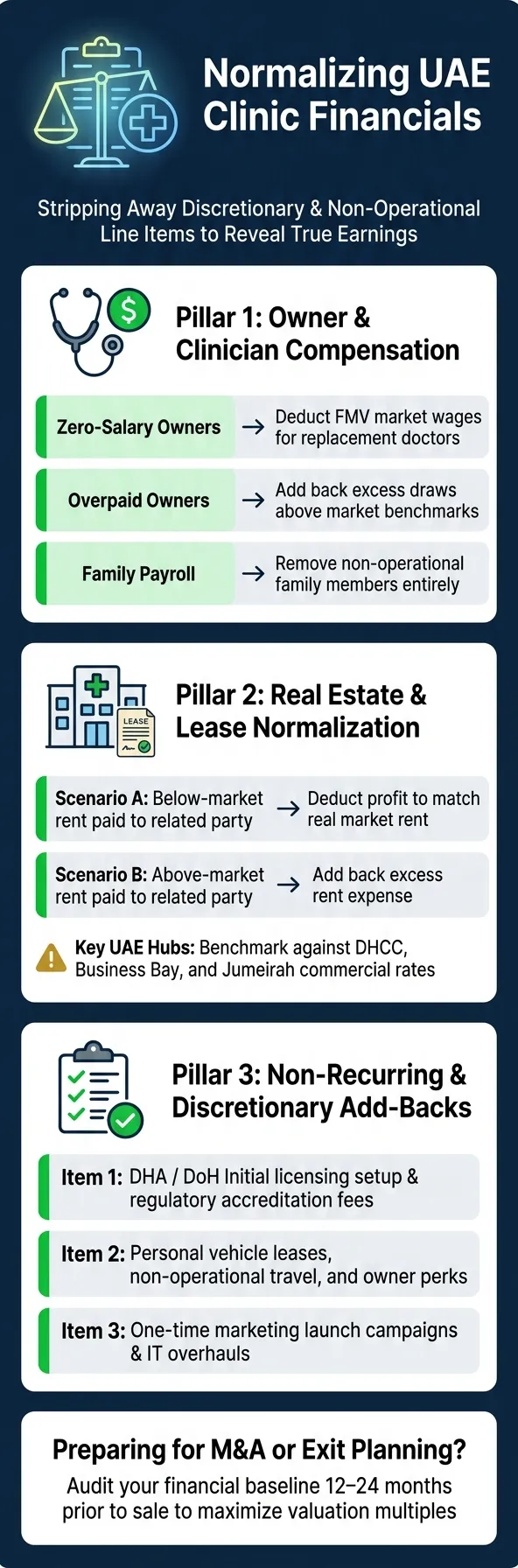
Normalizing compensation requires replacing actual owner distributions with the Fair Market Value (FMV) of hiring a replacement physician or administrator.
- Zero-salary adjustments. If an owner-doctor takes no formal salary, historical net income appears artificially high. Subtract the market rate for a replacement physician to bring EBITDA down to its true baseline.
- Excessive owner draws. If an owner-operator draws compensation above local market standards, add the excess payment back to increase historical EBITDA.
- Family payroll adjustments. Relatives on payroll who perform no operational role must be removed entirely. Relatives paid above market rates must have their salaries adjusted to fair market value.
- Separating clinical vs. operational duties. Split owner income into clinical revenue generation and management duties. Replace the owner’s clinical role with market-rate commissions or base pay, and their managing director role with standard administrative management costs.
3. How Do You Adjust Non-Arm’s Length Rent and Facility Leases in the UAE?
Real estate expenses frequently skew historical P&L statements when practice owners own the underlying commercial property.
| Lease Scenario | Financial Impact on Raw P&L | Normalization Adjustment Required |
|---|---|---|
| Below-market rent | Artificially inflates historical profit | Subtract expenses to match fair commercial market lease rates |
| Above-market rent | Artificially depresses historical profit | Add back excess rent to reflect true market operating costs |
| Owner-held property | Lease rates set to transfer intercompany cash | Re-align the lease contract with independent commercial appraisals |
Evaluating real estate costs requires benchmarking lease terms against prevailing rates in primary UAE healthcare hubs — specialized free-zone rates in Dubai Healthcare City (DHCC), premium commercial high-rise benchmarks in Business Bay and Downtown, and prime standalone or medical-villa rates in Jumeirah and central Abu Dhabi.
Normalizing facility leases also requires reviewing lease duration and renewal clauses. Short-term leases subject to sudden rent increases add long-term risk to FME calculations. Distinguish, too, between standard landlord rent and owner-funded capital fit-out expenses — amortize major interior construction over the full life of the lease instead of deducting it as an immediate operational expense.
This adjustment is not just an accounting convention. Under UAE Corporate Tax legislation, related-party transactions — including rent charged by an owner-controlled real estate entity — must be priced on an arm’s length basis, so normalized lease figures should also reflect the rate a genuinely independent landlord would charge.
4. What Non-Recurring and Personal Expenses Must Be Normalized?
Non-recurring and personal expenses distort historical operating margins. Stripping away these one-time costs isolates true operational cash flow.
- Licensing and regulatory setup costs. Add back initial facility approvals, licensing fees, and accreditation expenses from the Dubai Health Authority (DHA) or the Department of Health – Abu Dhabi (DoH).
- One-time marketing campaigns. Remove launch expenses, major rebrand costs, or single-event promotional spend that will not recur annually.
- Owner discretionary expenses. Add back personal vehicle leases, non-operational travel, country club memberships, and personal utility bills charged to the practice.
- Legacy IT and capital repairs. Remove one-off software migrations, major non-capitalized equipment repairs, or legacy IT overhauls from recurring operating costs.
- Legal fees and litigation. Exclude legal expenses related to shareholder restructuring, corporate setup, or single-event dispute settlements.
5. Step-by-Step Calculation: Converting Net Profit to Normalized EBITDA and FME
Calculating Normalized EBITDA and FME involves a systematic series of additions and deductions:
Normalized EBITDA = Reported Net Profit + Interest, Taxes, Depreciation & Amortization + Add-Backs − Deductions
Sample UAE Polyclinic Financial Adjustment
Consider a multi-specialty polyclinic in Dubai presenting the following financial profile:
- Reported net profit: AED 1,200,000
- Interest, depreciation, and taxes: AED 300,000
- Owner-doctor salary: AED 0 (owner works full-time as lead physician; FMV replacement cost is AED 450,000)
- Lease paid to owner’s real estate firm: AED 600,000 (fair market rent in the area is AED 400,000)
- One-time DHA licensing expansion: AED 100,000
- Personal vehicle leases and travel: AED 150,000
| Calculation Step | Financial Line Item | Amount (AED) | Running Total (AED) |
|---|---|---|---|
| Starting point | Reported net profit | — | 1,200,000 |
| Standard EBITDA | Add back interest, depreciation & taxes | +300,000 | 1,500,000 |
| Adjustment 1 | Deduct replacement owner-doctor salary (FMV) | −450,000 | 1,050,000 |
| Adjustment 2 | Add back above-market rent adjustment | +200,000 | 1,250,000 |
| Adjustment 3 | Add back one-time DHA licensing expansion | +100,000 | 1,350,000 |
| Adjustment 4 | Add back discretionary personal expenses | +150,000 | 1,500,000 |
| Final result | Normalized EBITDA | — | 1,500,000 |
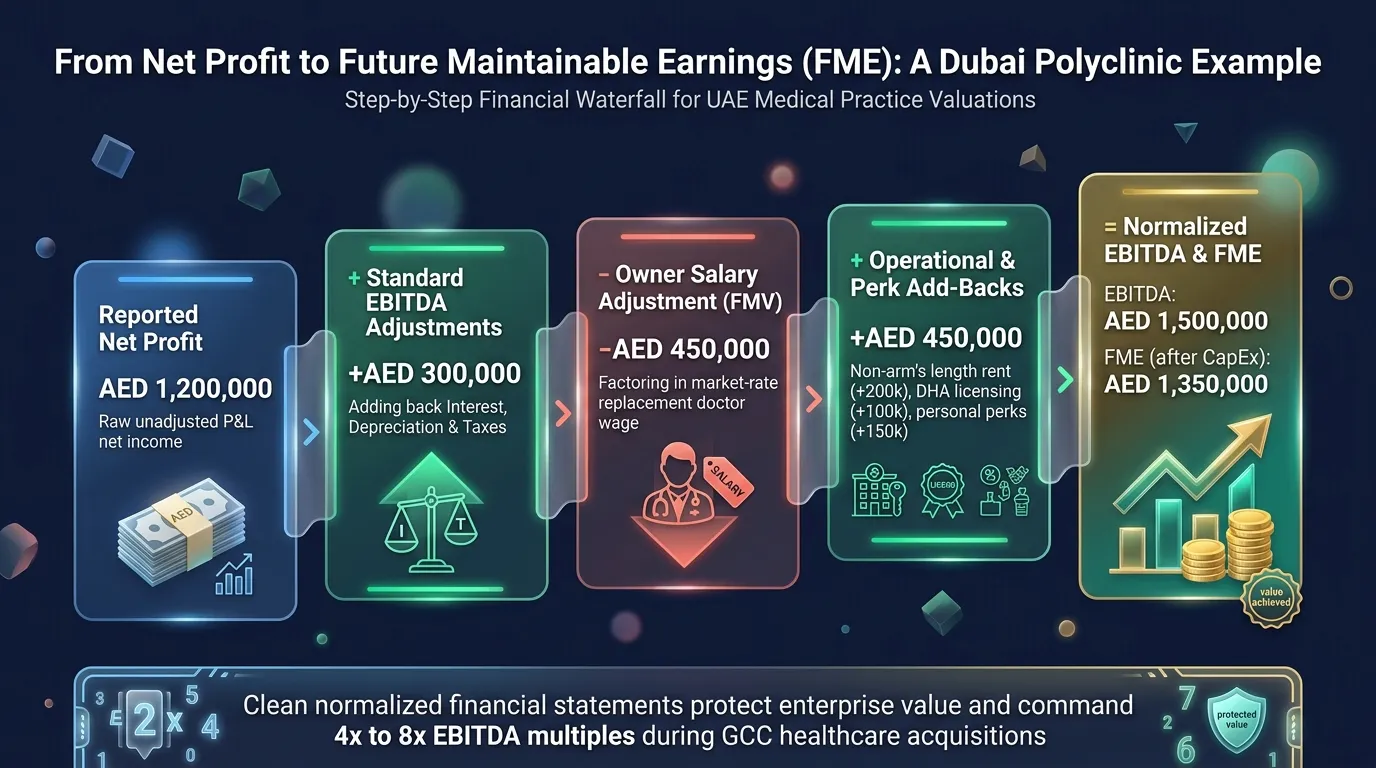
To convert Normalized EBITDA into Future Maintainable Earnings (FME), subtract ongoing capital expenditure (CapEx) reserves. Medical facilities must continuously repair and update equipment. Subtracting a recurring annual CapEx reserve of AED 150,000 yields a final FME of AED 1,350,000.
6. How Does Normalized EBITDA Direct Clinic Valuation Multiples in the GCC?
Normalizing financial statements directly affects enterprise value during an acquisition. UAE medical clinics typically trade at valuation multiples between 4x and 8x adjusted EBITDA. Clean, normalized financials reduce buyer risk and support multiples toward the top of that range, while unadjusted or inconsistent financials increase perceived risk and get discounted accordingly.
Audited financial adjustments increase buyer confidence, allowing sellers to negotiate higher valuation multiples. However, operational risk factors can discount this multiple despite strong earnings:
- Physician dependency risk. High reliance on a single lead doctor reduces earnings quality. Buyers typically apply a 15% to 35% discount to the valuation multiple unless the owner commits to an extended transition contract or earn-out structure.
- Insurance payer mix. Revenue reliant on direct-billing insurance network contracts carries lower profit margins and longer collection cycles. Cash-pay private revenue commands higher valuation multiples due to higher margins and immediate collection.
For a full walkthrough of how these multiples apply across specialties, see our guide on how to value a medical clinic in Dubai.
7. Strategic Conclusion
Standardizing historical financial statements is essential when preparing a UAE medical clinic for sale or equity investment. Adjusting owner compensation, commercial rent, and personal expenses reveals the operational profitability of the facility. Practice owners, CFOs, and financial controllers should audit their financials 12 to 24 months before an exit to establish clean records, maximize Future Maintainable Earnings, and secure optimal valuation multiples.
8. Frequently Asked Questions
What is the difference between EBITDA and Normalized EBITDA for a UAE medical clinic?
Standard EBITDA adds back interest, taxes, depreciation, and amortization to net income. Normalized EBITDA goes further by removing non-recurring expenses, personal perks, non-market rent, and unadjusted owner salaries. This reveals the true, repeatable operational earnings under new ownership.
How do you normalize an owner-doctor’s salary when calculating clinic EBITDA?
Replace actual owner compensation with the Fair Market Value (FMV) cost of hiring a replacement physician for the same duties. If an owner-doctor takes zero salary, add a market-rate salary expense to lower EBITDA. If an owner overpays themselves, add the excess amount back to increase EBITDA.
What is Future Maintainable Earnings (FME) in healthcare business valuation?
Future Maintainable Earnings (FME) is the normalized profit a clinic is expected to generate consistently going forward. FME takes Normalized EBITDA and deducts an annual capital expenditure (CapEx) reserve to give buyers an accurate cash-flow baseline.
Why must rent be adjusted when normalizing financials for a Dubai or Abu Dhabi clinic?
Practice owners often own the commercial property and charge their clinic entity non-market rent. Adjusting lease expenses to local market rates ensures historical operating costs reflect what a new buyer will actually pay.
Which non-recurring expenses can be added back to EBITDA during a UAE practice sale?
Common add-backs include initial DHA or DoH licensing setup fees, legal costs from shareholder disputes, one-time rebranding campaigns, non-capitalized major equipment repair bills, and personal expenses charged to the business.
For professional support in normalizing your clinic’s financials ahead of a sale or investment round, explore HAY Consultants’ Healthcare Financial Consulting Services.