

Regulatory licensing in Dubai and Abu Dhabi directly drives healthcare enterprise value. Non-compliance creates deal friction, delays closings, and leads to purchase price write-downs during legal due diligence. This guide from HAY Consultants explores how licensing status with the Dubai Health Authority (DHA) and the Department of Health – Abu Dhabi (DoH) shapes healthcare M&A transactions in the UAE, supported where needed by dedicated healthcare financial consulting services.
1. How Do UAE Healthcare Regulations Impact M&A Enterprise Value?
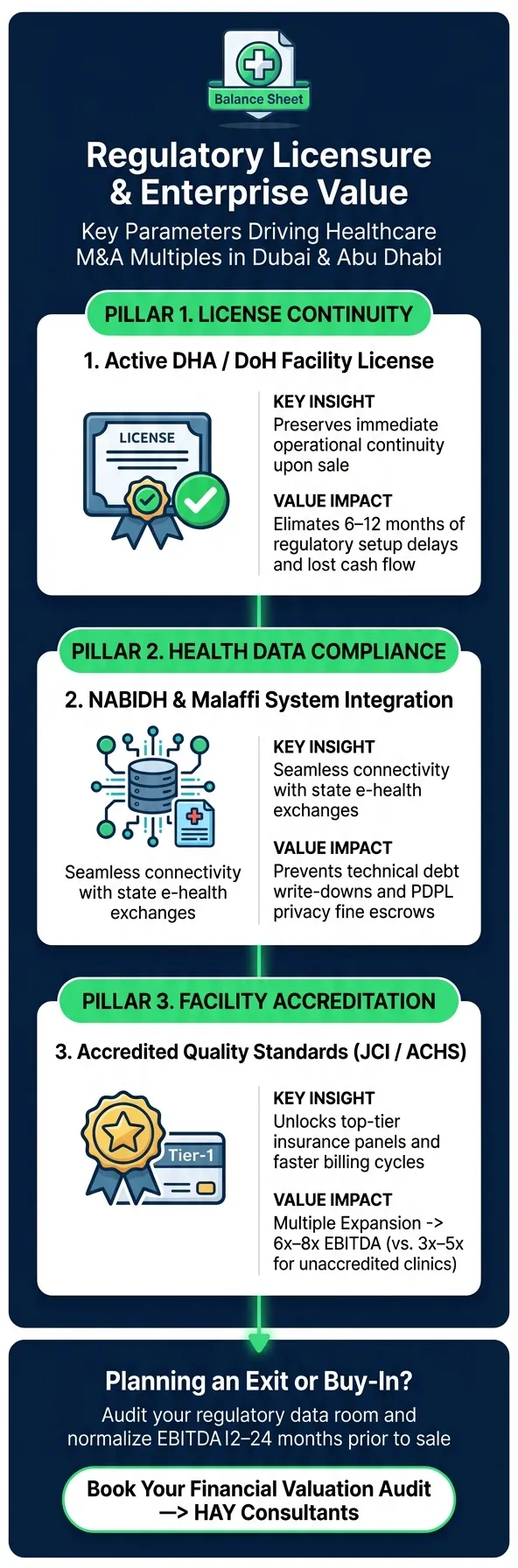
Regulatory compliance is a primary value driver in UAE healthcare M&A. Active facility licenses, clinical accreditation, and data connectivity command premium valuation multiples. Unaddressed regulatory gaps expose buyers to sudden operational halts and financial penalties.
Active Licensing & Compliance → Reduces Buyer Risk → Expands EBITDA Multiples
Unresolved Regulatory Gaps → Increases Liability → Applies Valuation Discounts and Escrows
Healthcare deals in the region require specific scrutiny across three primary areas:
- Facility license transferability. The ease of transferring active permits directly affects operational continuity.
- System integration. Integration with state health information exchanges impacts technical due diligence.
- Operational quality. Facility accreditations dictate insurance payer tiering and cash flow stability.
2. How Does DHA and DoH Facility License Transferability Affect Valuation?
Securing a new facility license from the DHA or DoH requires six to twelve months. Acquiring an existing entity with an active license eliminates this delay, preserving immediate revenue continuity.
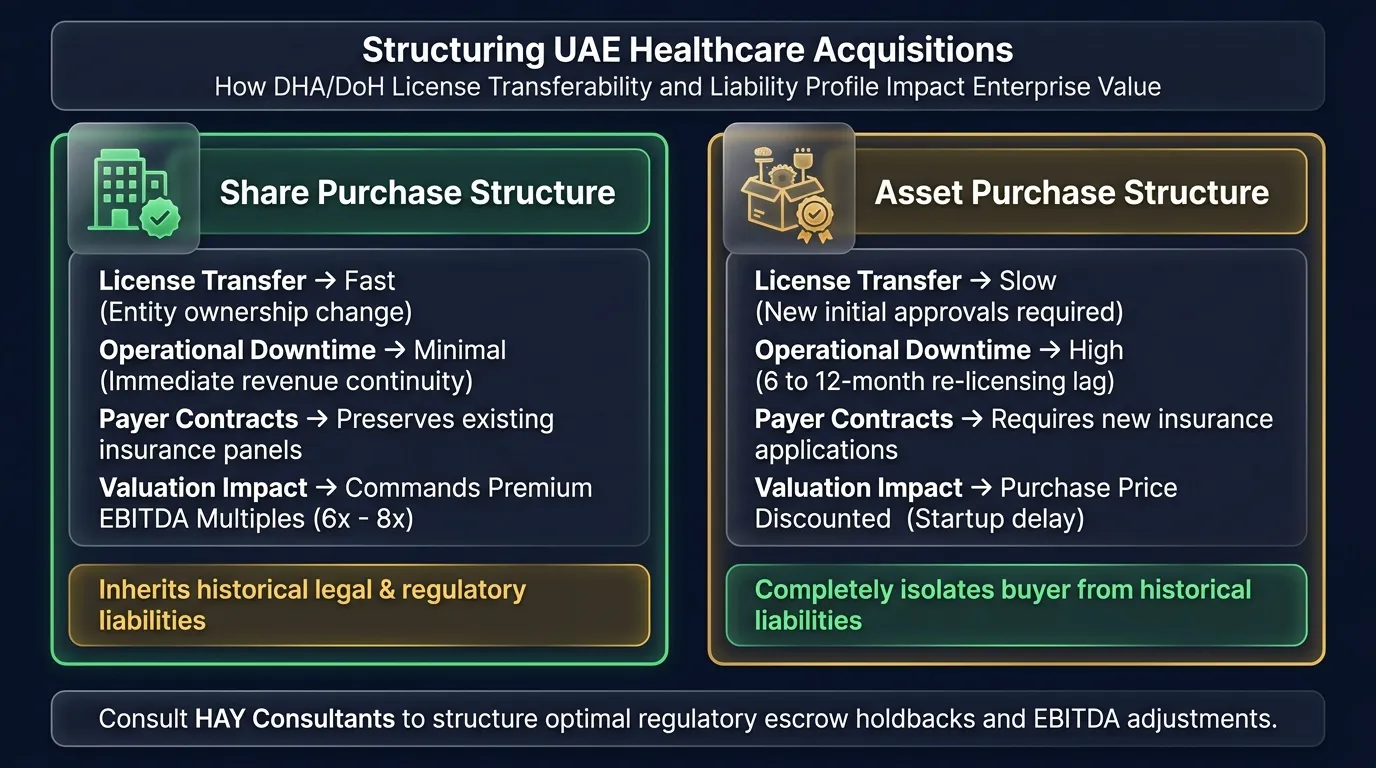
Share Purchase → Retains DHA/DoH License → Zero Operational Interruption
Asset Purchase → Requires New Application → 6 to 12 Month Revenue Lag
Asset Purchase vs. Share Purchase Friction
- Share purchase structure. The buyer acquires the complete corporate entity. The DHA or DoH facility ID, commercial registration, insurance contracts, and staff visas remain intact. This structure eliminates cash flow interruptions but transfers historical legal and regulatory liabilities to the buyer.
- Asset purchase structure. The buyer acquires physical fit-outs and equipment only. Historical liability is avoided, but the buyer must apply for a new facility license. Re-licensing equipment and re-negotiating payer contracts creates significant revenue downtime.
Regulatory Transferability Comparison
| Deal Metric | Share Purchase Model | Asset Purchase Model |
|---|---|---|
| DHA/DoH license transfer speed | Fast (entity ownership change) | Slow (requires new initial approvals) |
| Revenue interruption risk | Minimal (immediate continuity) | High (6–12 month re-licensing delay) |
| Historical liability risk | Inherited by the buyer | Isolated to the seller |
| Insurance panel transfer | Retains existing billing contracts | Requires new payer applications |
| Impact on valuation multiple | Commands a premium multiple | Discounted due to startup lag |
3. What Is the Impact of NABIDH and Malaffi Compliance on Financial Due Diligence?
Dubai requires patient data integration with the NABIDH platform. Abu Dhabi mandates integration with the Malaffi health information exchange. Adherence to the UAE Personal Data Protection Law (PDPL) is also compulsory. Non-compliant Electronic Medical Record (EMR) systems create technical debt that buyers deduct directly from the baseline enterprise value.
Legacy or Non-Compliant EMR → Integration Deficiency → Direct Valuation Deductions
Quantifying Technical Debt Adjustments
If a target clinic uses outdated software, the buyer must budget for system upgrades. M&A advisors adjust normalized earnings to account for this capital requirement:
Adjusted Enterprise Value = Base Value − EMR Upgrade CapEx − PDPL Remediation Costs
- Data governance risks. Non-compliant patient record tracking violates local privacy laws. Sellers face purchase price escrows to cover potential fines.
- Operational continuity. Lack of state platform connectivity interrupts digital prescription tracking and unified patient record transfers.
For a full walkthrough of how these adjustments feed into a defensible earnings baseline, see our guide on Normalized EBITDA for UAE medical clinics.
4. How Does Healthcare Facility Accreditation Drive Earnings Multiples?
Facility accreditation directly drives higher valuation multiples by de-risking operational revenues. Recognized accreditations include Joint Commission International (JCI), the Australian Council on Healthcare Standards (ACHS), and local DHA/DoH quality frameworks.
Facility Accreditation → Top-Tier Insurance Panels → Faster Billing Cycles → Expanded EBITDA Multiples
Accreditation improves financial performance across several key operational areas:
- Payer network tiering. Accredited clinics qualify for top-tier insurance panel placements.
- Improved reimbursement terms. Premium panel status yields higher fee schedules and lower claim denial rates.
- Higher EBITDA multiples. Unaccredited clinics tend to trade toward the lower end of the market range, while fully accredited, scalable clinics command multiples toward the upper end. For the broader multiple ranges applied across the UAE market, see our guide on how to value a medical clinic in Dubai.
5. How Do Legal Teams and M&A Advisors Mitigate Regulatory Risk During Due Diligence?
M&A advisors use clear structural mechanisms to protect capital and prevent transaction failures.
Pre-Sale Audit → EBITDA Normalization → Escrows and Indemnities → Protected Enterprise Value
Key Risk Mitigation Strategies
- Building a regulatory data room. Organize active DHA/DoH licenses, clinical staff permits, facility inspection logs, civil defense certificates, and EMR integration receipts.
- Normalizing EBITDA for regulatory one-offs. Add back non-recurring initial licensing fees, setup costs, or temporary compliance upgrade costs to isolate true ongoing operational profit.
- Contractual escrow holdbacks. Set aside a portion of the deal value in escrow for 12 to 24 months. This escrow funds any undisclosed regulatory fines or historical compliance breaches.
6. Strategic Summary
Regulatory compliance is a critical asset that protects practice value. Active DHA and DoH licenses, full NABIDH and Malaffi integration, and recognized facility accreditations lower deal friction and expand transaction multiples.
To evaluate your practice, consult HAY Consultants’ Healthcare Financial Consulting team for a valuation audit and regulatory assessment, or schedule a healthcare valuation audit directly.
7. Frequently Asked Questions
How does an active DHA or DoH facility license directly increase a clinic’s enterprise value?
An active DHA or DoH license eliminates six to twelve months of regulatory setup delays. It preserves immediate revenue generation, keeps active insurance billing contracts intact, and reduces operational risk for buyers.
What is the main regulatory difference between a share purchase and an asset purchase for UAE clinics?
In a share purchase, the buyer acquires the legal entity, retaining its DHA/DoH license, commercial registration, staff visas, and payer contracts. In an asset purchase, the buyer acquires physical assets only and must apply for a new facility license, causing operational downtime.
How does non-compliance with NABIDH or Malaffi impact clinic valuation during M&A?
Non-compliance creates technical debt. Buyers apply purchase price deductions to cover the capital expenditure required to upgrade Electronic Medical Record (EMR) systems and achieve mandatory state data integration.
Why does facility accreditation command higher EBITDA multiples in Dubai and Abu Dhabi?
Accreditation proves high operational quality and lowers regulatory risk. Accredited clinics secure top-tier insurance panel access and achieve higher reimbursement rates, which supports multiples toward the top of the market range compared with unaccredited practices.
Can licensing inspection penalties or audit failures be added back when calculating Normalized EBITDA?
One-time inspection penalties or non-recurring compliance setup fees can be added back to net profit as non-recurring expenses. Recurring compliance maintenance costs cannot be added back.