

Launching a medical facility in Dubai means clearing technical steps as well as clinical and commercial ones. One of the most overlooked is connecting your systems to NABIDH, the Dubai Health Authority’s health information exchange. Founders who treat it as a late IT task often find it holding up their final licensing sign-off.
This guide explains what NABIDH is, who must comply, what your software needs to do, and the six steps to get connected. For the wider licensing process, read our step-by-step DHA facility license guide. To plan the commercial side of your launch, HAY Consultants provides healthcare financial consulting services for UAE medical founders. NABIDH is one of five areas covered in our pillar guide on how to start a healthcare business in Dubai.
What is NABIDH and why is it mandatory for Dubai clinics?
Short answer: NABIDH is Dubai’s centralized health information exchange (HIE), run by the Dubai Health Authority (DHA). Connecting to it is a requirement for DHA-licensed facilities, and your facility license process includes NABIDH connection. Confirm the current requirements for your facility type with the DHA before you start.
Before NABIDH, clinics kept patient data in separate local systems. That produced fragmented medical histories and raised the risk of errors in emergencies. NABIDH acts as a digital bridge between public and private providers across the emirate.
In practice, a diagnosis, allergy or lab result recorded in one clinic can be available to an authorized clinician at another facility in Dubai. That matters most when a patient is treated away from their usual doctor.
What happens if you leave it late
Treating integration as an afterthought can disrupt your launch timeline.
- Licensing delays: Connection to NABIDH is part of the DHA’s final steps. If your system cannot pass the technical checks, license activation can be held up.
- Commercial cost of delay: Rent, payroll and equipment costs continue while you cannot legally open. Our cost to start a medical clinic in Dubai guide explains why holding working capital matters.
- Ongoing compliance risk: Facilities that do not keep their data connection healthy may face regulatory action. Check the DHA’s current policy for specifics.
Who must comply with NABIDH in Dubai?
Short answer: NABIDH applies to healthcare facilities licensed by the DHA in the Emirate of Dubai. That includes mainland clinics and facilities in free zones such as Dubai Healthcare City (DHCC), plus laboratories, pharmacies and day surgery centers. Size does not create an automatic exemption, so assume a single-chair dental office must connect just like a large medical center.
Whether your setup is mainland or DHCC can affect your licensing route. Our DHCC vs Mainland clinic setup comparison covers that decision.
| Facility type | Typical data shared with NABIDH |
|---|---|
| General and specialist clinics | Patient demographics, diagnoses, clinical notes, prescriptions, vitals |
| Diagnostic laboratories | Finalized lab results linked to the patient’s identity |
| Imaging and radiology centers | Diagnostic imaging reports and procedure records |
| Pharmacies | Dispensed medication records |
| Day surgery facilities | Surgical encounter notes and discharge summaries |
This table is a planning summary. The exact data sets and message types are set by the DHA, so your EMR vendor should confirm them against the current NABIDH specifications.
NABIDH, Malaffi and Riayati
Health information exchanges differ by emirate:
- Dubai: NABIDH, under the DHA.
- Abu Dhabi: Malaffi, under the Department of Health.
- Northern Emirates: Riayati, under the Ministry of Health and Prevention.
If your brand plans clinics in both Dubai and Abu Dhabi, your EMR must be able to connect to each exchange for the relevant facility. Ask vendors early whether they already support both.
What are the core technical requirements for NABIDH integration?
Short answer: You need an EMR (electronic medical record) system that the DHA recognizes for NABIDH connection, supports HL7 FHIR messaging, can identify patients by Emirates ID, and hosts data in line with UAE rules. Your vendor should confirm each point in writing before you sign.
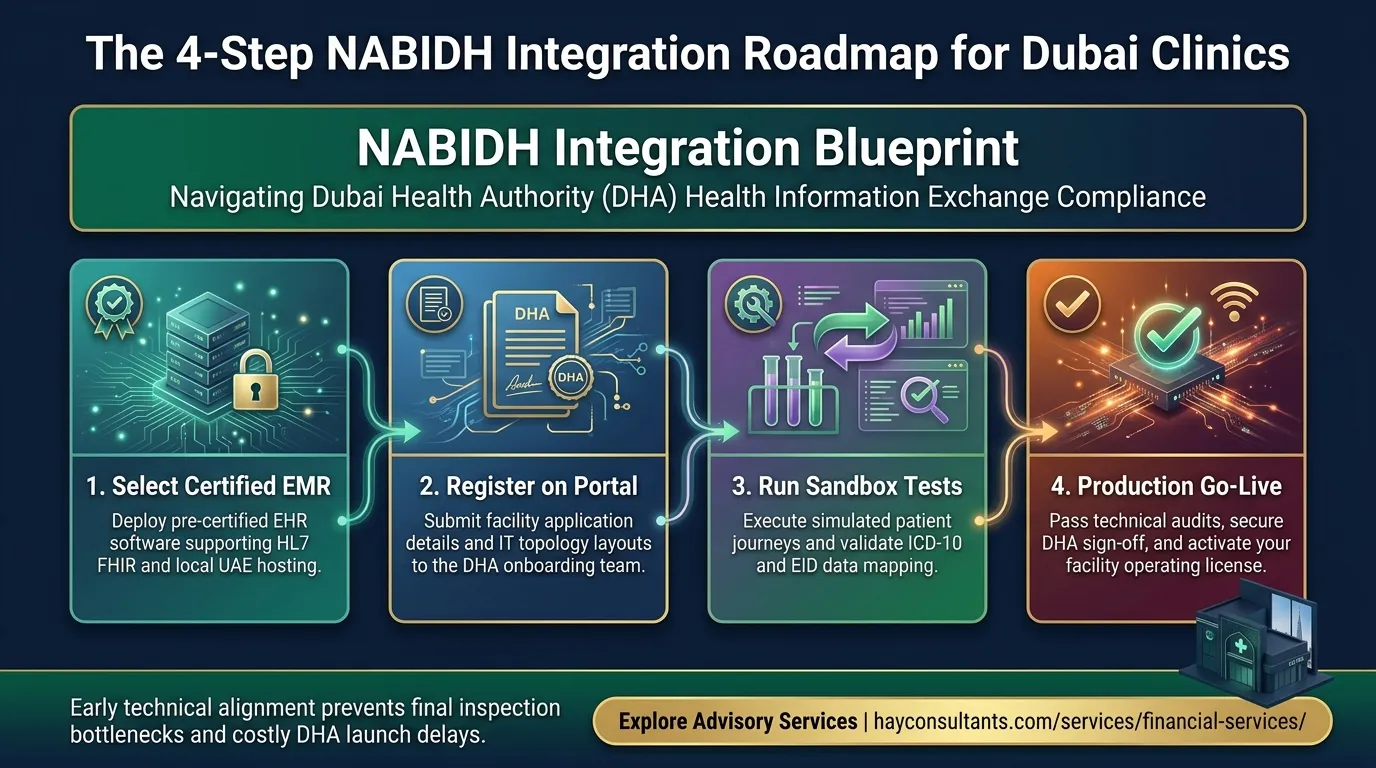
Data messaging with HL7 FHIR
HL7 FHIR (Fast Healthcare Interoperability Resources) is a modern standard for exchanging health data through web APIs. Instead of uploading files manually, your EMR sends structured messages automatically when clinical events happen, such as a signed consultation note.
Ask your vendor how their system sends data, how quickly, and how rejected messages are reported back to your team.
Emirates ID as the patient identifier
NABIDH relies on the patient’s Emirates ID to match records correctly.
- Put smart card readers at your reception desks.
- Avoid manual typing of names and ID numbers where you can. Typing errors create duplicate or mismatched records.
- Make sure your EMR reads the card and stores the details accurately.
Clinical coding standards
Structured, coded data is easier to validate than free-text notes. Expect your clinical workflow to use standard code sets, including:
- Diagnoses: ICD-10 coding.
- Procedures and services: CPT codes mapped to your service list.
- Medications: Alignment with the DHA’s medication reference data.
Good coding helps your NABIDH submissions and also supports clean insurance claims later.
How do you achieve NABIDH compliance? A six-step guide
Short answer: Select a suitable EMR vendor, register on the DHA onboarding process, map your clinical data, pass sandbox testing, move to production with DHA verification, and then monitor your data connection continuously.
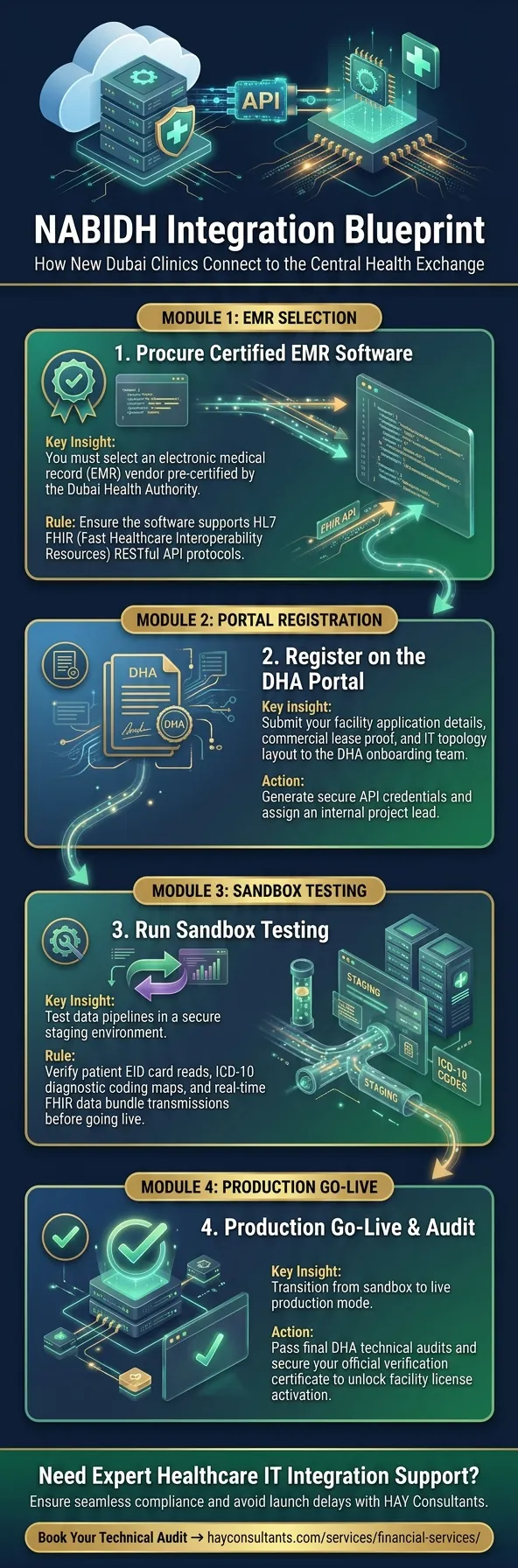
Step 1: Select a DHA-recognized EMR
Avoid building custom software unless you have strong local compliance resources. Choose an established vendor with a track record of NABIDH connections in Dubai, and ask for references from clinics similar to yours.
Step 2: Register on the DHA onboarding portal
Once your trade name and premises are in place, start the facility’s NABIDH onboarding with the DHA.
- Name an internal project lead, such as your medical director or operations manager.
- Have your DHA facility application details ready.
- Share your vendor’s details so facility credentials can be set up.
Step 3: Map your clinical data
Before test data goes anywhere, your clinical team and vendor should map your service list to the required code sets and reconcile your medication list against the DHA’s reference data. Unmapped items are a common cause of rejected messages.
Step 4: Complete sandbox testing
Your vendor connects to the DHA’s test environment, known as the sandbox. You then run simulated patient journeys, for example:
- Registering a patient using Emirates ID data.
- Recording a consultation with a coded diagnosis.
- Issuing a prescription and a lab order.
- Confirming that messages are accepted without errors.
Step 5: Move to production and get verified
After the DHA confirms your tests, your system moves to the live environment. The DHA’s verification supports your final facility inspection and license activation.
Step 6: Monitor continuously
NABIDH connection is an ongoing duty, not a one-time project.
- Choose an EMR with a dashboard that shows failed or rejected messages.
- Assign someone to review errors regularly and fix coding problems promptly.
- Keep your records and connection in good order, since licensing renewals and audits can look at them.
How does NABIDH fit with UAE data protection rules?
Short answer: NABIDH operates alongside federal health data rules, including the ICT Health Law (Federal Law No. 2 of 2019), and wider UAE data protection requirements. Your EMR vendor must handle patient data in line with these rules, including where it is stored and who can access it.
Data protection should be planned alongside interoperability.
Data residency
The ICT Health Law restricts storing and transferring health data outside the UAE, with limited exceptions. Ask your EMR vendor where data is hosted and how cross-border access is controlled. Get the answer in your contract.
Role-based access control
Even with NABIDH sharing data across Dubai, your own system should limit who can see what.
- Clinical staff: Access to the clinical records they need to treat patients.
- Administrative staff: Access limited to demographics and insurance details.
- Audit trails: Logs that record who viewed or edited each patient record.
Have your legal adviser confirm how these laws apply to your specific facility, since requirements can change.
What does NABIDH integration cost?
Costs vary widely by vendor and clinic size, so we do not give a single figure here. When you budget, ask vendors to quote separately for:
- Monthly or annual EMR subscription, usually priced per clinician or per user.
- One-time onboarding and integration fees.
- Emirates ID card readers for reception.
- Data mapping and setup support.
- Network hardware, security and backups.
Choosing a vendor that already connects other Dubai clinics to NABIDH usually reduces setup work. Add these lines to your startup budget alongside fit-out and equipment. If you plan to finance equipment, see our guide to medical equipment financing for UAE clinics.
Frequently asked questions
Is NABIDH integration mandatory for new clinics in Dubai?
Yes, DHA-licensed facilities are expected to connect to NABIDH, and it forms part of the licensing process. Confirm current requirements for your facility type directly with the DHA.
How long does NABIDH integration take?
It depends on your vendor’s readiness, how quickly your data is mapped, and how fast sandbox testing is completed. Ask your vendor for a realistic schedule and start well before your planned inspection date.
What happens if my clinic is not connected before inspection?
Your final license activation can be delayed until the connection is verified. That can stop you from opening, treating patients or billing insurers.
Can we use an international EMR that is not used in Dubai?
It may be possible, but the vendor must support DHA integration requirements, FHIR messaging, UAE data hosting and the DHA testing process. Custom development can add cost and time, so compare it against a locally proven option.
What patient data is sent to NABIDH?
Facilities share clinical data such as demographics, diagnoses, procedures, prescriptions and lab results. The exact data sets are defined by the DHA, so confirm them with your vendor.
Next steps
Planning your health IT early prevents bottlenecks during your final DHA inspection. Compliance also protects the value of your business later, since buyers review it in due diligence. See how DHA licensing and NABIDH compliance affect healthcare enterprise value.
Ready to plan your facility launch? Schedule a consultation with HAY Consultants or review our financial consulting services.