

Dubai is one of the most attractive places in the region to open a clinic, specialty center or polyclinic. Mandatory health insurance, a growing population and a strong medical tourism profile all support demand. The route to opening day is demanding, though. Founders deal with several government bodies, strict architectural standards and technical compliance rules, and one misstep in a lease, a layout drawing or an EMR choice can add months and burn capital.
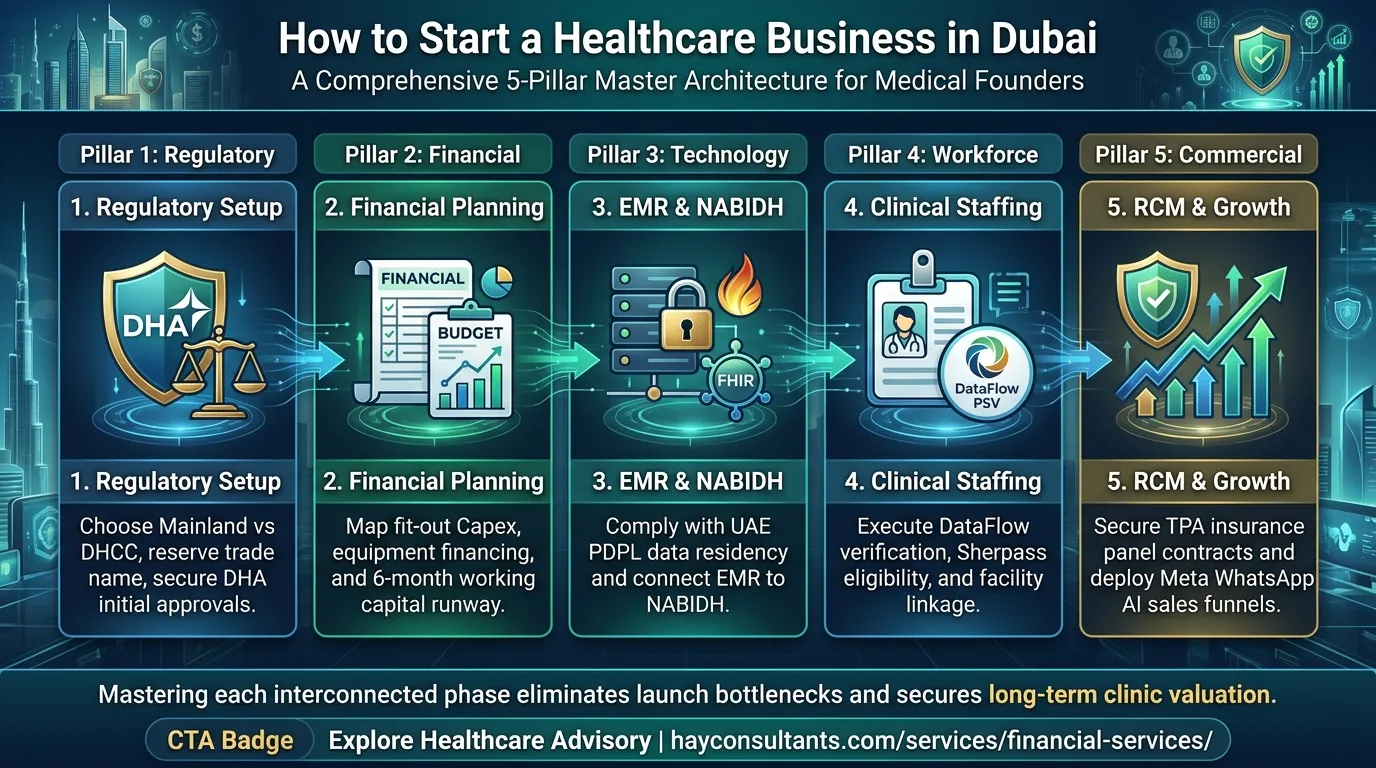
This guide gives healthcare founders and investors a practical roadmap for starting, funding, equipping, staffing and growing a medical business in Dubai. It covers five areas, each linked to a deeper guide: regulatory licensing, financial planning, technology and data compliance, workforce, and commercial strategy.
What does it take to start a healthcare business in Dubai?
Short answer: You choose a jurisdiction (Mainland or a free zone such as Dubai Healthcare City), secure a Dubai Health Authority (DHA) facility license, complete a compliant fit-out, license your clinical staff, connect your EMR to NABIDH, and set up insurance billing and patient acquisition so the clinic can earn revenue once it opens.
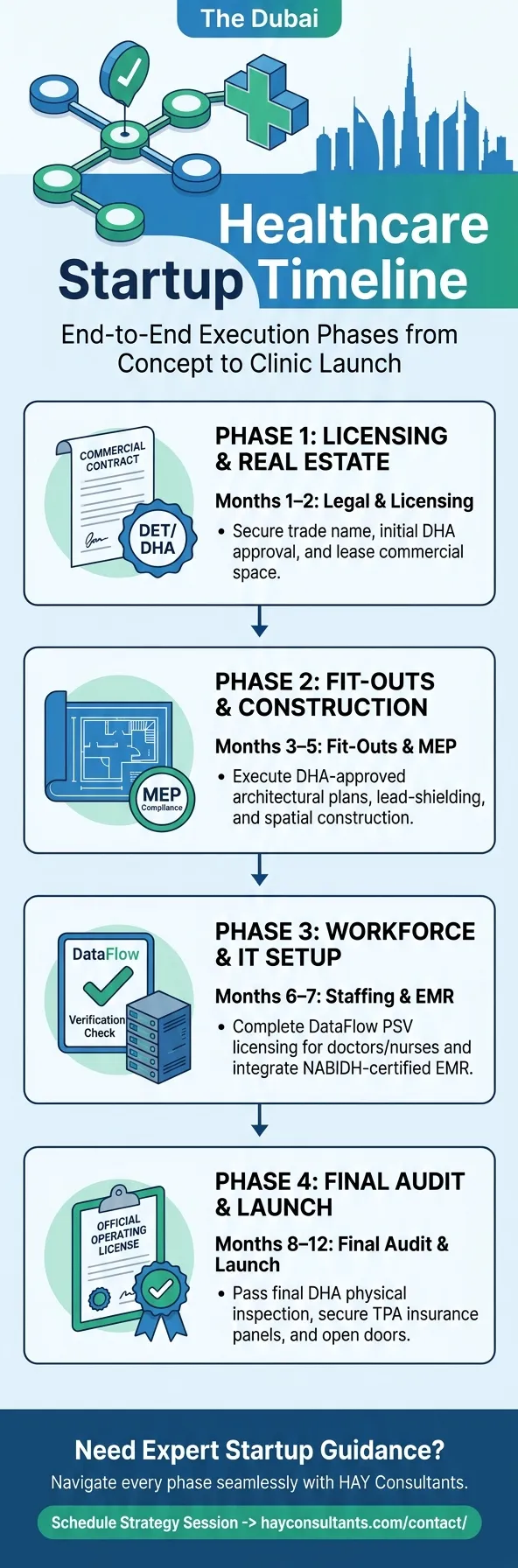
The full journey is commonly estimated at six to twelve months. The range depends on the size of the facility, the complexity of the space and how quickly approvals and inspections move. Treat the durations below as planning estimates and confirm them against current regulator guidance.
| Phase | Core focus | Governing body or platform | Indicative duration |
|---|---|---|---|
| 1 | Jurisdiction, trade name and initial approval | DET or DHCC, and the DHA licensing portal | 4 to 8 weeks |
| 2 | Commercial lease and architectural drawings | Approved MEP consultants and DHA engineering review | 6 to 12 weeks |
| 3 | Construction, fit-out and equipment | Contractors and DHA physical inspection | 12 to 16 weeks |
| 4 | Workforce credentialing and licensing | DataFlow and the DHA professional licensing process | 8 to 12 weeks, run in parallel |
| 5 | IT integration, NABIDH and final launch | EMR vendor and DHA final audit | 2 to 4 weeks |
Phase 4 overlaps with the others, which is why starting staff verification early shortens the critical path.
Pillar 1: How do licensing and government approvals work?
Short answer: Reserve a trade name, obtain DHA initial approval, get your architectural and MEP drawings approved, build the facility, and pass the DHA physical inspection to receive the operating license.
Mainland Dubai or a free zone?
Mainland Dubai companies are registered through the Department of Economy and Tourism (DET) with clinical oversight from the DHA.
- Patient reach: You can serve patients across the emirate and open branches wherever suitable premises exist.
- Location freedom: Facilities can sit in busy commercial corridors, shopping centers or residential areas, subject to DHA space requirements.
- Ownership: UAE commercial company reforms allow 100% foreign ownership for many activities. Confirm the position for your specific medical activity before structuring the entity.
Free zones such as Dubai Healthcare City (DHCC) offer a dedicated healthcare district.
- Clustered ecosystem: Hospitals, specialist centers, diagnostic labs and research organizations operate in the same district.
- Regulation: Facilities are overseen by the Dubai Healthcare City Authority, which maintains its own clinical standards.
- Scope: Licensing terms and permitted activities differ from Mainland, so check what your intended services allow.
Our guide to DHCC vs Mainland clinic setup in Dubai compares the two in detail.
The licensing lifecycle in four steps
- Trade name reservation: Reserve the legal name through DET or the relevant free zone authority.
- DHA initial approval: Submit ownership details, executive CVs and the proposed scope of services through the DHA’s online licensing system.
- Architectural and MEP approval: Submit mechanical, electrical and plumbing drawings prepared by qualified consultants. Layouts must meet DHA requirements for areas such as sterilization, waste handling, patient privacy and emergency access.
- Inspection and operating license: After construction, DHA inspectors audit the facility before the final operating license is issued.
For the full sequence with documents and common delays, read our step-by-step DHA facility license guide.
Pillar 2: How should you plan the budget and capital?
Short answer: Budget for four cost areas: licensing and pre-opening fees, premises and fit-out, medical equipment, and a working capital reserve. A common planning range is AED 500,000 to AED 3,000,000 or more, depending on specialty and scale.
A realistic budget stops a project running out of cash halfway through construction.
- Premises and lease: Rent varies widely by district, and landlords usually ask for the annual rent in a small number of cheques.
- Fit-out and MEP: Medical space costs more to build than office space because of requirements such as radiation shielding, medical gas piping, air exchange and specialist flooring.
- Equipment: Imaging units, dental chairs and surgical equipment can be bought outright or financed.
- Working capital: Keep a reserve to cover salaries, rent, utilities and marketing while early insurance claims are still being processed. Many founders plan for around six months of operating costs.
Banks and lenders typically look at the medical director’s credentials, the feasibility study and projected cash flow. Our guides on clinic startup costs in Dubai and medical equipment financing and bank loans for UAE clinics go into the numbers. If you are thinking about the eventual value of the business you are building, see how to value a medical clinic in Dubai.
Pillar 3: What are the EMR, NABIDH and data requirements?
Short answer: Licensed facilities in Dubai must connect their Electronic Medical Record (EMR) system to NABIDH, the DHA’s health information exchange, and handle patient data in line with UAE data protection and health data rules. Choose a NABIDH-compatible EMR before you reach the final inspection.
NABIDH connects patient records from participating providers across Dubai. Your EMR should be able to share encounter data, diagnoses, lab results and prescriptions through the integration the DHA specifies, so confirm the technical requirements with your vendor early rather than at the audit stage.
Clinics also handle sensitive personal and health information. Before you collect any patient data, confirm with your legal or compliance adviser how the UAE Personal Data Protection Law (PDPL) and DHA health data requirements apply to:
- Where records are hosted: Health data rules can restrict storage and transfer outside the UAE.
- Consent: Patients should give clear consent for treatment, billing and any marketing communications.
- Access control: Define who in your team can see which records.
Our NABIDH compliance guide for new healthcare facilities in Dubai explains the integration steps and common audit issues.
Pillar 4: How do you hire and license clinical staff?
Short answer: Every doctor, nurse and allied health professional needs an active DHA professional license before practicing. The process runs through primary source verification, a DHA eligibility decision, and linking the professional to your facility.
- Primary source verification: Candidates submit degrees, experience letters, home-country licenses and good standing certificates to DataFlow, which verifies them with the issuing institutions.
- DHA eligibility: After verification, and any required exam or exemption review, the candidate receives an eligibility decision from the DHA.
- Facility linkage: Your clinic links the candidate to its DHA facility account, provides the required professional liability cover and completes activation to issue the license.
Start this in parallel with fit-out. Verification can take weeks, and your clinic cannot open without licensed clinicians. Make sure employment contracts follow UAE labor law, including any restrictive covenants, which should be reasonable and enforceable. Our DHA professional license guide for doctors and nurses covers the portal steps.
Pillar 5: How do you build revenue through insurance and patient acquisition?
Short answer: Apply for insurance network listings early and build a billing process that keeps claim rejections low. Then give patients a fast way to reach you, such as WhatsApp.
Insurance panels and claims
With mandatory health insurance in Dubai, being listed on the networks of major insurers and Third-Party Administrators (TPAs) such as Daman, NextCare, NAS and others affects how many insured patients you can see. Panel applications take time, so begin them before opening.
Insurers can take a long time to settle claims, often well beyond the date of treatment. Clean claim submission, coding checks inside your EMR and tracking of rejections protect your cash flow. See our guide to insurance panel accreditation and RCM for new clinics.
Digital patient acquisition
Patients often message several clinics and book with the first useful reply. Many Dubai clinics now run Meta Click-to-WhatsApp ads that open a chat instead of a web form, and use an AI booking agent connected to the WhatsApp Business Platform and the EMR calendar to reply quickly, ask a few qualifying questions and offer open slots. Staff handle anything that needs human judgment. Read more in our guide to scaling patient acquisition with Click-to-WhatsApp ads and AI booking.
Essential guides for your healthcare startup journey
Each guide below goes deeper on one part of the launch.
Regulatory licensing and approvals
Financial setup and capital planning
- Cost to start a medical clinic in Dubai
- Medical equipment financing and bank loans for UAE clinics
- How to value a medical clinic in Dubai
EMR, NABIDH and data compliance
Workforce and credentialing
Commercial strategy and patient acquisition
- Insurance panel accreditation and RCM for new clinics
- Click-to-WhatsApp ads and AI booking for Dubai clinics
Frequently asked questions
Can a foreign investor own 100% of a medical clinic in Mainland Dubai?
In many cases, yes. UAE commercial company reforms allow full foreign ownership for a wide range of activities, including many healthcare activities. Requirements vary by activity, so confirm with DET and the DHA before finalizing your structure.
How much does it cost to open a medical clinic in Dubai?
A common planning range is AED 500,000 to AED 3,000,000 or more. A small specialist clinic sits at the lower end, while multi-specialty centers and surgical facilities cost considerably more. The total depends on specialty, location, fit-out and equipment, so confirm it against real quotations. See our startup cost breakdown.
How long does the DHA licensing process take?
The full journey from planning to opening is commonly estimated at six to twelve months. Site selection, drawing approval iterations and construction quality are the biggest variables.
Is NABIDH integration mandatory for new clinics?
Yes. Licensed facilities in Dubai are expected to connect their EMR to NABIDH, so choose a compatible system before the final inspection. Confirm the current requirements with the DHA.
What is the difference between opening in Mainland Dubai and DHCC?
Mainland clinics are registered through DET and overseen by the DHA, and can serve and open branches across the emirate. DHCC clinics operate inside a dedicated healthcare free zone governed by the DHCC Authority, within a cluster of other providers.
Next steps
Starting a healthcare business in Dubai means running several workstreams at once: legal structure, approvals, budget, technology, staffing and revenue. Coordinating them early is what keeps an opening date realistic.
If you are planning a clinic or medical center, explore HAY Consultants’ healthcare business setup and advisory services or contact the team to discuss your project.