

Cash-pay aesthetic and wellness services can carry attractive margins, but most general practice, pediatric, dental and multi-specialty clinics in Dubai depend on insured patients for volume. Without approval from the insurers and Third-Party Administrators (TPAs) your target patients use, those patients simply go elsewhere.
Getting listed is only half the job. Once you treat insured patients, your cash flow depends on how well you run Revenue Cycle Management (RCM): eligibility checks, coding, claims submission and denial follow-up. This guide covers how to prepare for panel applications, approach tariff negotiations and build an RCM workflow that protects working capital from the first claim. For the licensing steps that come first, see our DHA facility license guide. For commercial and financial planning, HAY Consultants provides healthcare financial consulting services for UAE medical founders. Panels and RCM are the commercial pillar of our wider guide to how to start a healthcare business in Dubai.
What is insurance panel accreditation and RCM?
Short answer: Insurance panel accreditation is the process of getting your clinic approved by insurers and TPAs so insured patients can use their cover at your facility. Revenue Cycle Management is the end-to-end process that follows the patient from scheduling and eligibility verification through coding, claim submission, adjudication and final payment.
- Why panel access matters: Health insurance is mandatory in Dubai, so a large share of residents and employees hold cover. A clinic outside the relevant networks limits who can use it without paying in full.
- Why RCM matters: Insurers pay after the visit, not at it. Weak front-end checks and documentation turn into rejected claims and delayed cash.
- Why payer mix matters: Balancing insurance volume with higher-margin cash-pay services steadies working capital and cushions payment delays.
Step 1: How do you prepare your clinic for TPA and insurer applications?
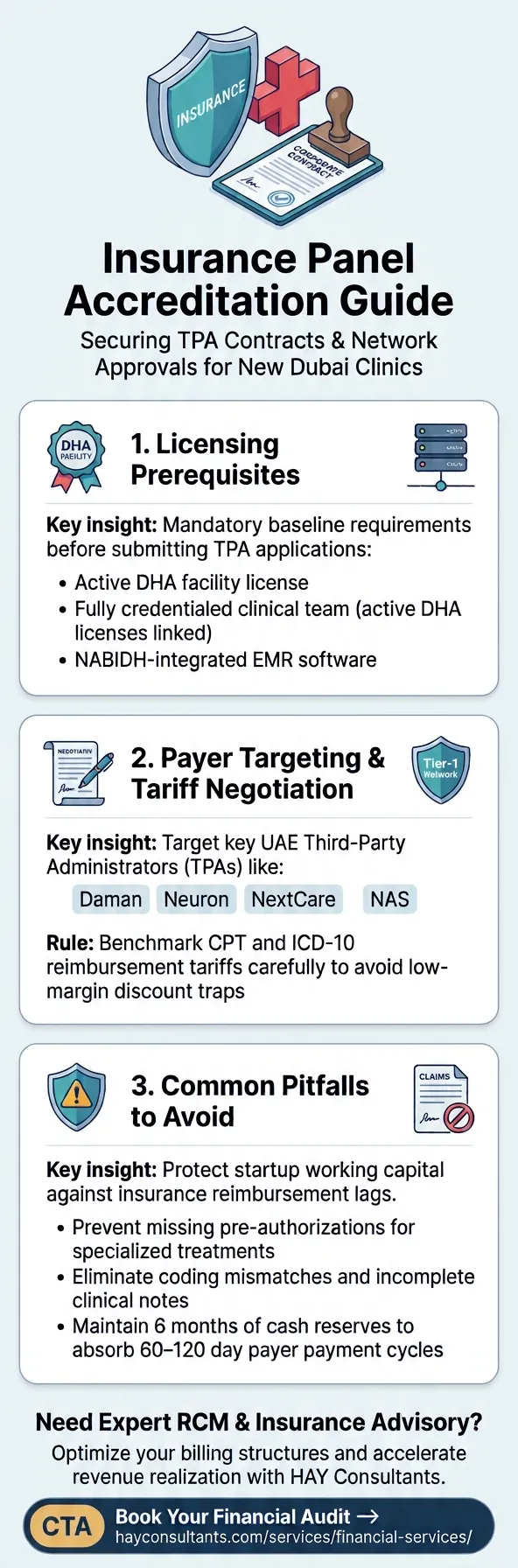
Short answer: Have your facility license, licensed clinical team and integrated EMR in place before you apply. Payers and TPAs check these during credentialing, and gaps are a common reason applications stall. Confirm each payer’s current requirements directly.
Pre-application checklist
- Active facility licensing: A valid Dubai Health Authority (DHA) facility license and commercial trade license.
- Credentialed clinical staff: Every doctor, nurse and allied health professional holds an active DHA professional license linked to your facility. Our DHA professional license guide walks through that workflow.
- EMR and health data integration: A working EMR connected to NABIDH, Dubai’s health information exchange. See our NABIDH compliance guide.
Which payers should you approach first?
Rather than applying everywhere at once, prioritize the networks that match your location and specialty. Examples of payers and TPAs active in the UAE include:
- Daman: A major insurer, often relevant for corporate and government-linked employee cover.
- Neuron, NextCare and NAS: TPAs administering a range of commercial insurance portfolios.
- International and regional insurers: Relevant if you target expatriate communities in areas such as Jumeirah, Downtown or Dubai Marina.
Ask each payer for its current provider application requirements and network needs, since these change and not every payer is open to new providers in every area.
Step 2: How do you approach tariff negotiations and payer contracts?
Short answer: Tariffs set your margin on every consultation, test and procedure. Model your true cost of service first, then negotiate fee schedules against that cost rather than accepting a headline discount.
Understand fee schedules and coding
- CPT and ICD-10 mapping: Reimbursement relies on standardized codes for procedures (CPT) and diagnoses (ICD-10). Your clinical and billing teams must map services consistently.
- Discount structures: Some payers propose fee schedules as a percentage discount on your cash price list. Others use their own tariff. Check which applies before you compare offers.
Avoid low-margin traps
A discount that looks small can still fail to cover doctor remuneration, consumables and overhead. Before signing:
- Calculate the contribution margin per high-volume service at the proposed tariff.
- Check which services need pre-authorization and which are excluded.
- Review payment terms, rejection and appeal windows, and any volume expectations.
- Have a lawyer review the agreement.
Step 3: How do you build an RCM workflow that protects cash flow?
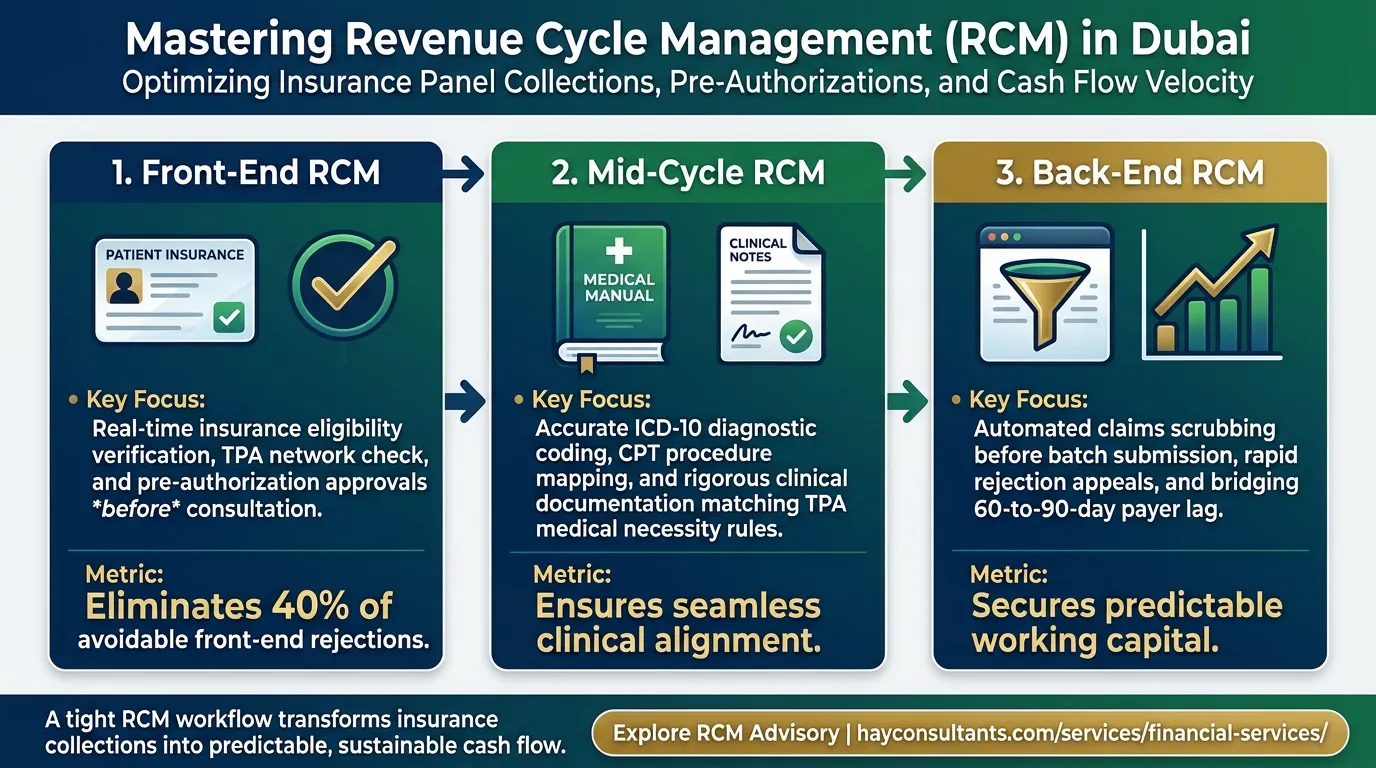
Short answer: Split RCM into three phases and assign an owner to each: front-end (eligibility and pre-authorization), mid-cycle (documentation and coding) and back-end (claims scrubbing and denial management). Most avoidable rejections can be traced to one of these three.
Phase 1: Front-end RCM
- Verify eligibility and coverage details, including co-pay and deductible, before the patient consults.
- Obtain pre-authorization for procedures, advanced diagnostics and other services the payer requires it for.
- Confirm network status so you do not treat patients under plans you are not contracted for.
Phase 2: Mid-cycle RCM
- Document clearly: Clinical notes should support every billed ICD-10 diagnosis and CPT procedure.
- Prove medical necessity: Payers reject claims where the record does not justify the treatment or medication.
- Train clinicians and coders together so the clinical record and the claim say the same thing.
Phase 3: Back-end RCM
- Scrub claims with billing software to catch missing data, coding errors and formatting problems before submission.
- Run a denial workflow: Log each rejection by reason, correct it and resubmit within the payer’s appeal window.
- Track outcomes such as rejection rate and days to payment, and review them monthly.
How long does panel accreditation take and what should you budget?
Short answer: Plan for roughly three to four months from application to live billing, with stages running in parallel where possible. These are planning estimates only. Actual timing depends on each payer’s committee cycle and how quickly you respond.
| Stage | Planning estimate | Main dependency |
|---|---|---|
| Facility licensing and EMR setup | Completed first | Active DHA license and NABIDH integration |
| Payer application and review | 4 to 8 weeks | Corporate documents and provider profiles |
| Tariff negotiation and contracting | 2 to 4 weeks | Agreeing fee schedules and network terms |
| System integration and testing | 2 to 3 weeks | Electronic claim testing between your EMR and the payer |
| Total | About 3 to 4 months | Parallel execution shortens the timeline |
Budget for the gap between treating patients and getting paid. Payers can take weeks or months to settle claims, so your launch plan needs enough working capital to cover salaries, rent and overhead meanwhile. Our cost to start a medical clinic in Dubai guide shows how that cash buffer fits into a wider launch budget. If you are weighing finance options, read our medical equipment financing guide.
Frequently asked questions
How long does it take a new Dubai clinic to get approved on insurance panels?
Many clinics plan for about three to four months after facility licensing, depending on each payer’s review cycle and how quickly the clinic supplies documents and agrees terms.
Can a new clinic operate without insurance panels?
It is possible for boutique aesthetic or wellness clinics that serve self-paying patients. General practice, pediatric, dental and multi-specialty clinics usually rely on insurance panels for sufficient patient volume.
What causes most claim rejections for new clinics?
Common causes include missing pre-authorization, mismatched ICD-10 codes, incomplete clinical notes and patients whose cover was not valid at the time of service.
How does insurance payment delay affect a startup clinic’s cash flow?
Payers settle claims after adjudication, often weeks or months after the visit. Clinics need working capital to cover doctor pay, rent and overhead during that gap, so model it in your launch budget.
Should we apply to every TPA at once?
Usually not. Start with the payers that cover your target patients in your area and specialty, then expand once your claims process is running smoothly.
Next steps
Panel approvals turn clinical capacity into insured patient volume, and a disciplined RCM process turns that volume into predictable cash. Without specialist support, tariff negotiations and claims workflows can leave a new clinic short of cash for months.
If you want help with your billing structure, payer strategy or launch budget, schedule a consultation with HAY Consultants or review our healthcare financial consulting services.