
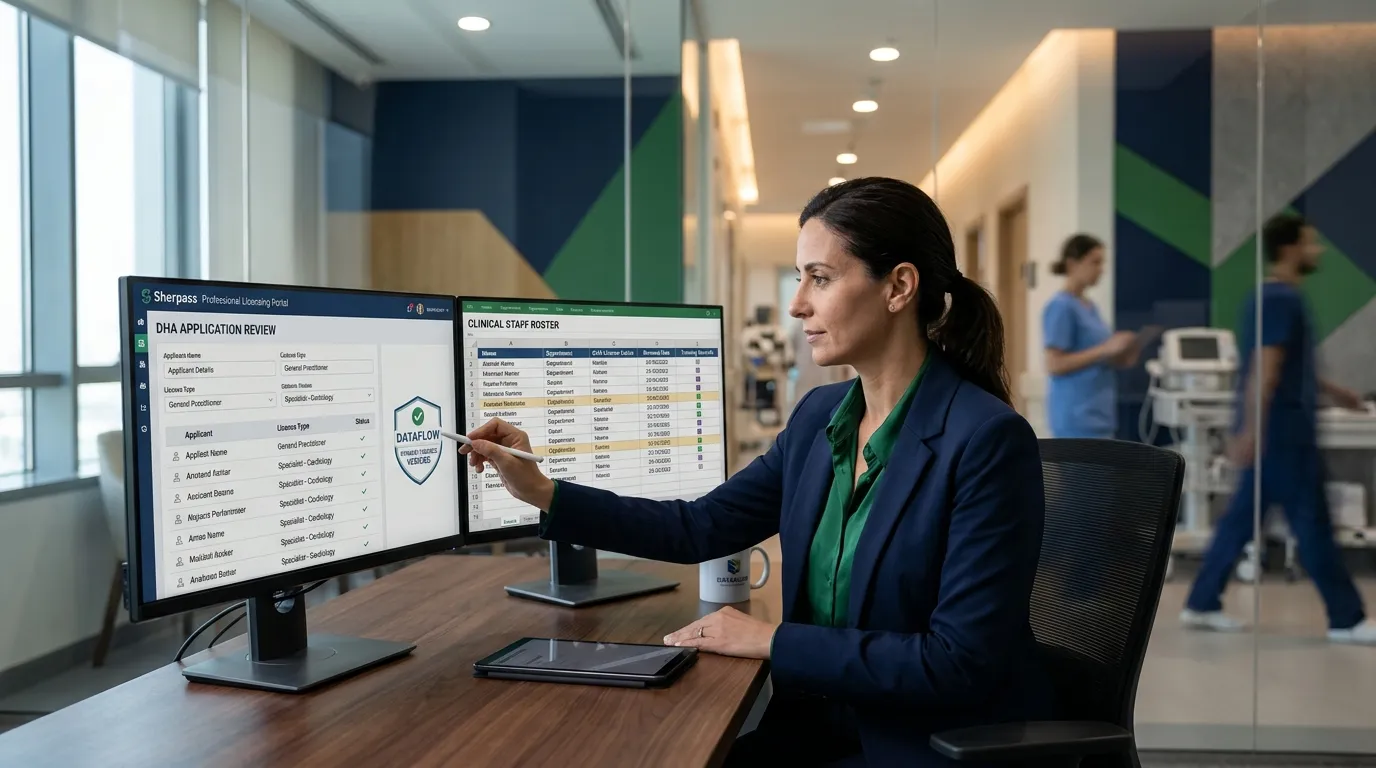
A Dubai clinic can have its premises, equipment and facility license in place and still be unable to see patients. The missing piece is often people: every doctor, nurse and allied health professional needs their own professional license from the Dubai Health Authority (DHA) before treating anyone.
This guide walks clinic owners and HR leads through the individual licensing workflow: DataFlow verification, the Sherpass portal, the eligibility letter and linking the clinician to your facility. For the facility side, read our DHA facility license guide. To plan the commercial side of your launch, HAY Consultants provides healthcare financial consulting services for UAE medical founders. Staffing runs in parallel with the rest of the launch, as set out in our guide to how to start a healthcare business in Dubai.
What is the DHA professional licensing process and why does it matter?
Short answer: It is the regulatory pathway every physician, nurse, dentist and allied health professional must complete to practice in Dubai. It runs through the DHA’s Sherpass portal and typically involves primary source verification (DataFlow), a credential review, an eligibility letter, and activation of the license against a licensed facility. Confirm the current requirements for each candidate with the DHA.
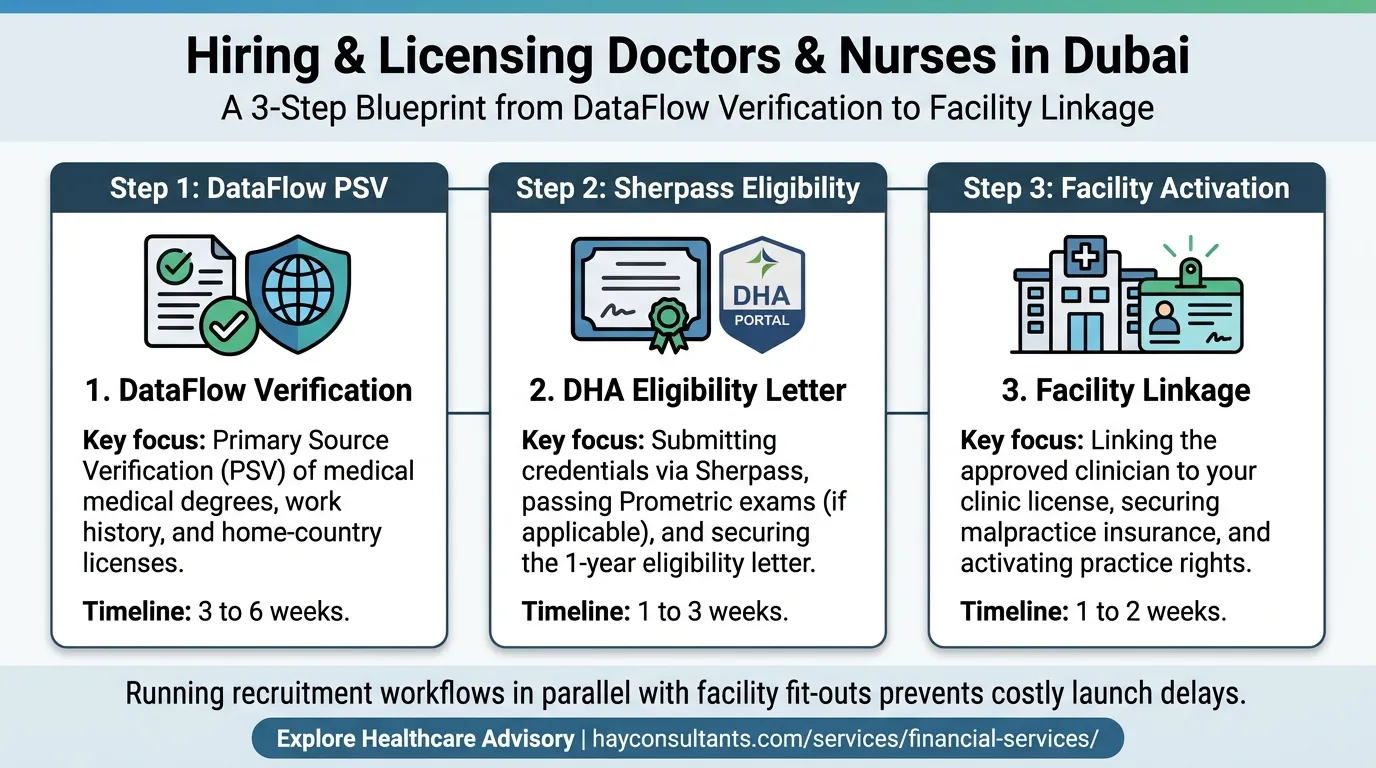
The sequence for most candidates looks like this:
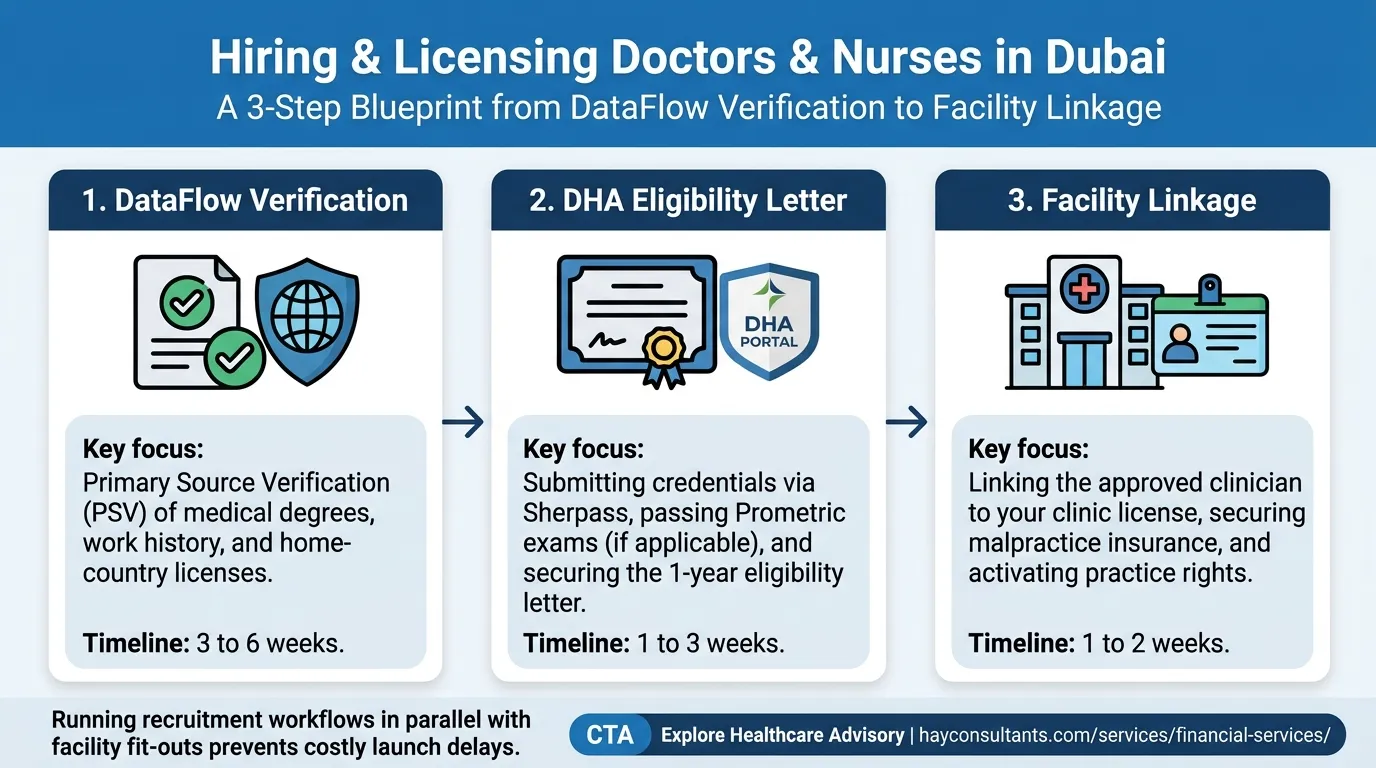
- Candidate submits documents for DataFlow primary source verification.
- Candidate applies for eligibility through Sherpass.
- DHA reviews the file and, where required, the candidate sits an exam or assessment.
- DHA issues an eligibility letter.
- A licensed facility links the clinician and the license is activated.
What is at stake if you get it wrong
Allowing clinicians to practice before they are properly licensed creates serious exposure for the clinic and the individual:
- Regulatory action: The DHA can fine facilities and take action against licenses where unlicensed practice is found. Check the DHA’s current enforcement policy for specifics.
- Legal liability: Practicing medicine without a license is a legal offense in the UAE and can expose clinic leadership as well as the practitioner. Take legal advice on your own position.
- Launch delays: Unlicensed staff can hold up final inspection and insurer panel access, while rent and payroll keep running. Our cost to start a medical clinic in Dubai guide explains why that burn matters.
Who needs a DHA professional license?
Short answer: Anyone providing clinical care in a DHA-licensed facility, including doctors, nurses, midwives, dentists, pharmacists and allied health staff such as physiotherapists, radiographers and lab technicians. The DHA sets qualification and experience requirements by profession and grade.
Requirements differ by category, so ask the DHA or your adviser to confirm the grade a candidate qualifies for before you make an offer. As a general planning guide:
| Category | What the DHA typically looks at |
|---|---|
| General practitioners | Recognized medical degree, internship and post-internship clinical experience |
| Specialists and consultants | Recognized postgraduate qualification or board certification and relevant specialty practice |
| Registered nurses and midwives | Recognized nursing degree or diploma and documented clinical experience |
| Allied health professionals | Recognized qualification in the field and, usually, a home-country license and experience |
Minimum experience years and accepted qualifications are set in the DHA’s professional qualification requirements and can change. Do not rely on a summary table when making a hiring decision. Check the current rules for the specific profession.
Step 1: How does DataFlow primary source verification work?
Short answer: DataFlow is the independent verification provider used for DHA licensing. It checks a candidate’s qualifications, work history and licenses directly with the issuing universities, employers and regulators, rather than relying on copies the candidate supplies.
Verification generally covers:
- Education: Degrees, diplomas and specialty certificates.
- Employment: Dates, roles and clinical practice with previous employers.
- Licenses: Current or previous professional licenses held in other countries.
- Good standing: A certificate from the relevant regulator confirming there are no disciplinary issues, where required.
Documents to prepare early
Missing or unclear documents are a common cause of delay. Candidates should usually have ready:
- Passport copy.
- Degrees and transcripts.
- Experience letters covering the required period.
- Home-country license.
- Good standing certificate (check how recent it must be).
- Surgical or procedural logbooks, where relevant to the specialty.
- An up-to-date CV in chronological order.
Ask DataFlow or the DHA for the current document checklist for the candidate’s profession and country, since requirements vary.
Step 2: How do you get the DHA eligibility letter through Sherpass?
Short answer: The candidate creates a Sherpass account, submits their application and verification results, and the DHA assesses the file. If it is satisfied, it issues an eligibility letter confirming the professional can proceed to licensing once linked to a facility.
The eligibility letter is not the practicing license. It shows the candidate has met the DHA’s requirements and is pre-approved. Candidates then need an employer, and the DHA sets how long the letter remains valid. Confirm the current validity period when you plan your recruitment.
Exam, exemption or assessment
Depending on profession, qualification and country of training, a candidate may follow one of these routes:
- Exam exemption: Some candidates with qualifications from recognized jurisdictions may be exempt from the exam and are assessed on their documents.
- Prometric exam: Others must pass the DHA licensing exam, which is delivered through Prometric testing centers.
- Further assessment: The DHA may ask for additional assessment in some cases.
Which route applies is decided by the DHA, not by the clinic. Ask the candidate to check their route early, because exam scheduling can add weeks to the timeline.
Step 3: How do you link a clinician to your facility and activate the license?
Short answer: Once a candidate holds an eligibility letter, your facility submits a request through its Sherpass account, supplies the employment and insurance documents the DHA asks for, pays the fees, and the DHA activates the license against your facility.
A typical flow for your HR administrator:
- Raise the request: Log in to the facility’s Sherpass account and start the process to link the professional.
- Upload documents: Signed offer or contract, proof of professional liability cover, and any other documents requested.
- Pay fees: Settle the licensing fees shown in the portal.
- Receive the license: The DHA issues the professional license showing your facility as the practice location.
Visa and Emirates ID processing run alongside this for candidates relocating to the UAE, so plan them together with your PRO.
Protect your recruitment investment
Recruitment, verification and licensing take time and money. Before the clinician starts:
- Employment contract: Align it with UAE labor law. If you want non-compete or non-solicitation terms, have a lawyer draft them to be enforceable.
- Malpractice cover: Put professional liability insurance in place before the first patient consultation.
- Records: Keep copies of each license, eligibility letter and renewal date in a central file. Buyers and investors look at this in due diligence, as we explain in how DHA licensing affects healthcare enterprise value.
How long does the whole process take?
Short answer: Planning for roughly two to three months from document gathering to license activation is a sensible working assumption, but timing varies with candidate, country and how quickly institutions respond. Treat these figures as planning estimates, not DHA commitments.
| Stage | Planning estimate | Main dependency |
|---|---|---|
| Document gathering | 1 to 2 weeks | Obtaining good standing and experience letters |
| DataFlow verification | 3 to 6 weeks | Speed of universities, employers and regulators |
| Sherpass eligibility review | 1 to 3 weeks | DHA review and exam scheduling, if required |
| Facility linkage and activation | 1 to 2 weeks | Active facility license and insurance in place |
The practical lesson is to run recruitment in parallel with your fit-out. Start verification for key hires while the premises are being built, so your team is ready for inspection. Also add recruitment, verification and licensing fees to your launch budget. See our medical equipment financing guide for the equipment side of that plan, and our NABIDH compliance guide for the health IT step that also sits on the critical path.
Frequently asked questions
Can a doctor practice in Dubai on a home-country license while waiting for DHA approval?
No. A clinician needs a DHA license, or a permit the DHA has specifically issued, before practicing in Dubai. Allowing otherwise exposes both the clinician and the facility to penalties.
What is DataFlow and why is it required?
DataFlow is the primary source verification provider used in DHA licensing. It confirms degrees, experience and licenses directly with the issuing bodies, which reduces the risk of credential fraud.
How long does it take to license a doctor or nurse in Dubai?
Many clinics plan for two to three months end to end. The biggest variables are how quickly institutions respond to DataFlow and whether the candidate needs to sit an exam.
Can a professional license move to another clinic if the clinician changes jobs?
Generally yes, a clinician can be licensed to a new facility, but it requires the DHA’s transfer process through Sherpass, usually including documents from the previous employer. Check the current steps with the DHA before promising a start date.
How long is the eligibility letter valid?
The DHA sets the validity period, and it is limited, so the candidate needs to be linked to a facility within that window. Confirm the current period when you issue an offer.
Next steps
Licensing your clinical team is a project with its own timeline and budget, and delays here hold up the whole launch. Starting verification early and running it in parallel with your fit-out is the simplest way to protect your opening date.
Need help planning your launch budget and workforce timeline? Schedule a consultation with HAY Consultants or review our healthcare financial consulting services.