

Valuing a medical clinic in the UAE requires balancing two distinct factors: medical goodwill and physician dependency. Medical goodwill creates long-term, transferable enterprise value, while physician dependency creates key-person operational risk that lowers what a buyer will pay. This guide from HAY Consultants helps solo practitioners and multi-specialty group practice owners quantify goodwill, calculate key-person risk, and protect enterprise value during practice appraisals, M&A transactions, or equity sales, supported where needed by dedicated healthcare financial consulting services.
1. How Do You Value Medical Goodwill vs. Physician Dependency in UAE Clinics?
Medical goodwill represents the intangible assets owned by the practice itself. These assets include the clinic’s brand equity, active patient panels, strategic location, and insurance contracts. They continue to generate revenue even if individual employees leave.
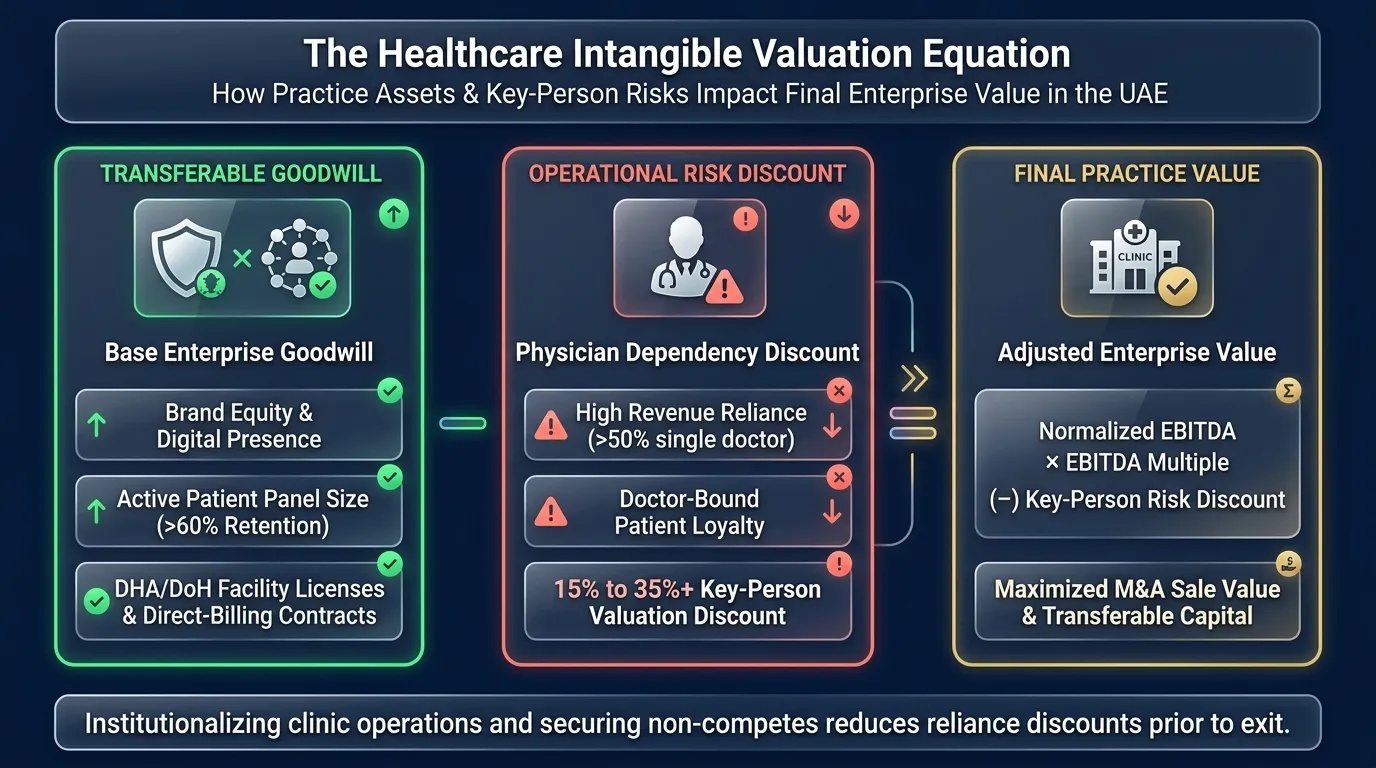
Physician dependency occurs when revenue relies on the personal reputation or skill of a single doctor. If that doctor leaves, patient volume drops. Appraisers must calculate goodwill while deducting a key-person discount to find true market value.
Base Intangibles (Brand, Patient Panel, Insurance Contracts) → Minus Key-Person Risk Discount (15%–35%+) → Transferable Practice Goodwill
2. What Is Medical Goodwill and How Is It Quantified in the UAE Healthcare Market?
Medical goodwill is the financial value of a practice’s non-tangible assets above its physical equipment and real estate. In Dubai and the broader UAE, goodwill relies on four primary components:
- Brand equity. The reputation and digital presence of the clinic name, independent of individual clinicians.
- Active patient panel size. The number of unique patients returning for care annually.
- Insurance payer contracts. Direct-billing network agreements with major UAE insurers.
- Facility accreditations. Active Dubai Health Authority (DHA) or Department of Health – Abu Dhabi (DoH) facility licenses and operational approvals.
Valuation professionals use three distinct methods to calculate these intangible assets in the UAE healthcare market.
Method 1: Capitalization of Excess Earnings Method
This method isolates goodwill by separating returns earned on physical assets from total practice profit, in line with the normalization principles recognized by the International Valuation Standards Council (IVSC).
- Calculate the Fair Market Value (FMV) of all net tangible assets (medical devices, IT, fit-outs).
- Assign a standard rate of return to those physical assets, typically 10% to 12%.
- Subtract this physical return from the clinic’s Normalized EBITDA.
- Capitalize the remaining excess earnings using a capitalization rate to determine goodwill value.
Excess Earnings = Normalized EBITDA − (Net Tangible Assets × Target Return Rate)
Method 2: Multiples of Patient Panel Value
This approach values the active patient database directly. Valuers filter the database for active patients who visited within the past 12 to 24 months and exclude inactive records.
Patient Panel Value = Active Patient Count × Average Annual Revenue per Patient
In the UAE, high-retention specialty panels, such as chronic care, pediatric dentistry, and dermatology, command higher per-patient multipliers due to predictable repeat visits.
Method 3: Patient Retention Rate and Lifetime Value (LTV) Analysis
This method evaluates long-term cash flow predictability based on patient loyalty.
Patient Retention Rate (%) = (Active Returning Patients ÷ Total Unique Patients Treated) × 100
A clinic with an annual patient retention rate above 65% proves that patients return for the clinic’s service, not just a specific doctor. Valuers apply higher cash-flow multiples to practices with strong retention metrics.
3. What Is Physician Dependency and How Does It Create Key-Person Risk?
Physician dependency is the risk tied to key clinical personnel. When a single doctor generates the majority of a clinic’s billings, the business lacks transferable value. If the lead doctor retires or resigns, revenue declines immediately.
The risk profile varies significantly between solo practices and multi-specialty group practices.
| Metric / Factor | Solo Practitioner Practice | Multi-Specialty Group Practice |
|---|---|---|
| Revenue concentration | High (>50% generated by one doctor) | Low (<20% generated per physician) |
| Patient loyalty | Tied to individual practitioner | Tied to clinic brand and facility |
| Operational impact of departure | High risk of revenue collapse | Minimal operational disruption |
| Valuation discount range | 20% to 40% key-person discount | 0% to 10% discount |
Quantifying Key-Person Valuation Discounts
When key-person risk is present, appraisers apply a 15% to 35%+ discount to the clinic’s initial goodwill valuation or EBITDA multiple. For example, if a clinic achieves AED 2,000,000 in Normalized EBITDA and qualifies for a 6x multiple, its base enterprise value is AED 12,000,000. If the lead doctor generates 70% of total revenue, a valuer may apply a 30% key-person discount:
| Calculation Step | Amount (AED) |
|---|---|
| Base enterprise value (Normalized EBITDA × 6x multiple) | 12,000,000 |
| Key-person discount (30%) | −3,600,000 |
| Adjusted enterprise value | 8,400,000 |
For a full walkthrough of how EBITDA multiples are derived before this discount is applied, see our guide on how to value a medical clinic in Dubai.
4. How Can UAE Practice Owners Mitigate Physician Reliance to Protect Practice Value?
Practice owners can actively reduce key-person risk before entering M&A negotiations or exit planning. Implementing strategic risk mitigations preserves enterprise goodwill and protects the final valuation multiple.
Contractual Protections and Restrictive Covenants
Owners must secure clinical talent using structured employment agreements that comply with labor regulations enforced by the UAE Ministry of Human Resources & Emiratisation (MOHRE).
- Non-compete clauses. Restrict departing physicians from opening or joining a competing practice within a reasonable geographic radius for a specific timeframe.
- Non-solicitation agreements. Prevent departing staff from soliciting existing patient databases or clinical team members.
Earn-Outs and Equity Transition Structures
Buyers offset key-person risk by structuring multi-year acquisition payouts.
- Earn-out payments. A portion of the purchase price is held back and paid only if revenue targets are maintained post-sale.
- Phased equity vesting. Retaining selling physicians on multi-year employment contracts with performance bonuses helps ensure smooth patient transition.
Institutionalizing Brand Equity
Shift marketing and operational focus away from individual practitioners toward institutional brand equity. Redirecting patient acquisition to clinic-wide healthcare marketing and patient acquisition strategies and implementing AI WhatsApp automated intake agents helps institutionalize patient panels under the clinic brand rather than an individual doctor’s booking book. Standardizing operational protocols and cross-referring patients across internal clinical teams further builds multi-departmental loyalty.
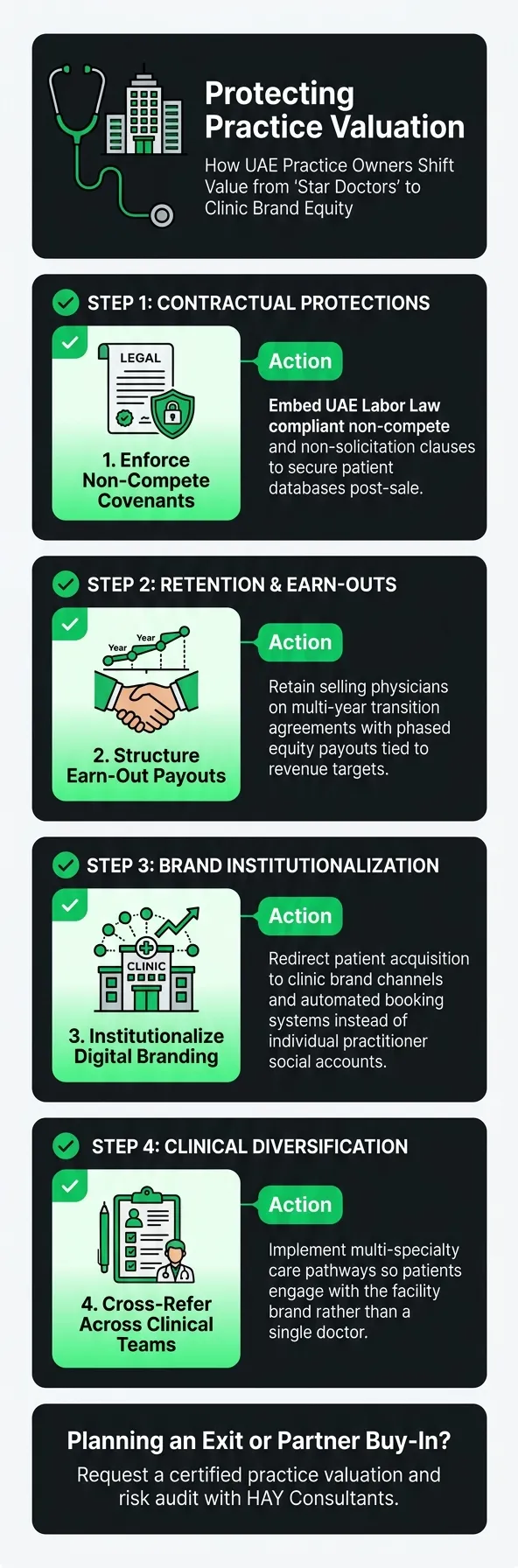
Personal Doctor Branding → High Key-Person Risk → Valuation Discount (20%–40%)
Institutional Clinic Brand → Transferable Goodwill → Premium Valuation Multiples
5. Strategic Summary & Next Steps
Medical goodwill represents true enterprise value, while physician dependency introduces operational risk. Quantifying active patient panels, securing contract covenants, and institutionalizing clinic operations allows UAE practice owners to minimize key-person discounts and maximize overall market value.
Preparing for a clinic sale, investor buy-in, or equity restructuring requires independent financial appraisal. You can consult with HAY Consultants’ Healthcare Financial Consulting team to request a practice valuation or intangible asset audit, or schedule a practice valuation audit directly.
6. Frequently Asked Questions
What is the main difference between medical goodwill and physician dependency in practice valuation?
Medical goodwill represents transferable intangible assets owned by the clinic, including brand equity, patient panel retention, and active insurance contracts. Physician dependency is non-transferable value tied strictly to an individual doctor’s personal reputation, which creates key-person risk and lowers enterprise value.
How much of a valuation discount does doctor dependency cause in UAE clinics?
High reliance on a single physician typically results in a 15% to 35% key-person discount applied to the clinic’s gross valuation or EBITDA multiple. The discount increases if the lead physician generates over 50% of practice revenue and plans to leave post-sale.
How is patient panel retention rate calculated during a clinic valuation in Dubai?
Patient panel retention is calculated by dividing active unique patients visiting within the last 12 to 24 months by total historical patient records. Retention rates above 60% show that patient loyalty belongs to the clinic brand rather than an individual doctor.
Can non-compete clauses legally protect goodwill when buying a practice in the UAE?
Yes. Non-compete and non-solicitation covenants in employment and M&A contracts protect goodwill by restricting selling physicians from competing within a specified geographic area and timeframe, in line with UAE labor regulations.
How can a solo practitioner build transferable goodwill before selling a clinic?
Solo practitioners can build transferable goodwill by hiring associate doctors, standardizing operational procedures, building institutional brand marketing, and cross-referring patients across multiple internal departments.