

WhatsApp qualification questions for clinics are the short set of questions an AI agent asks to learn what a patient wants and how quickly your team should act. This guide is for owners and managers of clinics and medical centers in Dubai and across the UAE who want to choose those questions before they automate anything. It covers how many to ask, what order to ask them in, which questions suit which enquiry, which to leave out, and how the answers decide who deals with the enquiry next.
For the full picture, see our guide to how AI WhatsApp agents work for clinics.
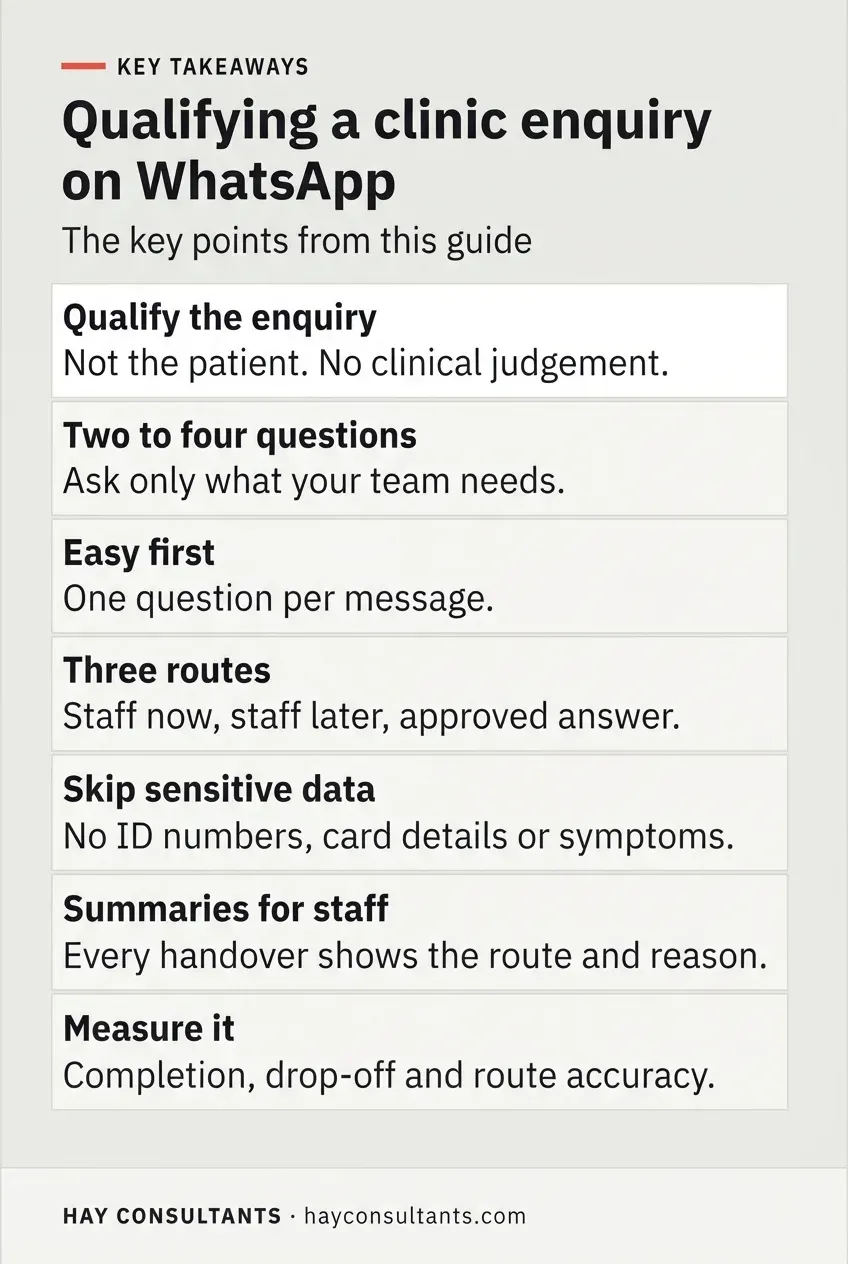
Short answer: Ask two to four questions, one at a time, and only those your team needs to act. Use the answers to send each enquiry down one of three routes: to staff now, to staff later, or to an approved answer. Leave out budget questions unless you decide they are needed, and never ask for ID card numbers, payment card details or symptoms. The agent qualifies the enquiry, not the patient. It makes no clinical judgement.
What qualification means for a clinic enquiry
Qualifying an enquiry means finding out what the person is asking for, and how soon your team should respond, so the right person picks it up. It is not a medical assessment. The agent does not judge whether a patient needs treatment, and it does not decide who deserves an appointment.
Sales teams in other industries use lead scoring, which ranks prospects by how valuable each one is to the business. A clinic does not need points or a formula. Two plain questions do the same job. What does this person want? Does a staff member need to act on it now?
Qualification has three uses in a clinic:
- It gives staff the context they need, so they do not start every conversation from zero.
- It shows which enquiries need a person quickly and which can wait for the next working hour.
- It stops the agent from collecting information nobody uses.
The booking path itself is covered in our guide to the clinic WhatsApp appointment booking flow. This guide focuses on the questions and the routing decisions that sit inside that path.
How many questions to ask, and in what order
Ask two to four questions in most conversations. Every extra question gives the patient another reason to stop replying, and every extra answer is more personal data to protect. A good test is whether a receptionist would ask the same thing in the first minute of a phone call.
Four rules keep the sequence short and natural:
- Start with the easy question. Ask what the person is looking for before you ask for any detail about them.
- Ask one question per message. A message with four questions usually gets one answer.
- Skip what you already know. If the first message says “I want a dental check-up next week”, the agent has the service and the timing already.
- Accept answers out of order. Patients rarely follow your script. The flow should take a later answer and carry on.
A typical order looks like this:
| Order | Question | Why it comes here |
|---|---|---|
| 1 | What are you looking for? | Easy to answer, and it sets the route |
| 2 | Which branch suits you? | Only if the clinic has more than one location |
| 3 | When would you like to be seen? | Tells staff how soon to act |
| 4 | Is this your first visit? | Tells staff which record to open |
| 5 | May I have your name? | Asked last, once the person is engaged |
Not every conversation uses all five. A patient who only wants opening hours needs none of them.
Question sets by enquiry type
Different enquiries need different questions. A fixed list for everyone makes the agent feel like a form. Build a short set for each type of enquiry your reception team handles most often.
New patient asking for an appointment. Ask for the service or doctor, the branch, two preferred days and times, who the visit is for, and the person’s name. Our guide to the clinic WhatsApp appointment booking flow explains each of these fields.
Service enquiry. The person wants to know what you offer. Ask which service they mean, then answer from approved text. Ask for a name and preferred time only if the person wants to take the next step.
Price enquiry. Decide in advance whether the agent may quote a fee. If it may, it gives the approved figure for that service. If it may not, the approved answer is that a team member will share the fee, and the agent asks which service the person means so staff have context.
Question about a doctor. Ask which doctor or specialty. Answer only with what your website already says about the doctor’s field, and pass anything else to staff.
Returning patient. Ask what they need, such as a follow-up booking or a change of time, and whether they have a preferred day. Staff handle anything that depends on the patient’s record.
Complaint or unhappy message. Ask nothing. Acknowledge the message and hand it to a person at once.
If you want a second opinion on the question set your clinic should start with, talk to HAY Consultants about your WhatsApp enquiries.
Questions to skip
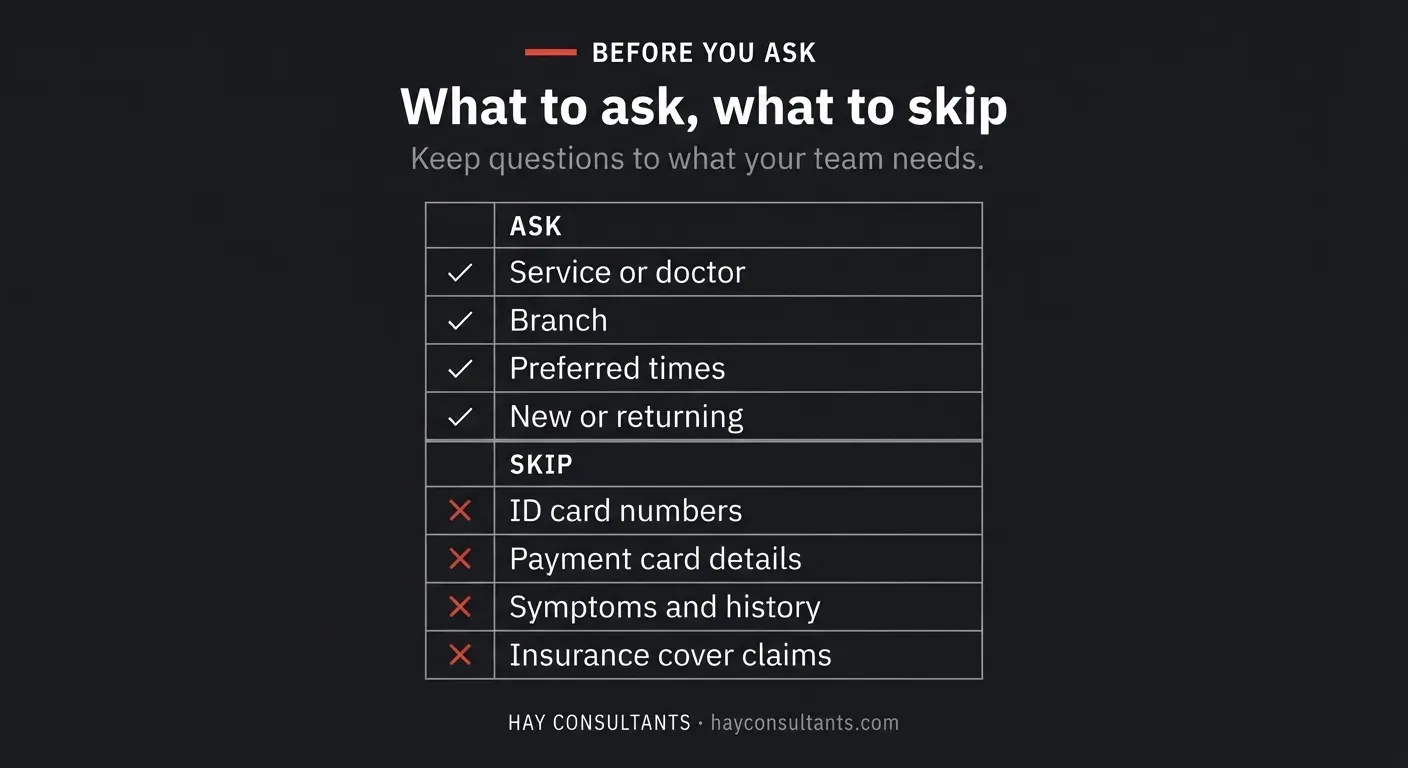
A question is worth asking only when it changes what your team does. These are the ones to leave out of an automated flow.
- ID card numbers. As of 8 October 2026, Meta’s WhatsApp Business Messaging Policy says businesses must not ask people to share personal ID card numbers or other sensitive identifiers. Staff can collect these at reception.
- Payment card details. The same policy rules these out.
- Symptoms, medical history and reports. These belong in a phone call or a visit. Asking for them turns a sales and enquiry flow into a clinical one, and brings health-data duties.
- Statements about insurance cover. The agent must not tell a patient what their insurance will pay. Decide whether staff will deal with insurance questions after handover, and set the approved answer to say so.
- Budget questions, unless you decide they are needed. Some businesses ask for a budget range to sort enquiries. In a clinic, this can feel like screening patients by wealth, and it is rarely needed to book a consultation. If you do ask, make it a conscious decision, explain why you are asking, and never use the answer to refuse a patient a reply.
This is data minimization: collecting only the personal data a purpose requires. It lowers risk and usually improves completion, because patients are asked for less.
Routing rules: staff now, staff later, approved answer
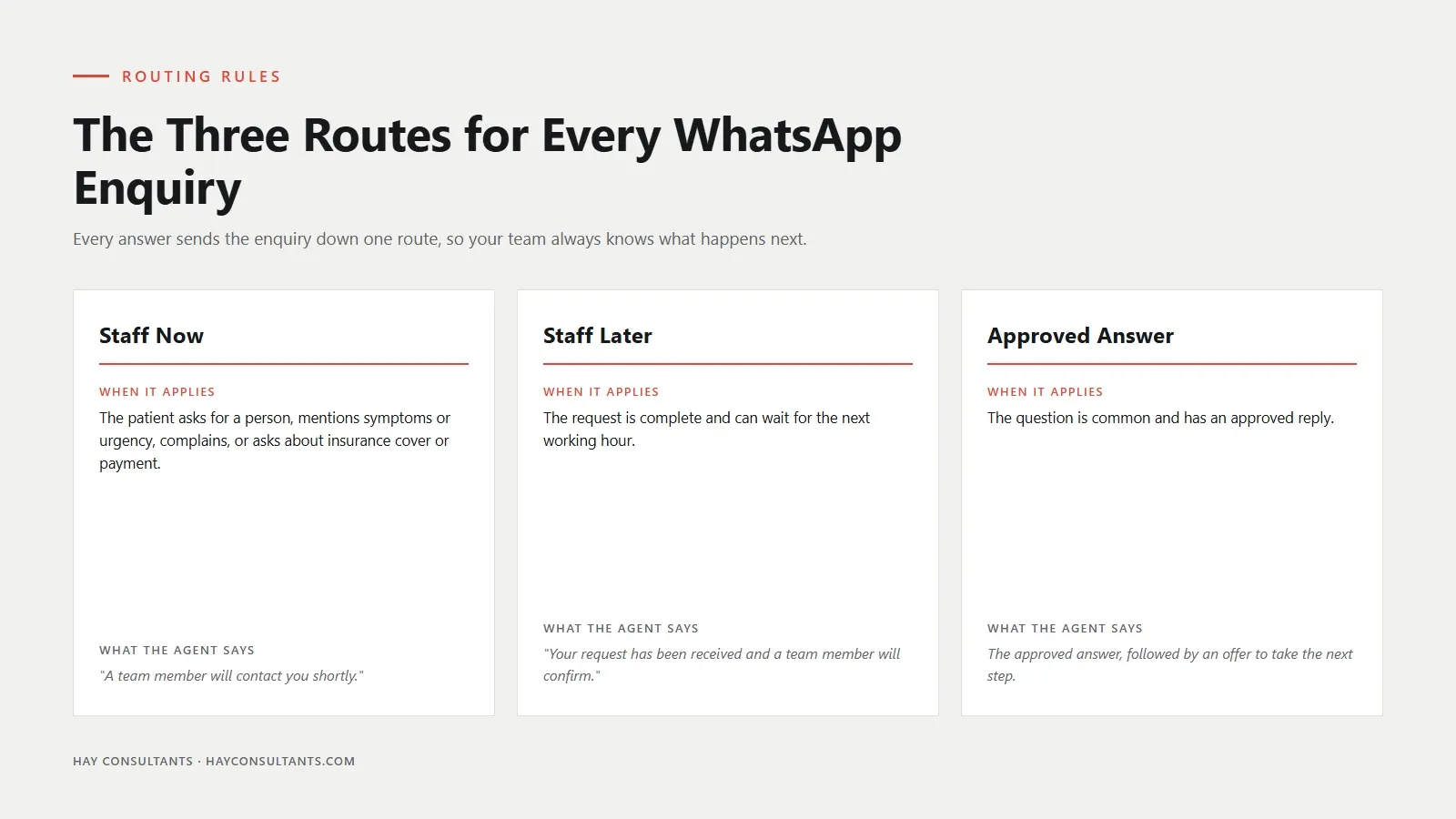
Routing means deciding, from the answers, who deals with the enquiry next. Keep it to three routes. More than that, and your team will not remember the rules.
| Route | When it applies | What the agent says |
|---|---|---|
| Staff now | The patient asks for a person, mentions symptoms or urgency, complains, or asks about insurance cover or payment | A team member will contact you shortly |
| Staff later | The request is complete and can wait for the next working hour | Your request has been received and a team member will confirm |
| Approved answer | The question is common and has an approved reply | The approved answer, followed by an offer to take the next step |
Write the rules as plain if-then statements, a simple form of decision tree. For example: if the message mentions pain, route to staff now. If the patient has given a service, a branch and two times, route to staff later. If the question matches an approved answer, reply and ask whether they want to book.
Three habits keep routing reliable:
- One route per enquiry at any moment. If the situation changes, such as a new message that mentions symptoms, the route changes with it.
- Doubt goes to staff. If the agent cannot tell which route applies, a person decides.
- Rules have an owner. One named person approves changes, so the rules do not drift.
For symptoms or urgency, the agent should stop collecting details, tell the patient that a team member will contact them, and advise them to phone the clinic or use emergency services if they believe they need urgent care.
What the handover summary contains
A handover summary is the short note staff see when they pick up a conversation. It should let a team member reply without scrolling through the chat. Include:
- The patient’s name, if given
- The route and the reason for it, such as “staff now: mentioned pain”
- The service or doctor asked about
- The branch and preferred times, if given
- Any question asked and the answer the agent gave
- The time of the first message
The route and reason line is the most useful addition. It tells staff how to prioritise the queue at a glance and gives you a record of why each enquiry was routed as it was.
Illustrative example: two enquiries, two routes
Illustrative example. These conversations are invented to show routing. They are not real patients or a real clinic.
Enquiry 1: a service question that routes to an approved answer, then to staff later.
Patient: Do you offer teeth whitening?
Agent: Yes, the clinic offers teeth whitening. Would you like me to take a request so a team member can arrange a time?
Patient: Yes please. Next week, afternoons.
Agent: Thank you. Which branch suits you best?
Patient: Jumeirah.
Agent: May I have your name?
Patient: (gives name)
Agent: Thank you. I have passed your request to our team. A team member will confirm a time with you during opening hours.
The agent used an approved answer, collected four details, and routed the enquiry to staff later.
Enquiry 2: a message that routes to staff now.
Patient: I have had a sharp pain in my tooth since last night and I need to be seen.
Agent: Thank you for telling us. I cannot advise on symptoms, so I have asked a team member to contact you as soon as possible. If you feel you need urgent care, please phone the clinic or use emergency services.
The agent asked nothing further, gave no advice and handed over at once. The summary for staff reads: “Staff now: mentioned pain. Dental. First message at 11:42 pm.”
WhatsApp rules that shape your questions
Meta’s rules decide how long staff can reply freely and what an automated flow may ask for. As of 8 October 2026, the WhatsApp Business Messaging Policy sets out four points that matter here:
- On the WhatsApp Business Platform, a business can reply without a template only within 24 hours of the patient’s last message. After that, only approved templates are allowed.
- Automation is allowed inside that window, provided the patient has a prompt, clear route to a person.
- A business may contact people only if they have given their number and opted in.
- Businesses must not ask people to share personal ID card numbers or payment card numbers.
The first point matters for the “staff later” route. If an enquiry arrives at 9 pm and staff confirm the next morning, the free-text window may still be open. If it closes, only an approved template can restart the conversation. Set your internal response target well inside the window.
Health data and your qualification questions
Even simple answers can reveal health information. A message that says “I need a dermatologist” says something about a person’s health. UAE law treats health information with extra care. Federal Law No. 2 of 2019 on the use of information and communication technology in health fields was issued on 6 February 2019. You can read it on the UAE Ministry of Justice legislation portal.
In plain words, the law requires health data to be kept confidential (Article 4). It bars the use of patient information for non-health purposes without the patient’s written approval, with listed exceptions (Article 16). It also generally bars storing or moving health data tied to services in the UAE outside the country, except in cases set by a Health Authority decision (Article 13). The UAE government portal describes the law as covering health care in the UAE, including free zones.
Whether an enquiry counts as health information depends on what it says. Ask any provider where chats are stored, who can read them, and how long they are kept. Then confirm your own position with the relevant authority or a UAE-qualified adviser. Other emirates have their own rules as well. Abu Dhabi’s Department of Health, for example, publishes its own digital health policy.
This guide is general information, not legal, tax or financial advice. Confirm regulatory points with the relevant authority or a UAE-qualified lawyer.
How to test your questions before patients see them
Test the question set with realistic conversations, including the awkward ones. Ask a receptionist to run them, not only the person who wrote the flow. Cover at least these cases:
- A patient who answers every question in the first message
- A patient who answers with one word, or with a question
- A patient who answers out of order
- A message that mentions pain or urgency
- A price question for a service where the agent may not quote a fee
- A request to speak to a person
- A message that arrives at night
- A question with no approved answer
- A patient who stops replying after the second question
For each case, record the route the agent chose and check it against the route you expected. Fix the rule or the wording, and run the case again. Review the set whenever you add a service, a branch or a new approved answer.
How to measure your questions
Five measures show whether the questions are working. Each comes from the conversation log.
- Qualification completion rate: enquiries that reached a route with the details staff need, divided by conversations started.
- Drop-off by question: the question after which patients stop replying. A question with high drop-off is a candidate to move, reword or remove.
- Route accuracy: from a weekly sample of conversations, the share where staff agree the agent chose the right route.
- Time to staff response by route: the median time from handover to the first staff reply, shown separately for staff now and staff later.
- Enquiries with no approved answer: the count of questions that went to staff because no approved reply existed. Repeated questions show which answers to write next.
Record a baseline before you change anything, then change one question at a time so you can see which change made the difference.
Where an AI WhatsApp agent fits
An AI WhatsApp agent asks the questions, applies the routing rules and writes the summary every time a message arrives, including outside reception hours. It responds, asks qualification questions, answers common questions from approved information, follows up and hands the conversation to your team when human involvement is needed. HAY Consultants helps healthcare businesses design this through its AI WhatsApp agent service for clinics.
Choose the questions and the routes on paper first. An agent that follows rules your team already trusts is easier to review, and easier to correct.
Next step for your clinic
If you want help choosing WhatsApp qualification questions for your clinic, message HAY Consultants on WhatsApp. We will go through your enquiry types, your routing rules and your handover summary with you.