

Clinic WhatsApp FAQ responses are the short, pre-approved answers your AI agent uses when a patient asks a common question, such as opening hours, which services you offer or how a booking works. This guide is for owners and managers of clinics and medical centers in Dubai and across the UAE who want to build that set of answers before they automate anything. It covers where the questions come from, how to write one answer, which answers to leave out, who signs them off, and how to keep them accurate.
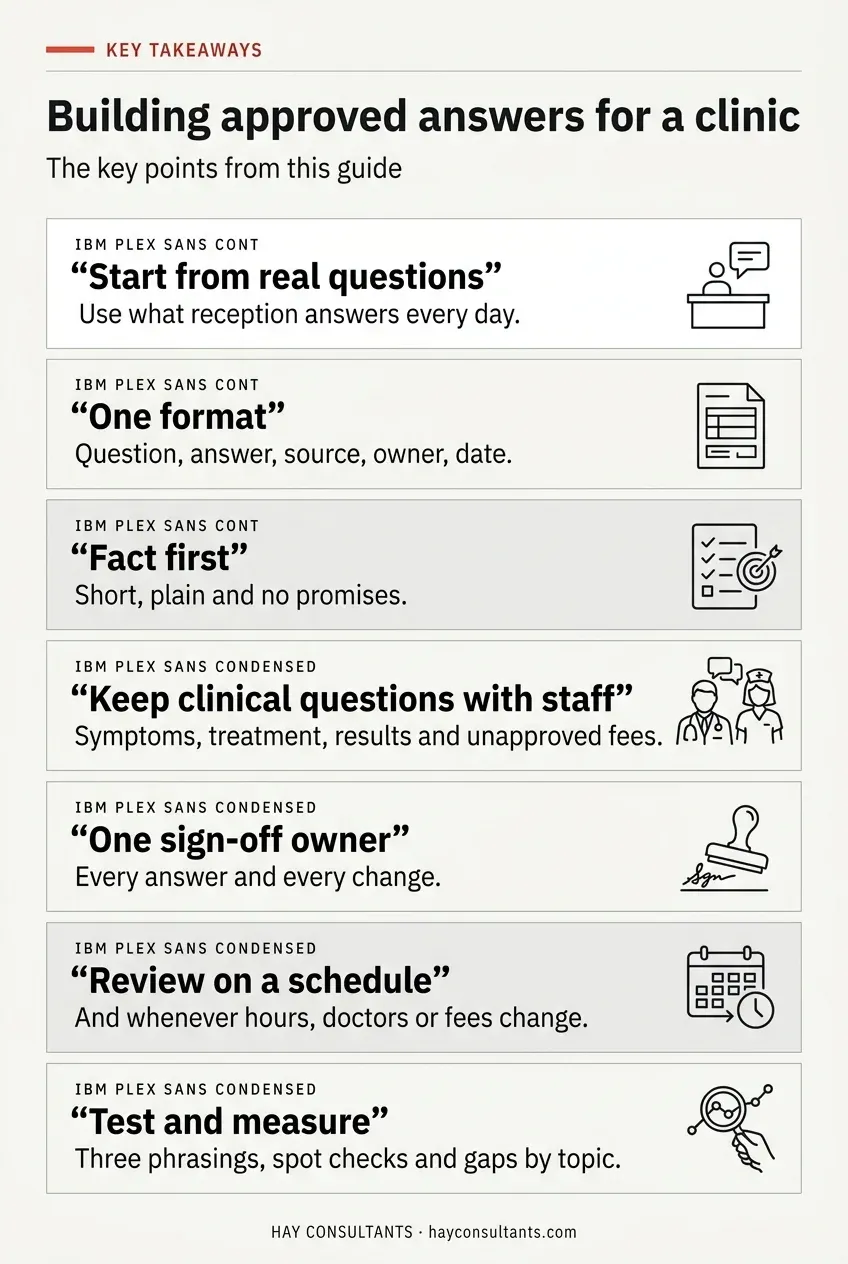
Short answer: Build the set from the questions your reception team already answers every day. Write each answer in a fixed format with a question, a short reply, a source, an owner and a date. State the fact first, promise nothing, give no clinical advice, and quote a fee only if you have approved it. Keep sensitive and clinical questions with staff, have one person sign off every answer, and review the set whenever hours, doctors, services or fees change.
What an approved answer is, and what it is not
An approved answer is a short reply that your clinic has signed off, and the agent uses it for a common question. The agent does not make up facts. If a question has no approved answer, it hands the conversation to a person.
Two things share the word “approved” in WhatsApp work, and they are easy to confuse.
| Approved answer | WhatsApp-approved message template | |
|---|---|---|
| Who approves it | Your clinic | |
| What it is for | Replying to a patient’s question accurately | Starting or restarting a conversation outside the reply window |
| Who writes it | Your team, with a named owner | Your team or provider, submitted to WhatsApp |
| What this guide covers | Yes | No |
As of 8 October 2026, Meta’s WhatsApp Business Messaging Policy says a business can reply without a template only within 24 hours of the patient’s last message, and after that only approved templates are allowed. That rule is about message formats. This guide is about the content of the replies your agent gives inside the window.
Check with your WhatsApp provider whether the agent uses your approved text exactly as written or adapts the wording. Either way, the facts in a reply should come only from the approved text. Decide which you want, and test it.
Where the questions come from
Do not guess which questions patients ask. Collect them from places where patients have already asked.
- Your reception team. Ask each person for the ten questions they answer most often. Ask what they answer wrongly or inconsistently, because those answers matter most.
- Past WhatsApp chats. Read a sample of recent enquiries and note the questions. Remove names and personal details before anyone outside the team sees them.
- Phone and walk-in notes. If your team logs why people call, use the log.
- Your own website. Questions your pages answer poorly show up as repeat questions on WhatsApp.
- Questions that led to a lost patient. If a chat went quiet after a question, the answer to that question may be missing or unclear.
Group similar questions together. “What time do you open?”, “Are you open on Friday?” and “Are you open now?” are one topic, with one set of facts. Rank the topics by how often they appear. Start with the ten to twenty most frequent, and add more as your conversation logs show gaps.
For groups with several branches, our guide to multi-branch clinic WhatsApp enquiries explains how to split group-wide answers from branch-specific ones.
The format of one answer
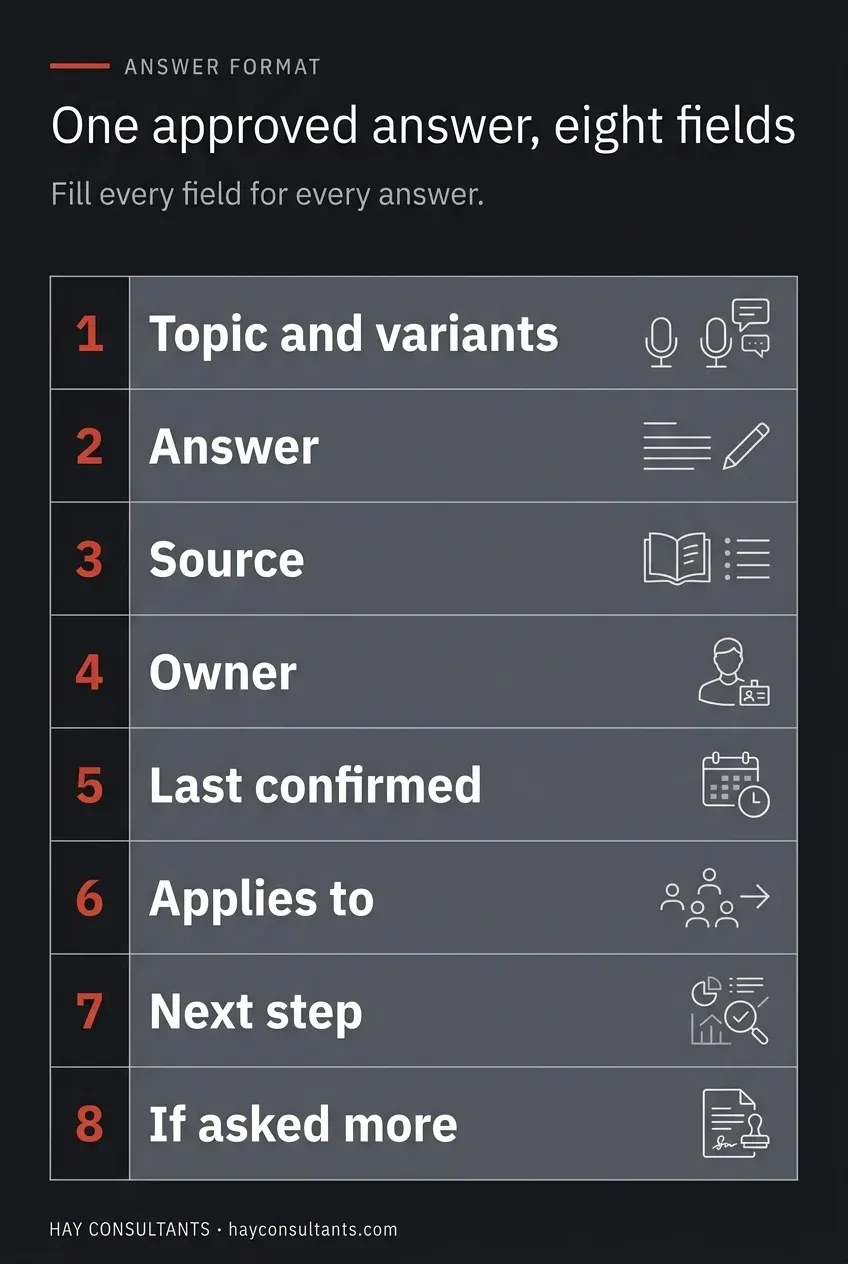
Write every answer in the same format. A fixed format makes answers easy to check, update and retire.
| Field | What goes in it |
|---|---|
| Topic and question variants | The question as patients ask it, with two or three other ways of saying it |
| Answer | The reply, in a few sentences |
| Source | Where the fact comes from, such as the website, the price list or the rota |
| Owner | The person who keeps it accurate |
| Last confirmed | The date someone last checked it |
| Applies to | The whole group, or named branches |
| Next step | What the agent offers after answering, such as taking a request |
| If asked more | Whether a follow-up question goes to staff |
The source field is the one most clinics skip, and it is the most useful. When a fact changes, the source tells you which answers to update. When a patient disputes an answer, the source shows where it came from.
Writing rules
Good answers are short, plain and safe. Follow these rules for every answer.
- Fact first. Put the answer in the first sentence. “The clinic is open from 9 am to 6 pm, Monday to Thursday” is better than “Thank you for your interest in our clinic.”
- Keep it to a few sentences. Long replies on a phone are skimmed or ignored. One idea per answer.
- Use plain words. Write the way your best receptionist speaks. Avoid jargon the patient did not use first.
- Promise nothing you do not control. Do not promise results, slots, speed or outcomes. Staff confirm every slot.
- Give no clinical advice. No diagnosis, no advice on symptoms, treatment or medicines. If a question needs one, it goes to a person.
- Quote fees only when approved. If the agent may not quote a fee, the approved answer is that a team member will share it.
- Name the next step. End by offering something the agent can do, such as taking a request, or telling the patient that a team member will reply.
- Choose your languages deliberately. Decide which languages your patients write in. Do not publish an answer in a language nobody on your team can check.
- Hold to one style. A short style guide, a set of rules for how documents are written, keeps answers consistent when several people contribute. One page is enough.
If you want a second opinion on your first set of answers, talk to HAY Consultants about your approved answers.
A starter list by category
Most clinics find that their questions fall into a handful of categories. Use these as a checklist for your first set.
| Category | Examples of topics | Watch for |
|---|---|---|
| Hours and locations | Opening hours, addresses, how to find the branch, parking | Hours that differ by branch or day |
| Services | Which services each branch offers | Services offered at some branches only |
| Doctors | Which doctors see which kinds of patients, as your website already says | Doctors who move or leave |
| Booking | How a request becomes a confirmed appointment, how long staff aim to take | Promising a slot |
| Visit preparation | Which documents to bring | Anything clinical, which needs a clinician’s approval |
| Fees | Whether the agent may quote a fee for a given service | Fees that change |
| Contact | Phone number, how to reach a person | Out-of-date numbers |
Insurance deserves a decision of its own. The agent should not state what an insurer will cover. Decide whether the approved answer simply says that a team member will confirm insurance questions, and write it that way.
Answers that should stay with staff
Some questions should never have an approved answer in the agent’s set. They go to a person, every time.
- Anything about symptoms, diagnosis, medicines, treatment or results
- Questions about a specific patient’s record or appointment history
- Fees the clinic has not approved the agent to quote
- Insurance cover and payment disputes
- Complaints and unhappy messages
- Any question where the honest answer is “it depends on the patient”
A useful test is to ask whether the clinic would put the answer in writing without knowing who is asking. If not, it belongs with staff. Our guide to setting up human handover on a clinic WhatsApp AI agent explains what happens next.
Who signs off, and how often to review
An answer set is only as good as the person responsible for it. Three roles keep it accurate.
- A set owner. One person approves every answer and every change. Without one, edits drift and contradict each other.
- A fact checker for each answer. The person who knows the fact, such as the practice manager for hours or the clinician for preparation instructions, confirms it before it goes live.
- A clinician for anything that touches a procedure. Preparation instructions and similar answers need a clinician’s approval, or should be left out.
Keep the set in one place, a single source of truth, so a change is made once and not copied by hand into several files. Keep a change record: what changed, who changed it and when.
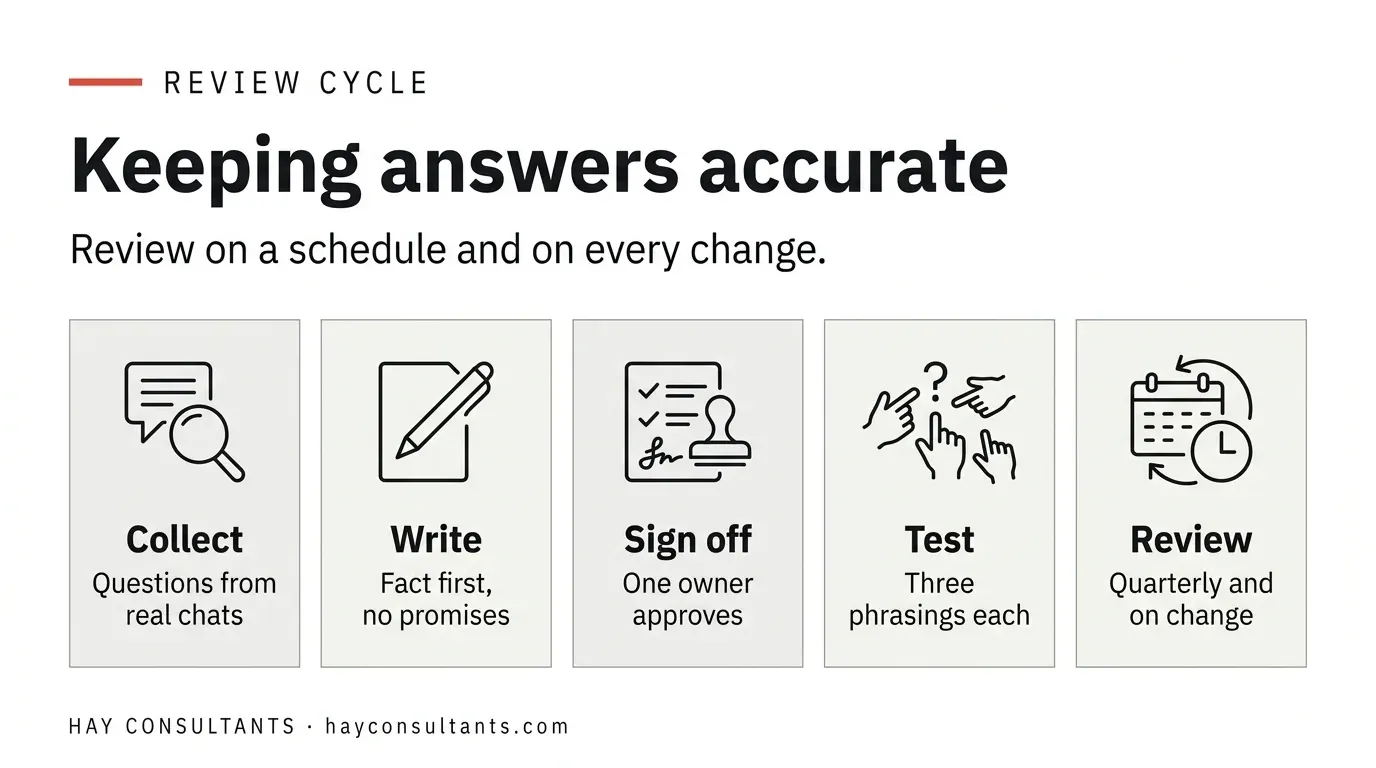
Review the whole set on a schedule, such as every quarter. Review the affected answers at once whenever hours, doctors, services or fees change. An answer whose “last confirmed” date is old is a risk, because the agent will keep giving it with full confidence.
Illustrative example: one answer, written badly and well
Illustrative example. The wording below is invented to show the difference. It is not a real clinic’s answer.
| Weak answer | Stronger answer | |
|---|---|---|
| Question | Do you offer teeth whitening? | Do you offer teeth whitening? |
| Reply | Yes! Our whitening gives you a brighter smile in just one session and is safe for everyone. | Yes, the clinic offers teeth whitening. A team member can explain the options and fees and arrange a consultation. Would you like me to take a request? |
| Problem | Promises a result and speed, makes a safety claim, and gives no next step | None. States the fact, makes no claim, and names the next step |
| Source and owner | Missing | Services page, reviewed by the practice manager |
| Last confirmed | Missing | Dated |
The weak answer sounds friendly and is risky. It makes claims the clinic may not be able to support, and it is not tied to a person who can correct it. The stronger answer is shorter, safer and ready to update.
WhatsApp rules that affect your answers
Meta’s rules apply to every reply. As of 8 October 2026, the WhatsApp Business Messaging Policy sets out four points that matter here:
- On the WhatsApp Business Platform, a business can reply without a template only within 24 hours of the patient’s last message. After that, only approved templates are allowed.
- Automation is allowed inside that window, provided the patient has a prompt, clear route to a person.
- A business may contact people only if they have given their number and opted in.
- Businesses must not ask people to share personal ID card numbers or payment card numbers.
Do not write an approved answer that asks for an ID card number or card details. Staff can collect these at reception.
Health data and your answer set
An answer set holds general information, not patient records. Keep it that way. No answer should contain a patient’s name, history or appointment details. UAE law treats health information with extra care. Federal Law No. 2 of 2019 on the use of information and communication technology in health fields was issued on 6 February 2019. You can read it on the UAE Ministry of Justice legislation portal.
In plain words, the law requires health data to be kept confidential (Article 4). It bars the use of patient information for non-health purposes without the patient’s written approval, with listed exceptions (Article 16). It also generally bars storing or moving health data tied to services in the UAE outside the country, except in cases set by a Health Authority decision (Article 13). The UAE government portal describes the law as covering health care in the UAE, including free zones.
When you collect real chats to find questions, treat them as sensitive. Share only what the team needs, which is data minimization. Remove names and details first. Other emirates have their own rules as well. Abu Dhabi’s Department of Health, for example, publishes its own digital health policy. Confirm your own position with the relevant authority or a UAE-qualified adviser.
This guide is general information, not legal, tax or financial advice. Confirm regulatory points with the relevant authority or a UAE-qualified lawyer.
How to test the set before patients see it
Test every answer with realistic questions, and ask a receptionist to do it, not only the person who wrote the answers. Cover at least these cases:
- Each answer, asked in three different ways
- A question with a spelling mistake or a missing word
- A question that mixes two topics
- A question that is close to an answer but not covered by it
- A question about symptoms or treatment
- A question about a fee the agent may not quote
- A question with no approved answer at all
- A question about a service only some branches offer
For each case, check that the agent gave the right answer, or handed over when it should. Compare each answer against its source. Fix the wording and run the test again. Our guide to the clinic WhatsApp appointment booking flow covers testing the booking path in the same way.
How to measure the set
Five measures show whether the set is working. Each comes from the conversation log.
- Share of questions answered from the set: questions that matched an approved answer, divided by all common questions.
- Handovers for “no approved answer”, by topic: the count for each topic. A topic that keeps appearing needs a new answer.
- Answers never used: answers that no patient triggered. Merge or retire them.
- Staff corrections: how often staff correct an answer after a handover. Each one points to an answer to fix.
- Age of answers: the number of answers past their review date.
Record a baseline before you launch, and review the numbers weekly at first, then monthly.
Where an AI WhatsApp agent fits
An AI WhatsApp agent is only as accurate as the information it is given. It responds, asks qualification questions, answers common questions from approved information, follows up and hands the conversation to your team when human involvement is needed. HAY Consultants helps healthcare businesses design this through its AI WhatsApp agent service for clinics. For the full picture of how the parts fit together, read our guide to how AI WhatsApp agents work for clinics.
Write the answers on paper first. A set your team has written, checked and signed off is easier to load, easier to test and much easier to correct.
Next step for your clinic
If you want help building the approved answers for your AI WhatsApp agent, message HAY Consultants on WhatsApp. We will go through the questions your team answers today and the first set worth writing.