

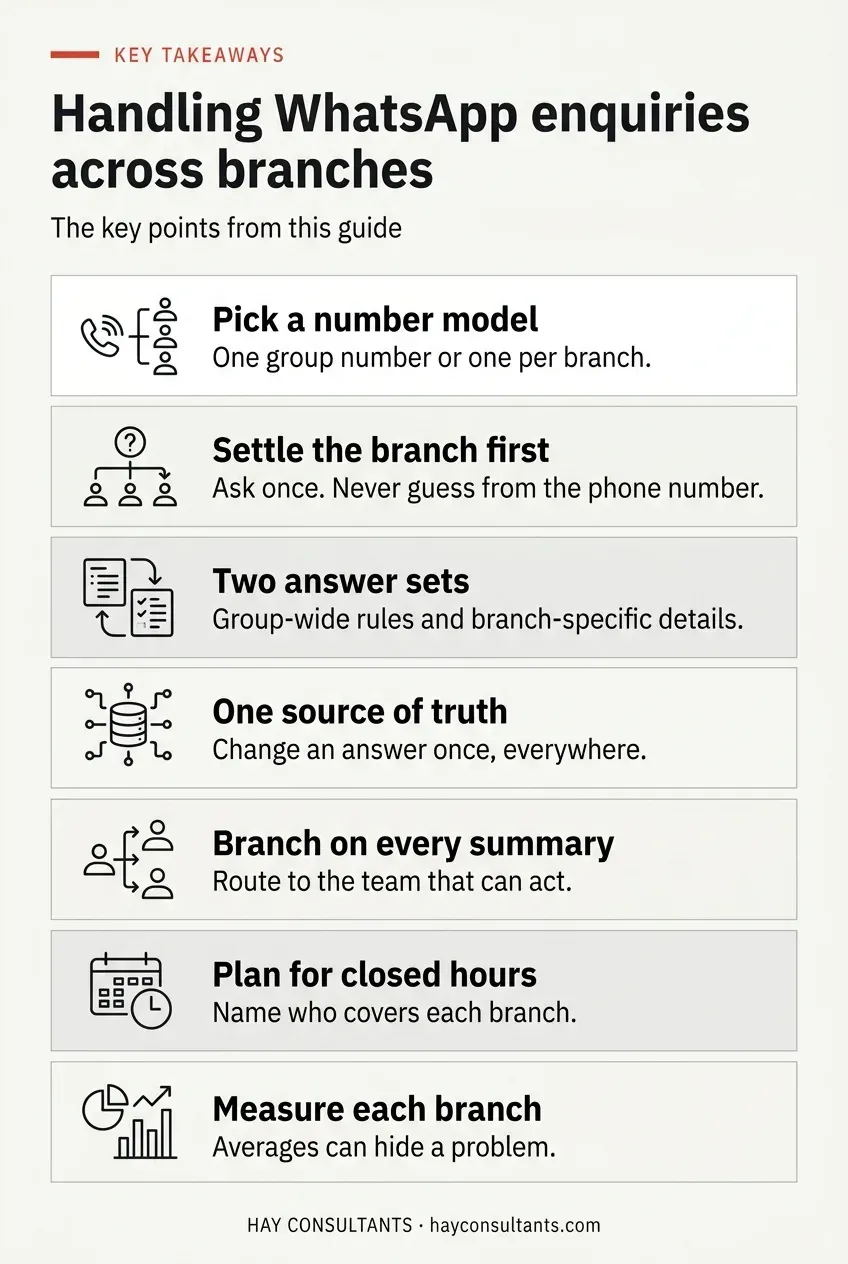
Multi-branch clinic WhatsApp enquiries need three things a single-site clinic can skip: a reliable way to find out which branch the patient means, approved answers that differ by branch, and a route to the right branch team. This guide is for owners and managers of clinic groups and medical centers in Dubai and across the UAE who want to design that process before they automate it. It covers the number decision, how to identify the branch, how to split group-wide and branch-specific answers, how to hand over, and how to measure each branch.
For the full picture, see our guide to how AI WhatsApp agents work for clinics.
Short answer: Decide first whether patients message one number or one per branch. Then make the branch the first thing the flow settles, keep group-wide answers in one place, give each branch its own approved answers for hours, doctors and services, and put the branch on every handover summary. Measure each branch separately. The agent handles sales and enquiries only. It gives no clinical advice, and a person takes over when judgement is needed.
What changes when a clinic has more than one branch
A second branch multiplies the questions a flow must answer. A single-site clinic can say “we open at nine”. A group has to say which branch, which doctors work there and which services it offers. Without that, an automated reply can be fluent and wrong at the same time.
Four things change:
- Hours differ. One branch may open late on Fridays and another may close for lunch. An answer given at 9 pm must use the right branch’s hours.
- Doctors and services differ. A service available in one branch may not be available in another.
- Ownership differs. Each branch has its own reception team, and each team needs the enquiries meant for it, not everyone’s.
- Rules must stay consistent. Patients expect the same standards from the same group. A group-wide rule about what the agent never says should not depend on which branch answers.
If you are new to these building blocks, our guides to the clinic WhatsApp appointment booking flow and to WhatsApp qualification questions for clinics cover the single-site flow. This guide covers only what the second and third branch add.
One number or one per branch
Every group faces a design choice before it builds a flow: do patients message one WhatsApp number for the whole group, or a separate number for each branch? Neither is right for every group. Each moves the problem somewhere else.
| One number for the group | One number per branch | |
|---|---|---|
| How the branch becomes known | The flow asks, or works it out from the message | The number the patient used |
| Main benefit | One place for patients to start, and one set of group rules | Clear ownership, and each branch can print its own number on local material |
| Main risk | The flow picks the wrong branch | Patients message the wrong branch’s number, and rules drift between numbers |
| What it needs | A good branch question and a way to correct mistakes | Central control of answers, rules and reporting across all numbers |
Some groups use a mix, with one group number for general enquiries and branch numbers for local campaigns. Whatever you choose, write it down and make sure every branch knows the rule. Check with your WhatsApp provider what number setups it supports before you commit, because the options depend on the provider and the plan.
Finding out which branch the patient means
The branch should be settled early, because every later answer depends on it. There are three common situations:
- The patient names the branch. “I want to book at the Business Bay branch.” The flow records it and moves on.
- The patient names an area, a doctor or a service. The flow suggests the matching branch and asks the patient to confirm. Never assume.
- The patient says nothing about location. The flow asks one plain question: “Which of our branches suits you best?” and lists the branches by name.
Three rules make this reliable:
- Ask once, then confirm in the summary. Do not ask the patient to repeat the branch later.
- Do not guess from the phone number or the language. A UAE number does not tell you which branch is nearest, and the language a patient writes in does not either.
- Let the patient change their mind. If the patient says “actually, the other branch”, the flow switches and tells staff.
When a group has branches in more than one emirate, the branch question matters even more. Different emirates have their own health authorities and rules, so the flow must not give an answer that is true in one emirate and wrong in another.
Group-wide and branch-specific approved answers
Approved answers are short replies your group has signed off, and the agent uses only these for common questions. In a group, split them into two sets:
| Set | What it holds | Who approves it |
|---|---|---|
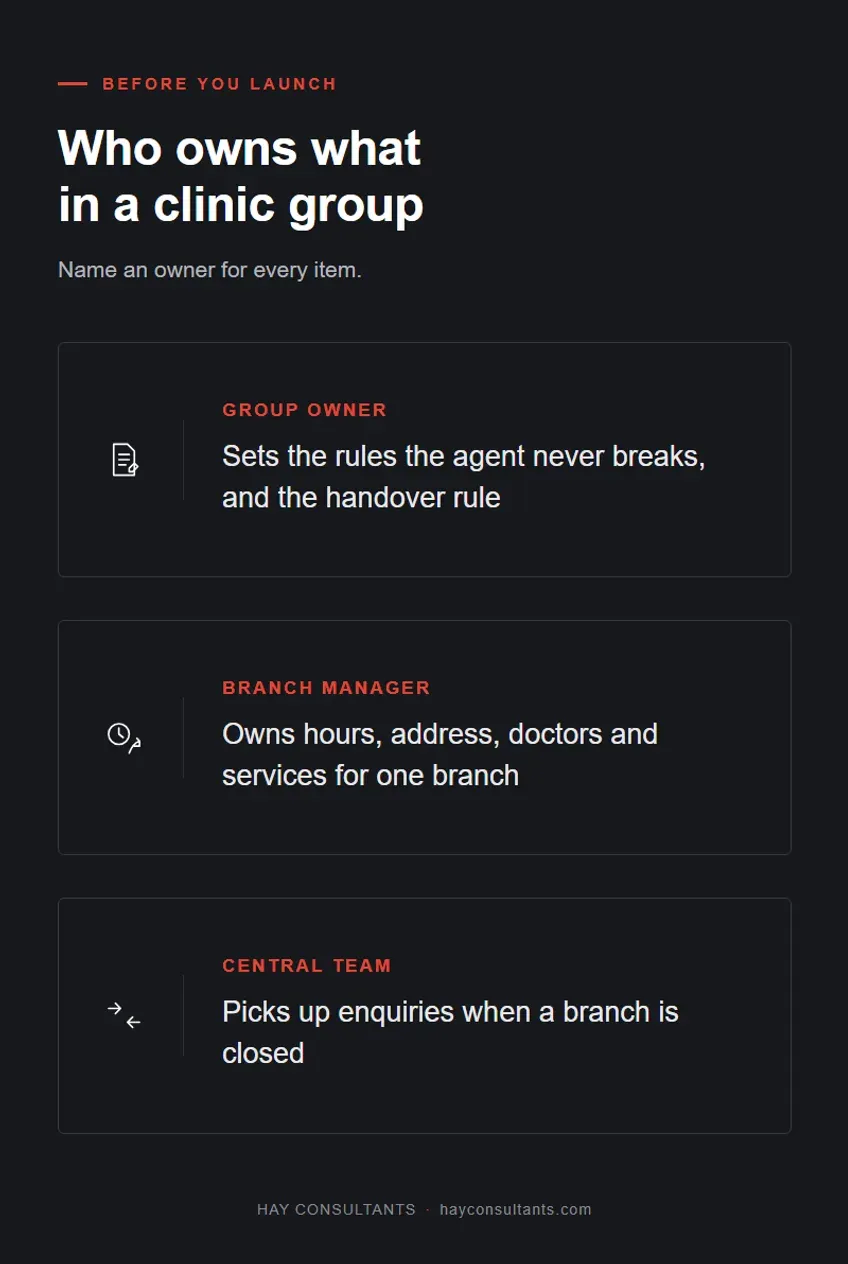
| Group-wide | What the agent never says, how a request becomes a confirmed appointment, how to reach a person, the handover rule | The group owner or a central manager |
| Branch-specific | Opening hours, address, phone number, doctors, services and documents to bring | The manager of that branch |
Keep the group-wide set in one place. This is a single source of truth: each piece of information is controlled in one location, so a change is made once and not copied by hand into every branch. If the group-wide rule on fees changes, one edit should update every branch.
Four habits prevent the usual problems:
- Date every answer. A date on each answer shows when it was last confirmed.
- Name an owner for each branch set. When hours or doctors change, that person updates the answer on the same day.
- Keep a change record. Note what changed, who changed it, and when.
- Say “ask the branch” when unsure. If a branch has no approved answer, the agent should hand over, not borrow another branch’s answer.
If you want a second opinion on how to split your group’s answers, talk to HAY Consultants about your multi-branch enquiries.
Routing and handover to the right branch team
Routing sends each enquiry to the team that can act on it. The idea is borrowed from call centres, where skills-based routing matches each incoming call with the most suitable agent. For a clinic group, the match is simpler: the branch, and sometimes the service.
| Situation | Route |
|---|---|
| The patient has confirmed a branch and the request is complete | To that branch’s team, to confirm later |
| The patient asks for a person, or mentions symptoms or urgency | To the branch’s team now, or to a central fallback if that branch is closed |
| The patient has not named a branch and does not answer the branch question | To a central team that can ask them directly |
| The service is not offered at the chosen branch | The approved answer says which branches offer it, then the patient chooses |
| The question has no approved answer | To the branch team, with the question attached |
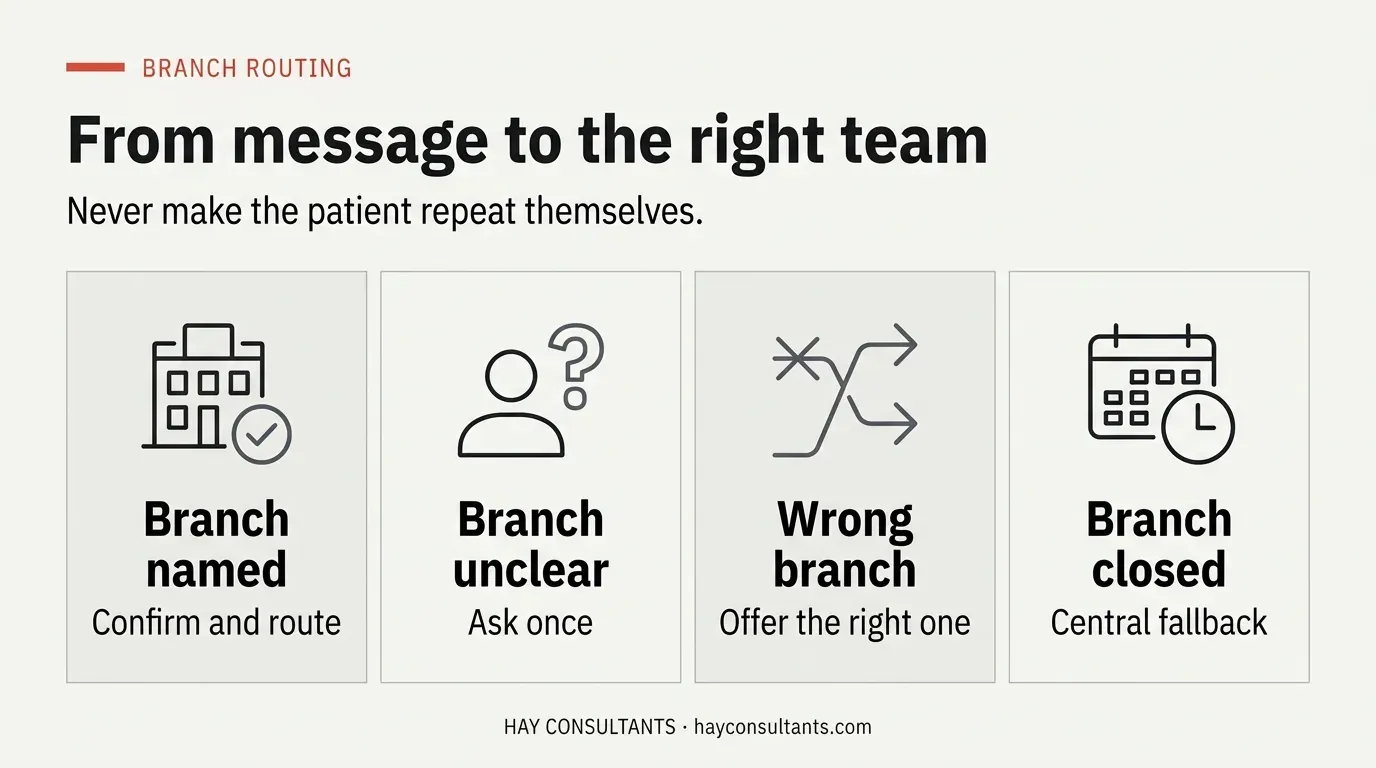
Every handover should arrive as a short summary that puts the branch at the top. Include the branch, the route and the reason, the patient’s name if given, the service or doctor asked about, preferred times, any questions asked and the answers given, and the time of the first message.
Plan for the hours when a branch is closed. Name who covers overnight and weekend handovers for each branch, and agree an internal service-level agreement for each: a stated standard for how quickly a staff member replies in opening hours. A central fallback team can pick up enquiries a closed branch cannot, but only if the group has agreed who they are.
When the patient is in the wrong place
Patients often start with the wrong branch, or the wrong number. The flow should be built to recover from this without making the patient start again.
- Wrong branch chosen. If the patient wants a service that the chosen branch does not offer, the approved answer says which branches do. The patient picks, and the summary shows the change.
- Message sent to the wrong number. In a group with one number per branch, the flow can offer to pass the request to the right branch. The patient should not need to copy and send the message again.
- Wrong city or emirate. If the patient asks about a location the group does not serve, the agent says so politely and offers the group’s phone number. It does not recommend other providers.
- Unclear. If the flow cannot work out what the patient means, a person decides.
The test for each of these is the same: the patient never needs to repeat what they have already said.
Illustrative example: one group, two enquiries
Illustrative example. These conversations are invented to show branch routing. They are not real patients or a real clinic group.
Enquiry 1: the branch is not named.
Patient: Hello, I would like to book a physiotherapy session next week.
Agent: Hello, thank you for contacting us. I can take your request and pass it to our team. Which of our branches suits you best: Downtown, Sharjah or Abu Dhabi?
Patient: Sharjah.
Agent: Thank you. Which two days and times next week would suit you?
Patient: Monday afternoon or Wednesday morning.
Agent: Noted. May I have your name?
Patient: (gives name)
Agent: Thank you. I have passed your request to our Sharjah team. A team member will confirm a time with you during opening hours.
The summary for the Sharjah team reads: “Branch: Sharjah. Route: staff later. Physiotherapy. Monday afternoon or Wednesday morning.”
Enquiry 2: the service is not offered at the chosen branch.
Patient: Do you do laser treatments at the Downtown branch?
Agent: Laser treatments are not offered at Downtown. They are offered at our Abu Dhabi branch. Would you like me to take a request for that branch?
Patient: Yes, please.
The agent used an approved answer, which was branch-specific, then switched the branch in the summary and carried on.
WhatsApp rules that shape a multi-branch flow
Meta’s rules apply to every number and every branch. As of 8 October 2026, the WhatsApp Business Messaging Policy sets out four points that matter here:
- On the WhatsApp Business Platform, a business can reply without a template only within 24 hours of the patient’s last message. After that, only approved templates are allowed.
- Automation is allowed inside that window, provided the patient has a prompt, clear route to a person.
- A business may contact people only if they have given their number and opted in.
- Businesses must not ask people to share personal ID card numbers or payment card numbers.
For a group, the first point sets a deadline for every branch. A branch that closes at 6 pm and opens at 9 am has a window that may still be open the next morning, and may not. Set each branch’s confirmation target well inside the window. If you want to measure how often that window gets missed first, see our guide to finding missed WhatsApp enquiries.
Health data across branches and emirates
Even a simple enquiry can reveal health information, such as a request to see a dermatologist. UAE law treats health information with extra care. Federal Law No. 2 of 2019 on the use of information and communication technology in health fields was issued on 6 February 2019. You can read it on the UAE Ministry of Justice legislation portal.
In plain words, the law requires health data to be kept confidential (Article 4). It bars the use of patient information for non-health purposes without the patient’s written approval, with listed exceptions (Article 16). It also generally bars storing or moving health data tied to services in the UAE outside the country, except in cases set by a Health Authority decision (Article 13). The UAE government portal describes the law as covering health care in the UAE, including free zones.
For a group, two questions follow. First, who in each branch can read the chats, and does that match who needs to? Collect only what each branch needs, which is data minimization. Second, do your branches fall under different authorities? Other emirates have their own rules as well. Abu Dhabi’s Department of Health, for example, publishes its own digital health policy. Confirm your own position with the relevant authority or a UAE-qualified adviser, branch by branch.
This guide is general information, not legal, tax or financial advice. Confirm regulatory points with the relevant authority or a UAE-qualified lawyer.
How to test the flow branch by branch
Test the flow with realistic conversations for every branch, not only the busiest one. Ask a receptionist from each branch to run them. Cover at least these cases:
- A patient who names the branch in the first message
- A patient who does not name a branch
- A patient who names a branch, then changes their mind
- A service that only some branches offer
- A question about opening hours at night, for a branch that is closed
- A request to speak to a person at a closed branch
- A message that mentions symptoms
- A question with no approved answer for that branch
- A message sent to the wrong number, if you use one number per branch
For each case, record the branch and route the agent chose and check it against what you expected. Fix the rule or the wording, then run the case again. Repeat the tests whenever a branch changes its hours, doctors or services.
How to measure each branch
Measure the group as a whole and each branch separately, because an average can hide a problem at one site. Six measures help:
- Completion rate by branch: requests passed to staff with all details, divided by conversations started.
- Branch correction rate: the share of conversations where the patient changed the branch. A high rate suggests the branch question or list needs rewording.
- Median time to staff response by branch: the middle value of the time from handover to the first staff reply.
- Handover reasons by branch: the count of each reason. A branch with many “no approved answer” handovers needs more approved answers.
- Drop-off by question: the question after which patients stop replying.
- Out-of-hours enquiries by branch: how many arrive when the branch is closed, and how long they wait.
Record a baseline before you change anything. Review the numbers weekly at first, and then monthly.
Where an AI WhatsApp agent fits
An AI WhatsApp agent asks the branch question, answers from the approved set for that branch, and writes the handover summary every time a message arrives, including outside reception hours. It responds, asks qualification questions, answers common questions from approved information, follows up and hands the conversation to your team when human involvement is needed. HAY Consultants helps healthcare businesses, including multi-location groups, design this through its AI WhatsApp agent service for clinics.
Choose the number setup, the answer ownership and the routes on paper first. A flow built on rules each branch already trusts is easier to review, and easier to correct.
Next step for your clinic group
If you want help designing WhatsApp enquiries across your branches, message HAY Consultants on WhatsApp. We will go through your branches, your approved answers and your handover rules with you.