

Equity partner transactions carry unique risk in a UAE medical practice: owner-doctor compensation, patient goodwill, and licensing status all distort a simple profit-and-loss read. This guide from HAY Consultants explains how certified Fair Market Value (FMV) opinions give equity partners, incoming clinicians, and legal representatives an independent, defensible baseline for buy-in, buyout, and equity restructuring transactions, supported where needed by dedicated healthcare financial consulting services.
1. What Is a Fair Market Value (FMV) Opinion for UAE Medical Partners?
An FMV opinion is an independent assessment of a medical practice’s financial worth, prepared by certified valuation experts following standard accounting frameworks and UAE healthcare regulations. The assessment evaluates tangible assets, historical cash flows, and Normalized EBITDA, alongside intangible brand goodwill and insurance payer contracts.
- Target audience. Equity partners, incoming clinical partners, and healthcare legal teams.
- Core purpose. Establish an unbiased baseline for partner buy-ins, exits, or equity restructuring.
- Regulatory alignment. Aligns equity transfers with Dubai Health Authority (DHA) and Department of Health – Abu Dhabi (DoH) standards.
2. Why Are Independent FMV Assessments Essential in Healthcare Buy-Ins and Buy-Outs?
Partner transactions in medical clinics carry unique operational and legal risks. Uncertified internal valuations often cause shareholder conflict.
- Resolves shareholder disputes. An independent report removes emotional bias and provides a neutral number grounded in audited financial data.
- Normalizes discretionary financials. Owner-doctors often adjust their own compensation or take discretionary draws. FMV opinions normalize these expenses to reflect true operating margins.
- Protects incoming partners. New clinical partners avoid overpaying for inflated practice goodwill.
- Supports buy-sell agreements. Certified reports set a fair price during partner retirement, disability, or sudden exit.
Engaging specialized healthcare financial consulting services ensures all partner transactions are defensible if a dispute later reaches arbitration or the courts.
3. Key Components of a UAE Medical Practice Valuation
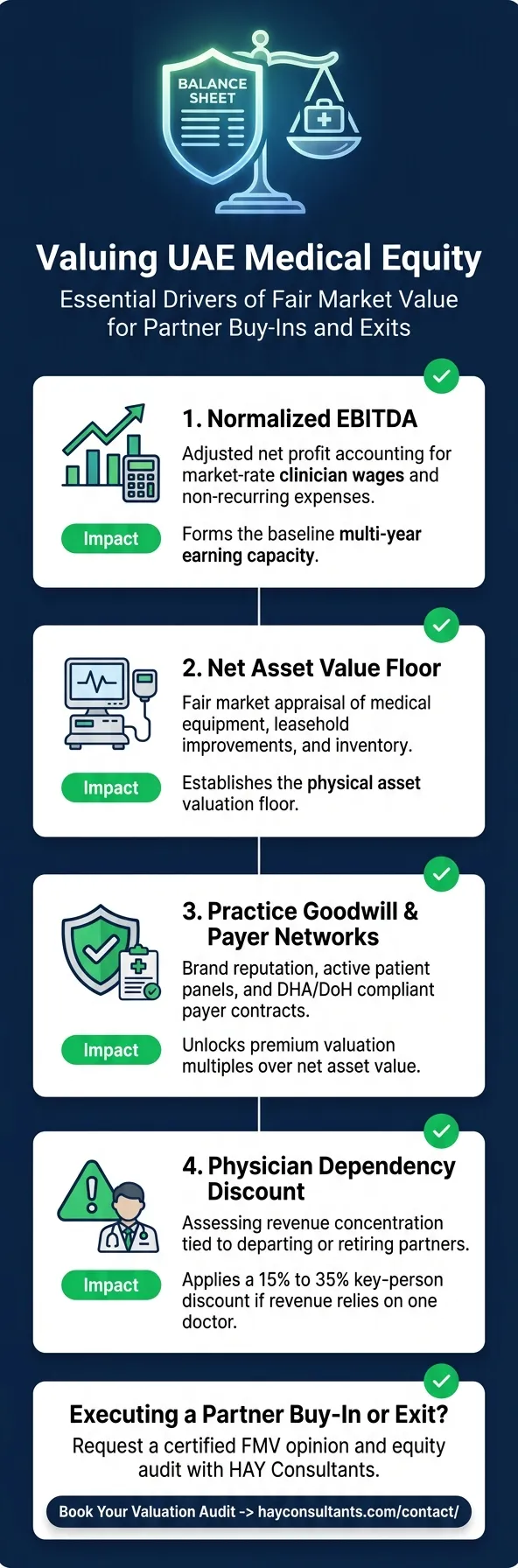
Appraisers weigh four core drivers when calculating a UAE medical practice’s fair market value for a partner transaction.
| Valuation Factor | Description | Impact on Valuation |
|---|---|---|
| Normalized EBITDA | Reported profit adjusted for fair owner salaries and non-recurring expenses. | Establishes base cash flow multiplier (typically 4x to 8x). |
| Tangible assets | Physical assets, medical devices, fit-outs, and inventory. | Defines the net asset value floor. |
| Medical goodwill | Transferable brand value, active patient panels, and payer networks. | Adds premium value above tangible assets. |
| Physician dependency | Revenue concentration tied to a single lead doctor. | Triggers a 15% to 35% key-person discount if risk is high. |
For a deeper look at how goodwill and key-person risk interact in a UAE clinic, see our guide on valuing medical goodwill in a UAE clinic.
4. Calculating Normalized EBITDA for Partner Equity Valuation
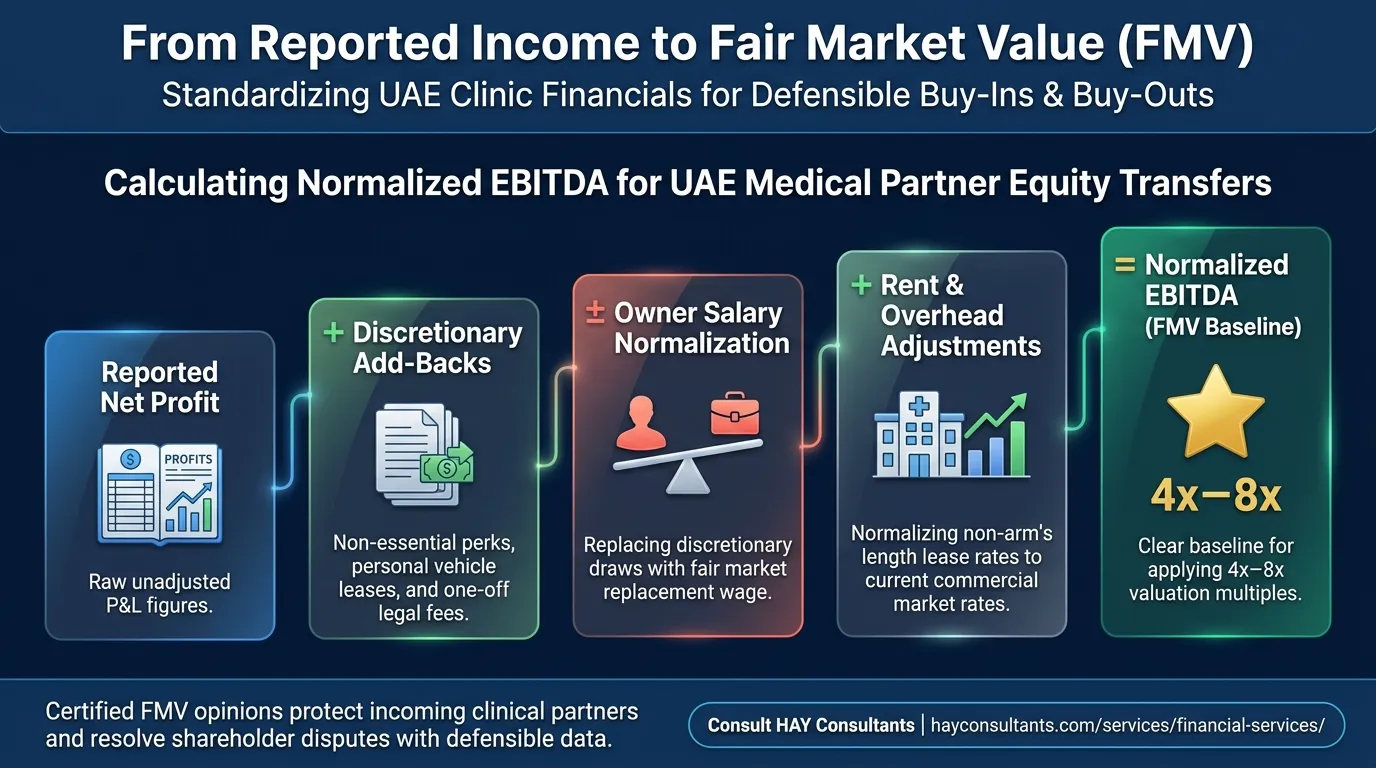
To calculate fair value, valuers convert reported profit-and-loss figures into Normalized EBITDA, following the normalization principles set out by the International Valuation Standards Council (IVSC).
Normalized EBITDA = Reported Net Profit + ITDA + Add-Backs − FMV Adjustments
- Add back discretionary items. Remove non-essential vehicle leases, personal travel, and one-off legal fees.
- Adjust owner-doctor salaries. Replace discretionary owner draws with the fair market wage of a hired doctor.
- Normalize real estate costs. Adjust lease payments to match current commercial market rates.
For the full walkthrough of add-backs and adjustments behind this formula, see our guide on Normalized EBITDA for UAE medical clinics.
Physician Dependency and Facility Licensing
High reliance on a departing doctor creates risk. Appraisers apply a 15% to 35% key-person discount to offset the potential revenue loss from a single physician’s exit. Active, fully compliant DHA or DoH facility licenses work in the opposite direction — they add enterprise value by saving incoming partners the regulatory setup time and fees of a new license application, as covered in our guide on DHA/DoH licensing and healthcare enterprise value.
Verifying electronic medical record compliance through the NABIDH platform and reducing manual booking overhead with AI-powered patient intake systems both support a cleaner data room during due diligence, while institutionalized patient acquisition strategies strengthen the medical goodwill component of the valuation.
Normalized earnings should also reflect arm’s-length partner compensation consistent with UAE Corporate Tax Law guidelines, since distributions disguised as salary expense distort the EBITDA baseline used in a buy-in or buyout price.
5. Strategic Next Steps for Practice Partners
Navigating equity changes requires precise, defensible financial data. Independent FMV opinions protect shareholder rights, reduce litigation risk, and streamline transaction timelines.
Need an independent partner valuation or equity audit? Contact HAY Consultants’ Healthcare Financial Consulting team to request a certified FMV assessment, or schedule a practice valuation consultation directly.
6. Frequently Asked Questions
Why is an independent FMV report needed for a UAE clinic buy-in?
An independent FMV report provides an objective valuation based on normalized earnings. It protects incoming partners from paying inflated prices.
How does doctor dependency affect a clinic’s buyout valuation?
High reliance on a departing doctor creates risk. Appraisers apply a 15% to 35% key-person discount to offset potential revenue loss.
Can DHA or DoH license transferability impact enterprise value?
Yes. Active, fully compliant facility licenses add enterprise value by saving new owners regulatory setup time and fees.