
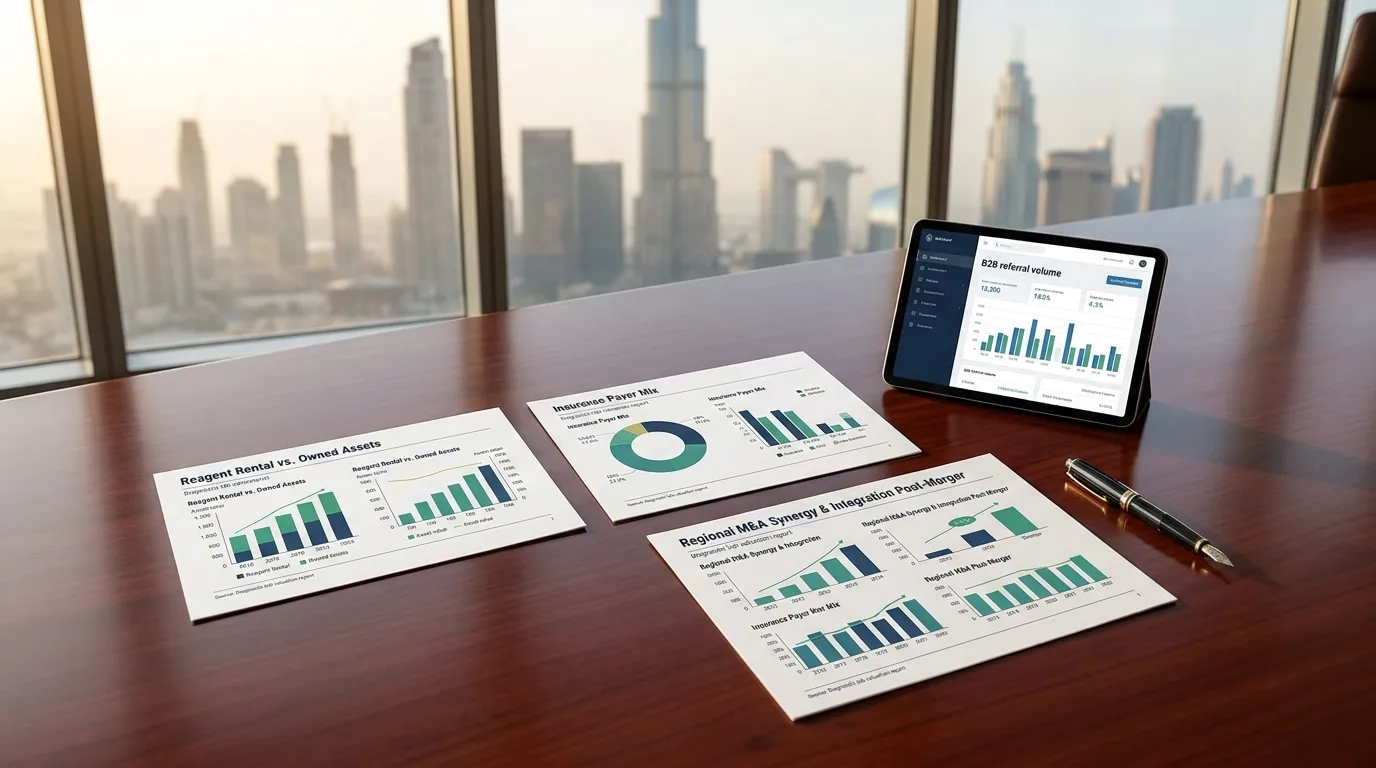
Diagnostic laboratories do not value the same way as clinics. A lab’s worth depends on capital-intensive equipment, specialized facility infrastructure, insurance payer mix, and B2B referral relationships rather than a single treating physician. This guide from HAY Consultants walks through how appraisers combine income, asset, and market approaches to value a UAE diagnostic laboratory, supported where needed by dedicated healthcare financial consulting services.
1. How Are Diagnostic Laboratories Valued in the UAE Healthcare Market?
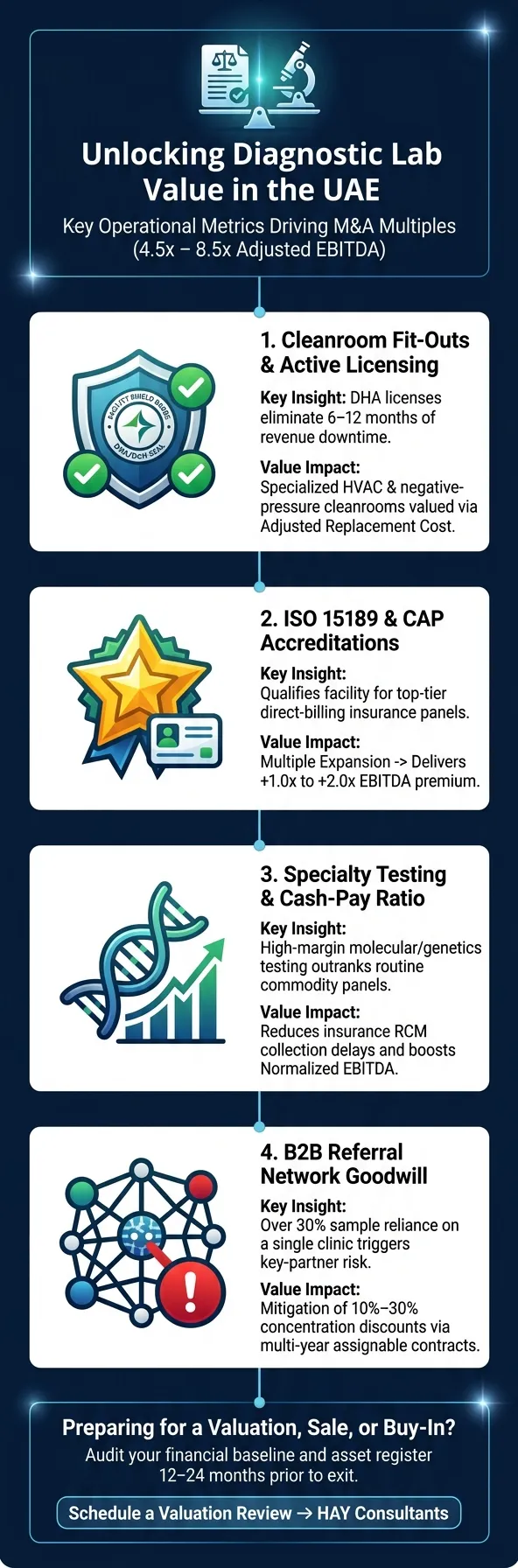
Diagnostic laboratories in the UAE trade at 4.5x to 8.5x Adjusted EBITDA. Because standard clinic valuation models do not account for heavy machinery, specialized fit-outs, or B2B sample streams, valuers combine three core methodologies to determine a lab’s true enterprise value.
Income Approach (DCF / FME) — applied to high-volume, direct-billing operations
Asset Approach (Net Asset Value) — establishes a floor value from machinery and fit-outs
Market Approach (Multiples) — 4.5x to 8.5x Adjusted EBITDA, benchmarked against GCC transactions
- Income Approach (Discounted Cash Flow / FME). Applied to labs with multi-year corporate testing contracts and stable direct-billing volumes.
- Asset-Based Approach (Net Asset Value). Establishes a floor value by tallying physical assets — analyzers, PCR platforms, cleanroom fit-outs — minus liabilities.
- Market Approach (EBITDA Multiples). Uses GCC transaction benchmarks. High-margin, accredited labs command multiples toward the upper end of the range.
For the underlying framework these methods are built on, see our guide on how to value a medical clinic in Dubai.
2. How Does Capital Equipment Appraisal and Depreciation Impact Valuation?
Specialized lab equipment is assessed at Fair Market Value rather than accounting book value during an appraisal.
Reported Net Profit → Subtract FMV CapEx Reserve → Future Maintainable Earnings (FME)
High-end laboratory machinery — automated chemistry analyzers, mass spectrometers, histology suites — depreciates faster than standard accounting schedules assume. Standard depreciation rarely matches an instrument’s true remaining operational life, so appraisers adjust the balance sheet using independent machinery appraisals, consistent with the normalization principles set out by the International Valuation Standards Council (IVSC) for equipment depreciation.
Leased vs. Owned Equipment Models
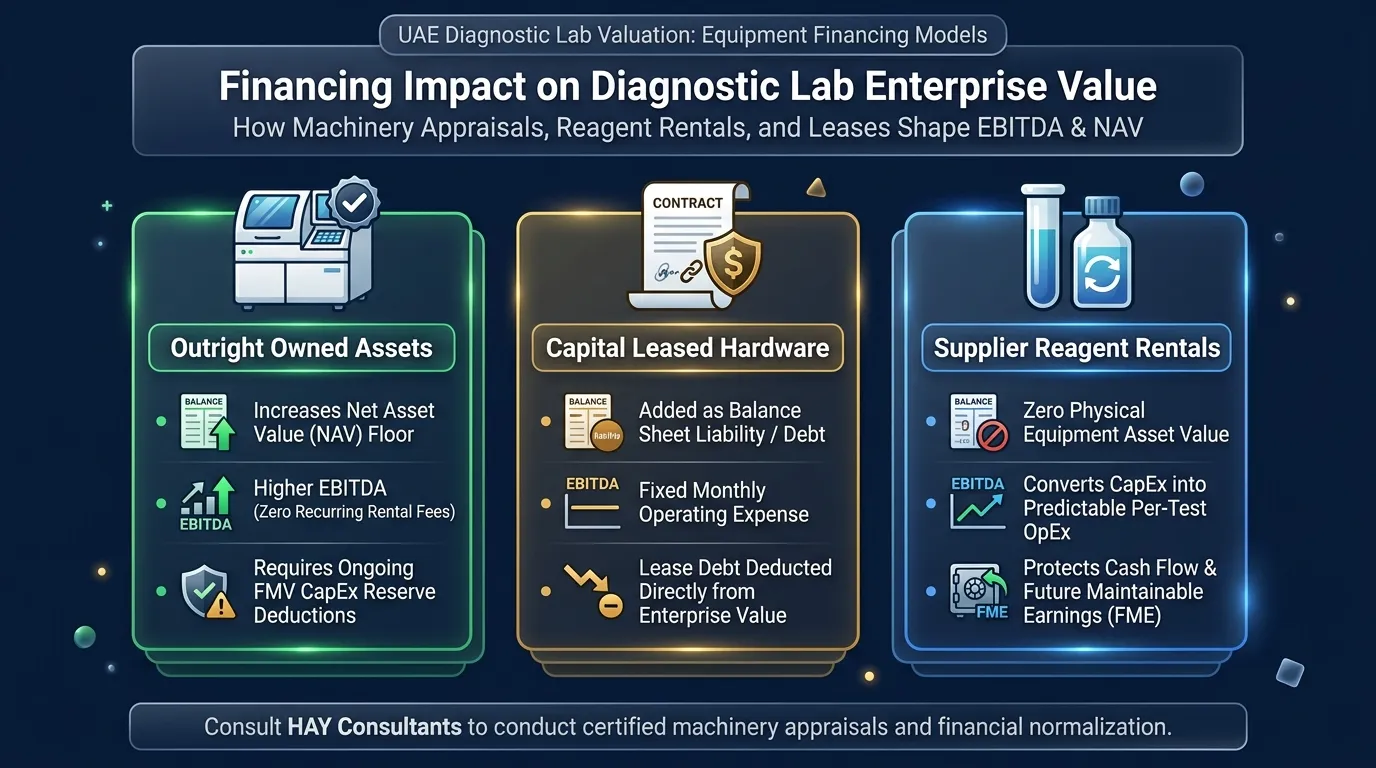
Lab operators source hardware through outright purchases, equipment leases, or supplier reagent placement agreements. Each model shifts value differently between the balance sheet and Normalized EBITDA.
| Financing Model | Balance Sheet Impact | EBITDA & Cash Flow Impact | Valuation Effect |
|---|---|---|---|
| Owned assets | Increases Net Asset Value (NAV) | High upfront CapEx; higher EBITDA with zero rental fees | Higher asset floor; requires ongoing CapEx reserve deductions |
| Leased equipment | Added as balance sheet debt | Fixed operating cost; lowers cash flow predictability | Lease debt deducted directly from enterprise value |
| Reagent placement | Zero physical equipment asset value | Converts CapEx to higher per-test OpEx | Protects cash reserves; stabilizes Future Maintainable Earnings |
Technology Obsolescence Risk
Legacy testing hardware nearing vendor end-of-support creates a hidden capital liability. Appraisers apply explicit price deductions for aging hardware, and buyers deduct expected replacement costs directly from the purchase price. A Normalized EBITDA figure that ignores upcoming CapEx replacement understates the true adjustment a buyer will make during due diligence.
3. What Role Do Specialized Facility Fit-Outs and Regulatory Approvals Play in Lab Worth?
Specialized facility fit-outs and an active DHA or DoH testing license raise enterprise value by removing operational delay from a transaction.
Share purchase → retains existing DHA/DoH license → zero operational interruption
Asset purchase → requires a new license application → 6 to 12 month revenue lag
Building a clinical laboratory requires purpose-built infrastructure — negative-pressure rooms, cleanrooms, biosafety cabinets, and dedicated medical waste filtration systems — all of which add tangible asset value. Valuers assess these fit-outs using the Adjusted Replacement Cost Method: current construction cost minus physical wear.
DHA and DoH Licensing Advantages
Securing a new laboratory permit under Dubai Health Authority (DHA) or Department of Health – Abu Dhabi (DoH) rules typically takes 6 to 12 months. Acquiring an existing licensed entity through a share purchase eliminates that revenue downtime — a factor we cover in more depth in our guide on DHA and DoH licensing and healthcare enterprise value.
Accreditation Valuation Premiums
Accredited laboratories command higher EBITDA multiples:
- ISO 15189 and CAP accreditations. Demonstrate clinical accuracy and operational quality.
- Payer access. Accredited labs qualify for top-tier insurance direct-billing panels.
- Multiple expansion. Fully accredited labs can achieve a 1.0x to 2.0x EBITDA multiple expansion during acquisitions.
4. How Does Insurance Payer Mix and Test Case Mix Drive Laboratory EBITDA?
High cash-pay volumes and a specialty-weighted test mix deliver stronger margins and higher valuation multiples than routine, insurance-billed panels.
| Revenue Channel | Margin & Collection Profile | Valuation Impact |
|---|---|---|
| Specialty cash-pay / B2B corporate contracts | High margins; fast collections | Supports higher multiples |
| Direct insurance billing | High volume; 60 to 90 day RCM delays | Baseline multiples |
The test mix directly shapes operating margin. Commodity panels, such as routine hematology, yield lower margins, while specialty testing — molecular diagnostics, oncology profiling, genetics — commands a premium.
Insurance Networks vs. Cash Revenue
Direct-billing contracts with insurance networks provide predictable sample volume, but insurance payers introduce strict pre-authorizations and 60-to-90-day Revenue Cycle Management (RCM) delays. Labs with strong cash-pay corporate wellness screening panels avoid insurance denial risk entirely. Reducing manual back-and-forth on bookings and results delivery — for example through automated patient communication and intake systems — also shortens the collection cycle on the cash-pay side and strengthens Normalized EBITDA.
5. How Do You Value B2B Referral Networks and Corporate Contracts?
B2B clinical referral networks represent intangible goodwill, but high customer concentration introduces a valuation discount.
Base goodwill (B2B contracts, clinic referral streams) → minus key-partner concentration discount (10% to 30%) → transferable enterprise goodwill
Independent diagnostic labs rely on external sample referrals from polyclinics, private hospitals, and corporate wellness clients. Appraisers calculate this goodwill using the Capitalization of Excess Earnings Method — the same core approach used to isolate medical goodwill from physician dependency in a clinic valuation.
Concentration Risk Discounts
If a lab relies on a single clinical network for over 30% of its sample volume, appraisers apply a 10% to 30% concentration discount, since losing that one referral partner would cause an immediate revenue disruption. Valuers look for three legal safeguards that support contract stability:
- Contractual longevity. Multi-year service agreements with automatic renewal terms.
- Assignability clauses. Legal rights to transfer B2B contracts seamlessly during a change of ownership.
- Exclusivity provisions. Enforceable non-compete agreements protecting B2B sample pipelines.
6. Step-by-Step Guide: How to Prepare a UAE Diagnostic Lab for Valuation and Sale
Fixed asset audit → financial normalization → referral risk assessment → data room setup
- Conduct a certified machinery and equipment appraisal. Establish Fair Market Value for all analytical platforms, automation lines, and specialized cleanrooms.
- Normalize financial statements. Add back non-recurring setup fees, owner discretionary perks, and non-market property leases to calculate Normalized EBITDA.
- Perform referral network audits. Diversify B2B sample channels to reduce key-partner concentration discounts.
- Assemble a virtual data room. Organize active DHA/DoH licenses, CAP/ISO accreditation records, NABIDH and Malaffi compliance logs, and reagent lease contracts.
7. Strategic Summary & Next Steps
Diagnostic lab valuations hinge on factors a standard clinic model does not capture: equipment financing structure, facility fit-out and licensing status, payer mix, and referral network concentration. Getting the machinery appraisal, financial normalization, and referral contract review right before a sale process protects the final multiple a buyer is willing to pay.
Preparing for a lab sale, investor buy-in, or equity restructuring benefits from an independent financial appraisal. You can consult with HAY Consultants’ Healthcare Financial Advisory team or schedule a lab valuation audit with HAY Consultants directly.
8. Frequently Asked Questions
What is the average EBITDA multiple for a diagnostic laboratory in the UAE?
Diagnostic laboratories in the UAE trade between 4.5x and 8.5x Adjusted EBITDA. Labs with specialized molecular diagnostics, international accreditations, and diversified B2B referral networks command multiples at the higher end of the range.
How does a reagent rental agreement affect diagnostic lab valuation compared to owned equipment?
Reagent rental agreements shift capital expenditure into predictable operational expense. Owned equipment increases Net Asset Value on the balance sheet but adds depreciation and replacement liability, while reagent rentals keep cash flows predictable and protect Future Maintainable Earnings.
Does ISO 15189 or CAP accreditation increase the market value of a UAE lab?
Yes. ISO 15189 and CAP accreditations demonstrate operational quality and clinical rigor. Accredited laboratories secure top-tier insurance billing access, face lower claims rejection rates, and can achieve a 1.0x to 2.0x EBITDA multiple expansion.
How does referral concentration risk lower the valuation of a diagnostic center?
If a diagnostic lab receives over 30% of its sample volume from a single medical center or corporate client, appraisers apply a 10% to 30% concentration discount to offset the risk of losing that key partner.
How are specialized lab fit-outs valued during a business appraisal in Dubai?
Specialized lab fit-outs — cleanrooms, negative-pressure HVAC, and medical waste drainage — are valued using the Adjusted Replacement Cost Method: the current cost to rebuild the infrastructure minus physical wear.