
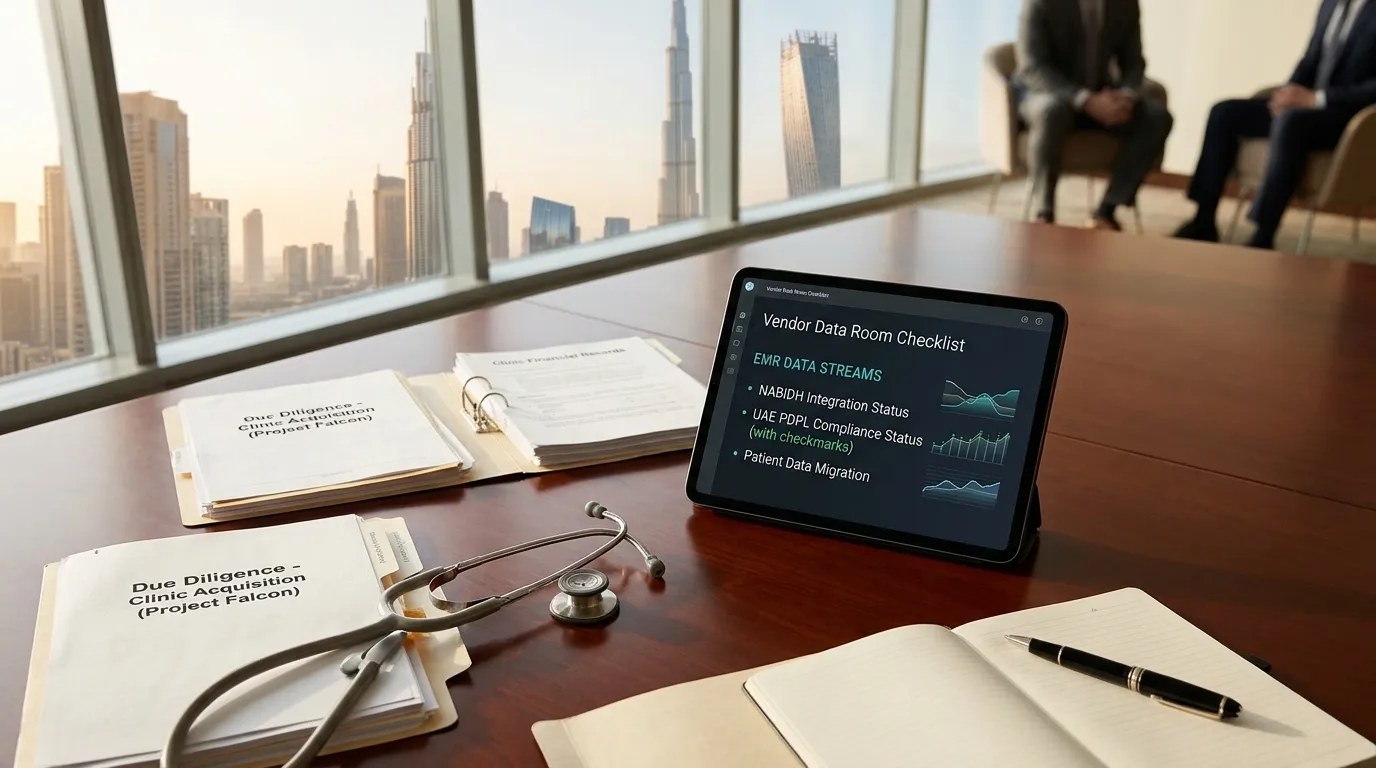
The healthcare merger and acquisition (M&A) market in Dubai is active. Private equity firms, regional hospital groups and well-funded operators are looking at polyclinics, aesthetic centers and dental practices. General sell-side guides written for other industries do not fit medical facilities, though. Dubai Health Authority (DHA) licensing, insurance payer dynamics and patient data law all shape what a buyer will pay, supported where needed by dedicated healthcare financial advisory services.
Many healthcare deals stall during due diligence. Disorganized financial records, unverified clinician credentials, licensing gaps and patient data non-compliance give buyers a reason to cut the price or walk away. A structured checklist lets you find and fix those issues 12 to 36 months before you go to market.
What is a healthcare vendor due diligence (VDD) checklist?
Short answer: A healthcare vendor due diligence checklist is a pre-sale audit. It compiles normalized financial statements, active DHA licenses, commercial leases and patient data governance records so a buyer sees a transparent, low-risk asset.
Financial normalization → Regulatory and licensing audit → Data privacy and IT check → Lease and asset review
The cost of not preparing
Leaving your virtual data room (VDR) until a buyer asks for it has predictable consequences:
- Valuation discounts. Buyers use every compliance gap or messy ledger to justify a lower multiple.
- Longer timelines. Missing documents mean repeated information requests and slower negotiations.
- Deal collapse. Hidden liabilities or data security issues found late in the audit are a common reason buyers withdraw.
What is the timeline for preparing a Dubai clinic for sale?
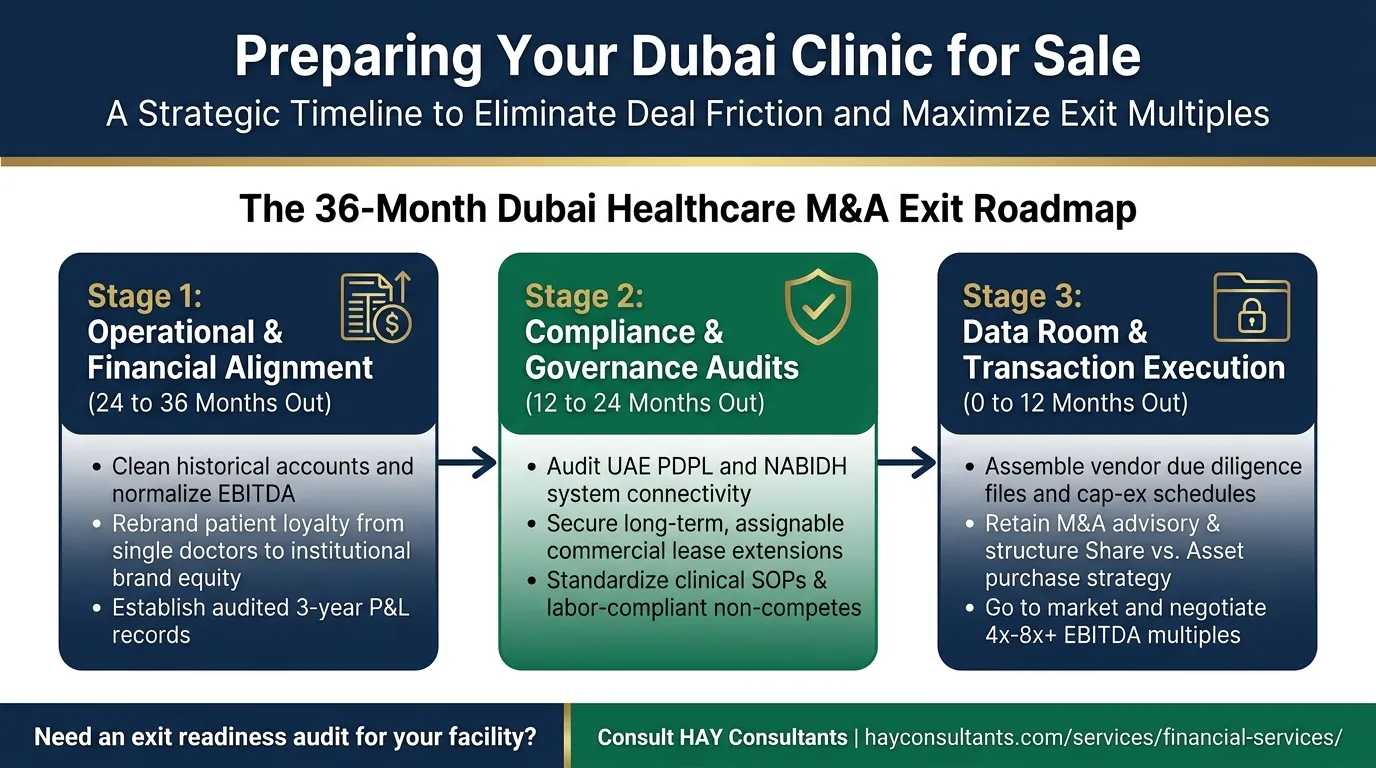
A multi-year timeline gives you room to correct problems before a buyer sees them.
- Stage 1: 24–36 months before sale (operational and financial alignment). Clean up accounting books, normalize earnings and shift patient loyalty from individual doctors to the clinic brand.
- Stage 2: 12–24 months before sale (compliance and governance audits). Audit data security compliance, inspect commercial lease agreements and review health insurance panel contracts.
- Stage 3: 0–12 months before sale (data room and transaction execution). Assemble vendor due diligence files, retain financial consultants and choose between an asset or share sale structure.
Pillar 1: How do you prepare financial records and normalized EBITDA?
Buyers do not value your gross revenue. They value normalized EBITDA (earnings before interest, taxes, depreciation and amortization), which isolates the true operating profit of the facility.
Clean historical accounts
Organize three to five years of audited financial statements, corporate tax filings and clear profit and loss (P&L) statements.
EBITDA normalization add-backs
- Replace owner compensation with the Fair Market Value (FMV) cost of hiring a replacement physician or manager. If you work as lead physician or CEO and pay yourself below market rate, current profit looks inflated and a buyer will correct it.
- Add back personal discretionary expenses, such as non-operational vehicle leases or non-business travel.
- Add back non-recurring items, such as initial DHA setup costs, one-time legal fees or non-capitalized equipment repairs.
For the full methodology and a worked calculation, see our guide on normalizing EBITDA for UAE medical clinics.
Revenue cycle management (RCM) review
Audit billing speed, insurance claim rejection rates and bad debt write-offs. Predictable insurance cash flow supports a stronger multiple.
Insurance payer mix and equipment schedules
Analyze the split between direct-billing insurance network contracts and cash-paying patients. Keep service logs, lease-purchase agreements and depreciation schedules for diagnostic devices, lasers and surgical suites.
Pillar 2: How do licensing and regulatory compliance affect enterprise value?
In the UAE, regulatory standing is part of what a buyer is paying for. Confirm the following before diligence begins:
- Active, transferable licenses. Your DHA facility license, your trade license from the Department of Economy and Tourism (DET) and any specialized clinical approvals should be current. Check how each one behaves in a share sale versus an asset sale.
- Verified clinician credentials. Confirm that every practicing doctor and nurse holds a valid DHA license, including Primary Source Verification (PSV) through DataFlow, with no files close to expiry.
- A compliant Medical Director. Your designated Medical Director must meet current DHA requirements. A vacancy or compliance flag in clinical governance can pause a transaction.
For a deeper look at how licensing feeds into valuation, read our guide on DHA licensing and healthcare enterprise value.
Pillar 3: How do you de-risk clinic operations before a sale?
Buyers penalize facilities with high operational risk.
Mitigating key-person dependency
Heavy reliance on one lead physician creates key-person risk. Buyers commonly apply a 15% to 35% valuation discount when patient volume is tied to a single doctor. Compliant non-compete covenants and post-sale earn-out agreements help offset this, a point we cover in our guide on valuing medical goodwill in UAE clinics.
Standard operating procedures (SOPs)
Document administrative triage, clinical workflows and billing protocols. Standardized SOPs show that operations run without constant owner intervention. A repeatable, less owner-dependent front desk, for example through AI-powered patient enquiry and lead-response tools, strengthens that evidence.
Patient database metrics
Track patient retention, acquisition cost and average treatment yield by department.
Pillar 4: How does patient data governance affect valuation?
Data security and health IT compliance are a primary focus of technical due diligence, and gaps translate directly into price adjustments.
UAE PDPL alignment
Make sure your Electronic Medical Record (EMR) software complies with the UAE Personal Data Protection Law (PDPL). Non-compliance creates legal risk that can delay deals or trigger purchase price holdbacks.
NABIDH integration
Dubai facilities must connect to the NABIDH platform. Gaps in data submission signal regulatory exposure to a buyer. If your facility is newer or you are changing EMR vendors, our NABIDH compliance guide for new healthcare facilities explains what a compliant connection involves.
Quantifying technical debt
Outdated clinical software creates technical debt. Buyers calculate remediation costs and deduct them from the offer:
Adjusted Enterprise Value = Base Value − EMR Upgrade CapEx − PDPL Remediation Costs
Clinics that route bookings and follow-ups through AI-driven WhatsApp communication workflows should confirm those channels sit on a PDPL-compliant, NABIDH-connected data pipeline. An unsecured integration can create the same technical debt as legacy software.
Pillar 5: How do you secure lease transfers in Dubai?
A clinic cannot operate without its location, and patient panels are tied to physical convenience.
- Assignability clauses. Review commercial leases early to confirm transfer rights survive a share or asset purchase.
- Remaining lease term. Buyers generally look for multi-year security, ideally three to five or more years remaining, in hubs such as Dubai Healthcare City (DHCC), Business Bay or Jumeirah.
- Rent normalization. If your rent is below prevailing market rates because of a legacy agreement, buyers will adjust projected costs to reflect what the space will really cost them.
Comparative M&A readiness checklist for Dubai clinics
| Valuation pillar | Key document or focus | Common pitfall | Valuation impact |
|---|---|---|---|
| Financials | 3-year audited P&L, normalized EBITDA, RCM reports | Personal expenses mixed with business accounts | Lower multiple |
| Regulatory | DHA facility license, DataFlow credentials, active Medical Director | Expiring clinician credentials or licensing gaps | Deal delay or halt |
| Operations | Non-competes, SOPs, multi-doctor protocols | Patient volume tied to one physician | 15%–35% key-person discount |
| Data and IT | NABIDH integration, UAE PDPL policies | Non-compliant servers or missing data logs | Escrow holdbacks or price deductions |
| Real estate | Commercial lease, assignability rights | Short term with a pending landlord renegotiation | Location risk discount |
Strategic summary and next steps
Preparing a clinic 12 to 36 months before an exit removes deal friction, protects your valuation and makes the transition smoother. Auditing your own practice before a buyer does is the most reliable way to avoid last-minute write-downs.
To evaluate your clinic’s exit readiness, consult HAY Consultants’ Healthcare Financial Advisory team or schedule a professional M&A audit to build a data room that supports your enterprise value.
Frequently asked questions
Why is an M&A valuation checklist essential for Dubai healthcare business owners?
It helps owners identify operational errors, financial discrepancies and compliance failures early. Fixing them before going to market reduces buyer risk, prevents deal cancellations and supports a higher valuation multiple.
How does UAE PDPL and NABIDH compliance impact the sale price of a Dubai medical clinic?
Non-compliance creates technical debt and legal liability. Buyers typically deduct software remediation costs from the purchase price or demand escrow holdbacks until systems are compliant.
What is the typical EBITDA multiple for medical clinics in Dubai?
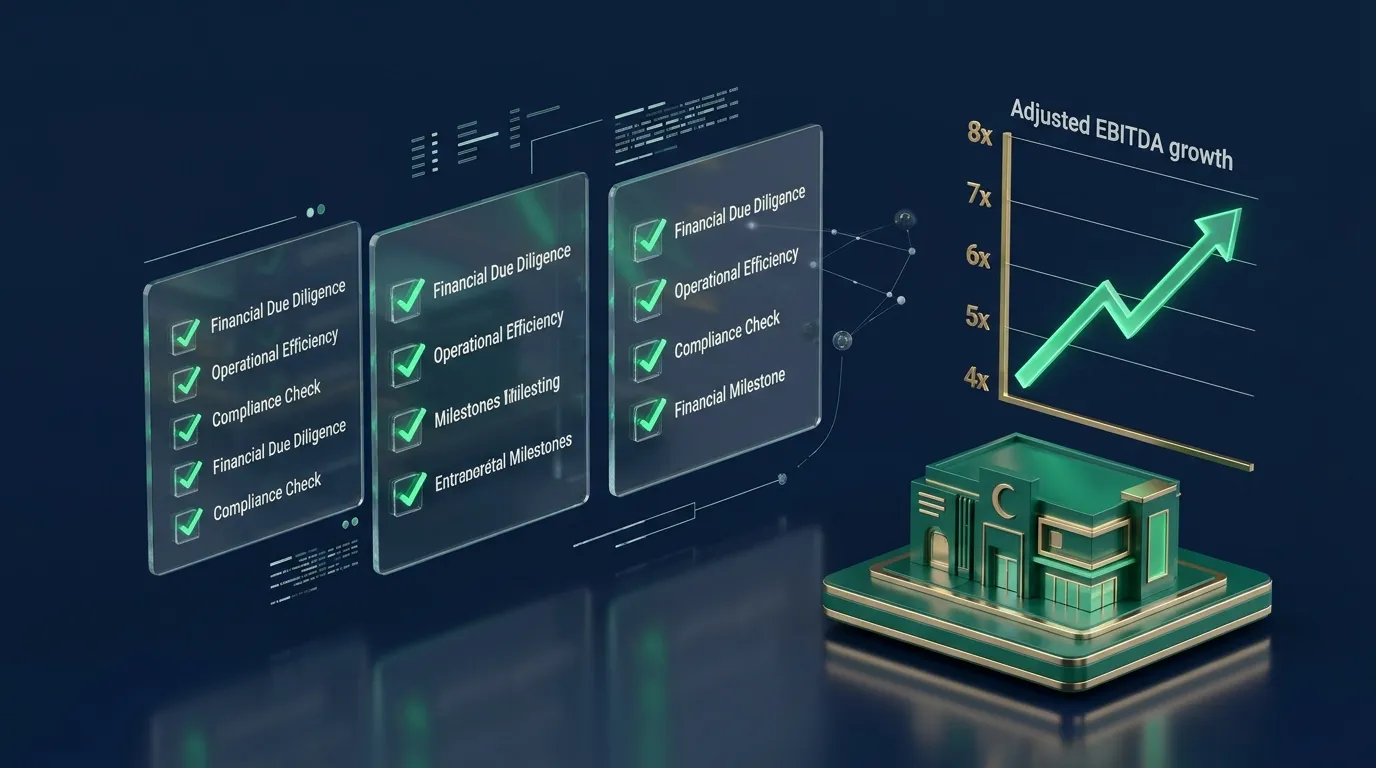
Medical clinics in Dubai generally trade at 4x to 8x Adjusted EBITDA. Multi-specialty facilities, accredited surgery centers and clinics with low physician dependency and clean insurance relationships tend to sit toward the upper end of that range.
How do commercial lease agreements affect healthcare M&A transactions in Dubai?
Short remaining lease terms or restrictive assignment clauses create transaction risk. Buyers generally require long-term, assignable leases in established healthcare hubs before finalizing a deal.
What is the difference between a share purchase and an asset purchase when selling a Dubai clinic?
In a share purchase, the buyer acquires the corporate entity, preserving active DHA facility licenses, commercial registrations and insurance panel contracts. In an asset purchase, the buyer acquires physical equipment and fit-outs only, which requires a new DHA facility license application and can cause operational downtime. Corporate tax treatment also differs, so the choice is generally reviewed against current UAE Ministry of Finance guidance during deal structuring.